
.png?width=20&height=24&name=Vector%20(15).png) For Leaders
For Leaders For Workers
.png?width=24&height=23&name=Vector%20(16).png) Partners
PartnersYour Body Is Your Business
WorkReady Podcast Episode 46
-
Speakers
Leigh Conducy | Missouri Valley JATC
Dr. Kevin Rindal | Vimocity -
View The Transcript
You and I have talked about this concept of workforce readiness. You really showed up today for real. Would everybody go home safe? And I really believe that. I think that would happen For some people, they're like, "Man, I drink four Red Bulls a day, a few roller dogs for lunch."
We start the bank in the morning in the plus side, you know? And I'm always trying to stuff money into my wellness bank. I'm back feeling like we're in this wheelhouse moment.
So Leigh, first question here. For the lineman or the apprentice who just hit play on the drive to the job site this morning, what is the one thing you want them to take away from this conversation and use today? Your body is your business. That's the one takeaway. Your body- Love that ... is your business, you know?
It, it is. You transitioned into safety and, and, you know, then eventually into mobile training, so I'd love to hear a little bit more about that progression. Yeah, you bet. Um, I a- always embrace the concept of new challenges and the idea of teaching apprentices. For me, I had this concept with, I think we're gonna hit on today in our podcast, which is like acorns to oak trees.
If I'm gonna make... How could I make the biggest difference? Shape and teach right at the, right at the onset of, of education. And Listen humbly, humble right out of the gate because to be honest, that's not easy. I didn't realize how difficult that really is to teach an apprentice from acorn to an oak tree, but I embraced it.
So I took the job at Missouri Valley, and then there came a point in time when I was offered a position, um, at a really large utility contractor and in the safety department. And I thought, man, a- as somebody with my experience moving into the safety side, and this is probably the ego side of me, which is thinking that as a lineman, I could go into the safety department, and then all the linemen would just embrace the concept, and then, man, I would change safety forever at that organization.
So I did a lot of safety education training, um, and left them to come back to Missouri Valley. I was given the opportunity to co- to build a mobile team. Um, we've been doing that now for about five years. I got a guy going to Colorado next week. I got a guy up in Becker, Minnesota. We're doing confined space rescue training.
Uh, we're doing OSHA classes. You know, you name it, if you're a contractor, you're NECA, you're IBW, we're able to come to you and do a direct training, you know. And we've, we've, we've opened those doors, and I, I'm back feeling like we're in like this wheelhouse moment where we're changing and affecting the culture, uh, in a really positive note.
How have you seen the industry change during your time, uh, you know, 25-plus years probably? Oh my goodness, yeah. Uh, you know, since like '97 to now, everything has changed from what we use to accomplish the work, to how we do the work, to the administrative controls, to the engineering controls. E- interestingly enough, everything has changed, Kevin, except the health and well-being of the worker.
Are people still living in this mindset that you work hard your entire career, you get to the end of your career, you're broken down, and that's just the way that it is? I've seen changes, but overall, our mentality as a lineman still kind of, uh, is, uh, you know, backed into this corner and ideology that we, we have a bad tendency of measuring our worth on our net worth And the only way to establish net worth is through the application and utilization of our, our physical capabilities to accomplish that.
And that's storm work, it's transmission work, it's distribution work. It's 410s, 510s, 610s, 710s, 712s, 716s, 714s plus. I love it. The call that comes in that says 714s plus means honestly, whatever you're really willing to work, we'll pay you. We've got that much work for you. And that's how I-- listen, I, I would say if I could, you know, if we go back in time, you know, I, I only measured my success on how much money I was putting in the bank and how much work I was accomplishing.
It's kinda sad What is the price of that? I mean, the price is... It, it, it, the, the price, that's interesting. Uh, the price is your health. The price is family, you know. I mean, I didn't get married until I was 36 years old. I didn't, didn't... I lived on the right of way. That's all I ever wanted to do was build power lines, so I really, my social and, um, I didn't have a big social network.
My friends, my friends were the right of way, you know, and everybody out on the work site. And not saying that that's a bad thing. I didn't really know there was, like, another side of, of the coin, you know. I, I thought this was the coin, you know, and that I was flipping it and turning it in all the greatest directions possible, so.
And there's a huge, uh, the other, the other side for not me, but for other people that I see, I see people that have worked themselves so hard that when they get to the, to that, they're, they're dreaming of that, like, end game, you know? And when they get there, I, I, I knew a lineman that was retired, and it was four weeks from his retirement that we were at his funeral.
And, you know, it's, it, you know, interestingly enough, at the funeral, you are surrounded by linemen, and they're like... I had one guy tell me, like, "Hey, you know what? That's, like, that's why I'll never retire." We see that, too. I see, we see linemen that are s- 70. They, they, they don't wanna leave. They, it's almost like they can't leave.
It's, it, it's like they don't have the m- the, the way, a, a way, a way out of what they do. They only know line work. Lee, let's talk about some of the shifts that you're seeing in, in the industry. Uh, one of those being we're starting to view, like, linemen, construction workers as workforce athletes versus, you know, just a trade worker.
I am seeing kids that are coming in that are, like, very physically fit, who you can tell they care about their fitness. You can tell they watch, they're watching what they eat. They are, um, not going to the bars. They're going to the gym, right, when they get off work, even if it's a 10-hour day. Like, they're putting in that time, so you do see, like, the magic behind, and you can see a better apprentice, a more physically fit apprentice.
You can see, like, you can see the differ- clearly, like, a difference between, like, old guy, new guy maybe. You would see a younger kid, like, he would stretch before he puts his hooks on. He would stretch before he gets in the bucket. He's actively doing them, and, and nobody said... You know what's funny is nobody really, like...
You know, they might give you a, you might hear a yoga joke here and there or whatever, you know, "Hey, look at Mr., you know, Stretchy Flexy," but honestly, you know, if, if he's physically fit, you don't see a lot of people are just like, "Man," you know, like, "You shouldn't do that." They might throw a joke at you, but nobody hinders that.
Kevin, I'll tell you, it's not, since the beginning of our trade, we haven't had, um- People that are willing to teach us that side of it or, or why it's important or, like, understand what, what the benefits are of it. It's kinda why I, I, I've embraced the Vimocity program so much. We teach our apprenti- apprentices when they're in a bucket to, let's say, move up and, like, into the working position, and that makes complete sense, and I can sell that to an apprentice.
But then I can, like, l- overlay on top of that, like, hey, not only is it better positioning, but it's better ergonomics, and your joints and everything is going to, like, have, like... Longevity is important. People get that. I don't think you have to sell it, Kevin. It's like we, we understand. Every lineman knows, like, I only get one elbow or, like, my shoulders, and you can't, you can't, like, replace our parts very easily.
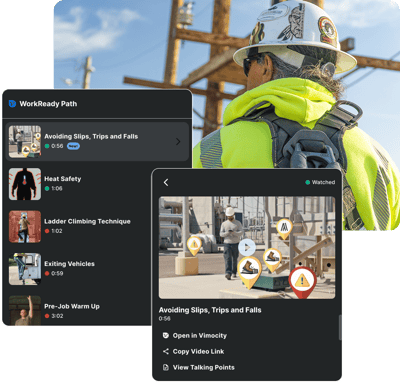
It's not easy to, to, to, to replace, and if you don't have it, and you can't use it, then our economics are, are, are affected by that. Our families are affected by that. Vimocity is more than training. It's a safety and readiness platform trusted by companies to keep their field professionals strong, healthy, and ready for the job.
Now we're launching something new, the WorkReady Community. It's the first online community built exclusively for field employees, a place to connect, learn, and lead the future of our industry. Join us and be part of the movement
You know, I've been working with, uh, the trades for the last 10, 12 years, and in that timeframe, I've, I've definitely have seen a huge shift in terms of people embracing these concepts a lot more. But it was pretty tough those first few years. I mean, there were a lot of crossed arms when I'd walk into a room, and Oh, yeah
people would be like, "Why are we here?" And they would make the jokes like, "Let's get our yoga pants on." You know, like, people just would kind of mock it more than they would, um, embrace it. But what was interesting is after about 10 minutes, people are like, "Yeah, this does make sense." Then, like, the next challenge is, like, okay, well, how do you make it stick?
There's two things that I see making it stick is first one is if your leaders buy into this. Like, leadership really, I believe, is the solution to almost every right of way problem that we have. And if your foreman embrace the culture and they believe in it, and they allow you the time to do it, and they consider it as important as a job briefing, then they'll do it.
I always have... I've, I've told every, every crew I go and speak to, Kevin, there's something that I'm, like, big into, which is like, if you really showed up today, like, if we really showed up for real, if we showed up and we gave it everything we had, would everybody go home so safe? And I really believe that.
I think that would happen absolutely if I really gave it a 100% effort. And so I think the same mentality has to happen with, with a movement like this. We see it, we agree it, we know it, but then are our leaders willing to really embrace it over time? Are we willing to embed it into our entire process?
And you need a support system. You gotta surround yourself with people that believe in it, you know, and you have to keep doing it. If you go out to a job site, and you walk out there without a hard hat on, it doesn't take very long for you to feel naked out on a job site or for somebody to tell you, like, hey...
like, just even give you, like, the head tap. It's almost like threshold behavior has to take over with health and well-being. There's a threshold, whether it's one person, or two people, or three, or four, or five. At some point in time, if everybody starts to do it, everybody will do it You and I have talked about this concept of workforce readiness, so thinking about people being physically, mentally, and from an operational perspective, ready to perform the work.
And I'd love to hear your perspective on the emphasis sometimes on trying to engineer safe situations versus focusing that attention on the human being prepared and work ready so that they can perform at the highest level, because that's also a component of, uh, and it's a variable of the overall safety and performance of a team.
Man, that's a loaded question, but I got-- I, I think I got a really, a unique perspective on this, which is engineering controls have helped us exponentially. We don't, we don't set poles w- with pike poles, which was 40 guys picking, you know, like 10 guys picking up a pole with a pike pole. Ph- the physicality behind that was pretty incredible.
We don't climb every single structure that we... You know, we have bucket trucks that put us, put us where we need to do the work. And so to that credit, Kevin, you could say, look how much money organizations are willing to spend on engineering controls to get the work done, to get the performance you want, to get-- and that's the key word, to get the performance you want out on the job site.
But for us, I think what you have to do is think about, um The investment, what investment are you willing to make and is the person willing to make in making that day a success? It, it's basically just like a wellness bank that you're, are going to like build up and work on. And then, you know, I really think I would lean towards like, you know, how much sleep did you get last night?
And if you didn't get enough sleep, w- how do you subsidize that? So let's say... And then, so say if you get enough sleep, we start the bank in the morning in the plus side, you know? And I'm always trying to stuff money into my wellness bank. And I think this is a great... It's, it works in leadership, it works in accountability, it works in management, it works in produ- production.
And then I look at, I look at other things. Like, if it's as simple as when I walk into a show up and there's a, there's a dozen donuts sitting there, the old sugar-coated lies, right? You know, there's a donut there. It's a quick fix. I'm kinda hungry. I didn't eat right. I didn't have a good breakfast. I just needs to stuff something in there and so that I'm full.
But what kind of fuel did I just put in? I just took money out of my bank. And I grabbed a Red Bull, you know, and I took money out of my bank because it gives me quick energy, but you know what? I'm ready for a nap so fast after a sh- a don- It's crazy. You could have a Red Bull and a donut, and I could take a nap.
Why is that? I, I love that concept of the wellness bank or wellness capital. We had another, a guest on the show, Sarah Mirandon, she talked about like the 401for your body, and it's like we, we put these deposits in and yeah, over time, it's... You're, you're gonna have something at the end of the, uh, the line, and what you have at the end is based on all those, uh, small things that you put in and the compounding effect, uh, of the impact there.
I think there's a lot of power in just saying, "I'm gonna just try to accomplish one thing today," and it doesn't have to be huge. But I know that if I change one thing on a consistent basis- Until I can master it. Then what that's gonna allow me to do is then add the next thing that I'm gonna focus on You look at people that are, like, super athletes and you, you read and hear about their entire structure, and then you instantly say, "Well, well, I, I should do that," you know?
And then I realized how I was basically setting myself up for failure. You know, the other thing, too, is, like, so Vimocity got me on it, too, is when I was watching one of the videos, talks about a 360-degree walk around. And so one thing, I just, when I wake up in the morning, it's, it's, it's like a one to two-minute activity is just like how do I feel, and, like, take in, like, what's going on.
And you know what? I respond to my day based on that, you know? Or I stretch based on that. Or my, you know, I, hey, I worked really hard. I was out chopping wood last night, you know, so let's stretch before I, I do that. Let's do... And, and so the, those elements are really important What would you say to that, you know, 18-year-old apprentice right now or, uh, you know, somebody who's five, 10 years into their career and they, they have, you know, another 20, 30 years in front of them?
Like, what can they do now that would have the biggest bang for their, for its buck? There's something that, that I think is, like, critical, is we have this weird idea that we have to, that, that we do this alone, like, life And the right of way. It, it is a team sport, but it's something that we're, like, on our own.
And I would tell you the number one thing is to build... If I could give one advice to apprentices or any- anyone in the, in the industry is find a support system and use your support system. There are other apprentices that are surrounded by you that are not going to the bar at night. They are going to the gym.
And ask, just walk up and they... I, I'm telling you what, if, if you are 300 pounds or out of shape or just where you're ever you're at, and you say, "Hey, Kevin, I know that you like to go, uh, you're a jujitsu guy. I watch UFC. Can I come to the gym? Let me..." And, and I'll tell you what, watch them light up because it...
for them, it's them getting their support system reinforced. And surrounding yourself with people that, that are, like, benefits, that, that find those benefits. So a support system is the number one thing that, like, your keys to your success is surround yourself with people. Walk up to a lineman that you know, find...
ask them for help. But we just don't do that enough, and I just don't understand where, the, the, there's this invisible wall, but just it's invisible. All you gotta do is walk up to somebody who's physically, physically fit. That's all I did, the same thing, physically fit guy, and be like, "Hey, tell me one thing I can do tomorrow.
Can we be friends?" It's easy, and it's one at a time. I think it's such a key thing to not go through life alone. And I, again, you brought up that point that so many of us, we, we just try to be mavericks out there, or we, we want to do stuff on our own. And man, it just... Everything is easier when you have somebody by your side, your, your co-pilot.
And so I think allies are so powerful when it comes to especially this type of work when you're on the road and you're working long hours, you're exhausted. One of the things that we're starting to see is the old mentality of being a traveling lineman that travels around and does 12, 14... It's not, it's not gone by the wayside, but, um, you're seeing a lot more workers that are, like, willing to, wanting to gravitating towards, like, 40 hours a week And I think a lot of our industry is like, "Hey, what's with that?"
You know, like, all... We used to just dangle the money carrot, and that should've been good enough, you know? And it's not enough. And I do think we're seeing more workers that are trying to find a work/life balance. I think as an industry is, I think all contractors are trying to figure out, like, "Holy, wait a second here," like, more...
I thought money was the carrot, like, more money. And it is. It is a carrot. We can make more money, but it- not at the expense of my relationship with my wife, not at the expense of being, you know, broken down. Do, uh, do you think that there's almost this lie that in order to get the work done, you have to work these crazy long hours, 16-plus hours a day?
You've gotta work seven days a week. But then if you were to really step back and have those hours maybe be 12 hours a day, 6 days a week, if we're talking storm, do you think you'd probably almost accomplish the same amount just because people are more focused and more productive and probably way safer?
You know, Kevin, I, I... We used to have, like, data on that. Uh, you know, the, the... One of the linemen that raised me, like, we had data on that. Like, he, he... You can only... You'll notice that a crew's performance will have, like, a max cap to it in a week. You can basically throw more hours at it and not see an in- a huge increase in productivity or performance.
Their, you know, their battery only has so much. You know, we've gotta re- you gotta recharge your battery And you gotta do it the right way. And the only way to do that is to get home and, you know, get your laundry done and, and, and spend time with your... Listen, it's not just like getting what you have to get done, it's like spending time with the people that you care about, finding personal time for yourself.
That kind of stuff is, uh, we as a, as a trades craftsman just aren't taught to see that as the value. The value has always been in, in the money. It really has. And you know, I, I, I wanna say this, I took a note here when you queued up for it, is sometimes what we have a bad habit of doing in the, in, in the United States, I think in general, is we, we leverage what we think we need to a point where we of...
to a point of sustainability, meaning our truck payments and our house payments and all of the stuff that we have that, that do become our required responsibility. We have that like li- life that we've chosen, the boats and the, you know, and the recreational st- We, we, we purchase, maybe we over-leverage our income.
Maybe we're on a transmission job and we're working a ton of hours and we're building, and that's like a three or four-year project, so we're building a life kind of around that. And then when we dip down and, you know, we kinda, we gotta be really careful with that because then you realize really quickly, like if you're only working 40 hours a week, that it's only gonna produce this much income, and you're sitting there going, "Man, I've got a $100,000 truck, you know, and I've got a house," you know, and you're like, "I can't, so I c- I can't do that.
I've gotta go find another transmission job." And I think this could be a real problem because you almost put yourself in a financial position to where you, you have to perform. And, and if you're going to do that, now if you're gonna do that, I think it can be done, but like you, you gotta eat right. You gotta get good sleep.
You gotta put good food in, good food out. You got... And you, you gotta have a regiment to that, and if you do... if you're gonna do that Well, I really appreciate that you have started to embrace this concept and think about, like, what is a more sustainable way to have career longevity. And you're in the perfect position 'cause you're influencing and teaching this next generation.
And, I mean, that's probably one of the quickest ways to be able to change the course of the industry. So what are some of the things that you're doing kinda outside the box at Missouri Valley JATC that could potentially change just the way that we view work and the way that we view, uh, career longevity and health in the trades?
That's great. I'm glad you brought that up bec- and I, and I'll... And I, I just wanna th- you know, I, I don't, I, I know you don't wanna celebrate yourself and what Vimocity is doing, but we, we as a JATC, we run as a nonprofit, so it's not like we have this pile of money to spend on and, and throw money at it.
And so Vimocity has given us a tool. What we're doing is learning how to utilize that tool and integrate those designs into what we're doing, into our competencies, and into the education of the apprentice. That's, that's a f- that... And that comes at every single scale, Kevin. We have financial advisors that are coming to our people.
They're talking to the kids about how to be financially sound, how to live, how to budget, how to take care of their investments, how to r- use their retirement to their advantage. We have instructors that are, you know, are also health forward, getting their sleep, lots of hydration and water and electrolytes, and like, you know, we're, we, we are taking those breaks that we may, uh, you know, we're doing, we're doing the right thing.
We're stretching before we put our hooks on. And are we perfect? If you go out to our job, you know, you go out to our apprenticeship tomorrow, is it perfect? No, but you know what? It's different, and our apprentices are embracing that culture. We have oranges and bananas, you know, and nutrition at the table.
And can we do better than that? Absolutely. Could our kitchen be protein shakes and hard-boiled eggs? Absolutely. But it... But we have definitely taken, or, and we're willing... Here's the other thing. We're willing to take more steps because at the end of the day, we all have, all JATCs, all n- all contractors in the United States, everybody needs more workforce.
It, this, you, you know, the The, the presidents and CEOs of NECA and the IBEW and the Contractors Association, everybody in our industry is saying that we are at one of the largest workforce developments in, in the, since the, since the boom of the telegraph. You know? Like, since the... Like, and so with that, everybody needs more workers.
We need more linemen. We need more journeymen. And we, and so as a JATC, our challenge is, okay, we know we need more. How do we attract more people into our trade? And I, I definitely think that we're having to move beyond... Listen, when I went- when you go to a trade show to a bunch of 18-year-old kids that are just about to go and try to figure out what they wanna do with their life, you can sell them on retire- retirement, but it doesn't work.
They're just like, you know, "Heh." Uh, but the things that, the things that we do, uh, that we've had to shift on is, like, why don't you sell the culture that we, that we create? It's physically demanding and rewarding. You know, we have, we have one of the best trades where you almost accomplish something every single day.
At the end of the day, it's almost like a workout. Whereas you start with, you start with a goal, and when you accomplish it, and you walk away from it and look at it, you're like, "Man, I d- I built that." You drive, take your wife on a, on a drive down to the elementary school and show her, like, "Hey, see that power line right there?
Like, I put all that wire. That's all, I did all, all that." So it feels really rewarding, the type of work that we do. That's what you wanna sell is, like, you're going to be able to accomplish things that n- not everybody else can. And it is interesting that most people know more about how to take care of their tools, maintain their tools, take care of their vehicle, their home, than their own body.
Like, look at, I mean, linemen, I, are pr- we pride ourselves. I've met, uh, so many linemen that are so OCD, and you go to their house, and everything is in, like, perfect order, and everything has its place. And their equipment, and their, all the stuff that they own is, is so cared for, and f- filters and oils and the amount of maintenance that they put into their $100,000 vehicle.
What if you put a price on your health and wellbeing? One, that what pays for everything that's in front of that individual, and how much are you investing in that? And like, you know, that's such a great... It, it is a great point because, like, if, if you spent, why would you not spend as much time on yourself as you do on the stuff that you own?
It's, it's kinda crazy. It's pretty crazy. A truck doesn't reach 300,000 miles without proper care and maintenance, and I think if, since we're on that, I'll stick to that as the design of the myth bust is you cannot wait till the end. I would say you would make a case that if you do wait, you're going to make fixing it more difficult.
I've learned that in my life. It's way harder to lose weight when you're 47 than it was when I was in my 20s. My body's ability to respond is w- and, you know, and I ha- wish I had taken health and wellbeing when I was younger into account. I would be in a better place today for sure Next myth, you have to completely overhaul your lifestyle for it to make a real difference.
Yeah, I've tried that, and the m- it's a total myth because I'm gonna be a better husband, I'm gonna be, um, physically fit, I'm gonna be, uh, you know, the, the best jujitsu guy, I'm gonna be the best journeyman lineman, I'm gonna... And, and, and then, and then looking at, like, super high caliber people and trying to adopt everything that they do.
If you, if you're, like, a big Jocko guy, extreme ownership, and you listen to all his podcasts, that is a person that ha- the, the Navy SEAL mentality, you do-- you cannot think or we do not know how hard that they've had to work to get, um, to get where they're at. And there's everybody's different, too, is the other thing, is every single person has a different, um, capacity, and I think that's really important.
So what is your capacity? And I do know this, everybody has the capacity to do one thing different every single day. And if it could just be a walk with your wife, just a walk, not a run. Now I'm gonna run three miles a day next week. You and I both know that's not happening. But how about a, a light walk for an hour or a jog?
Whatever that is, like, just one thing. I'll tell you, if you do one, just one... And, and you know what? Don't stop doing it until you do it every single day. Until... And that's when I'm very careful about taking on new stuff, new projects. I am pretty cautious about that. I do have to set boundaries in life because I do have a l- the leadership mindset is to take on as much as I possibly can, and I can.
And people ask, "Well, hey, can you do this? Can you do this? Can you..." Yeah, I can do... Yes, I can, but can I? Can I do that and keep my health and well-being in place? Can I take that on and still do the things that I wanted, that I am doing successfully? And the minute that you see them, like, um, that happen, I'll go right...
I like, I push right back, and just be like, "Hey, I'm not getting the right hydration every day, clearly." And then, and then listen, the other thing is don't be so hard on yourself. If you hit the wall, just reset. Just go back to fixing that one thing. One thing at a time Final myth here, if you're not sleeping enough, the coffee will carry you through God, I wish it, I wish it would.
And, and you know what the saddest part about that is our body is so intelligent, and have you noticed is like the more you put on, the more caffeine you induce, it actually puts you in such a negative state because what happens is, is like I- I... and you don't even have to go to the science behind it. You know that if you need six...
If you, if your body becomes reliant on six, five Red Bull, four, three Red Bulls a day, then every day you go, you get three. And you almost like set that like negative tone that like it can't live without it. And so with sleep with coffee, sleep and coffee are really one of those things where I'm not saying you can't drink coffee.
I know it's in every show up. We like caffeine. But when you, when you... But it definitely will not subsidize good sleep. There's really no comparison to a good night's sleep. And you and I both know, like when you get fully rested and feel fully rested how good you feel. And then a cup of coffee by all means, or some green tea, whatever, right?
Then have a r- fine, we can have our caffeine. I don't wanna be the anti-caffeine police 'cause I, I use caffeine just like everybody else does. But what I do want you to do is just be careful of like the concept, and we do in our trade, that you can replace I'll stay up and hang out with my people and, and, and, and, and have a good social night because I'll just make, I'll make it up in the morning with some coffee.
Gotta be careful with that. Right? You really have to be careful with that, don't you, Kevin? 'Cause you know what, on your way to work, on your drive to work, you know, your mental acuity and everything is... You, you get into that fog. Yeah, have you ever had like, um, have you ever like driving and drow- get drowsy while driving and then people like throw caffeine at it, right?
Versus I'll tell any... I, I stand by this 1,000%. If you pull over, find a quiet place, and you put like a 15, 20-minute nap in, how much longer does the body go with that 15, 20 minute? It, it's kinda nuts how good that... I mean, when you really get to that spot versus caffeine, you're cranking on it, the window's down, uh, you know?
But it do- it's so short-lived. It's kinda sad how short, short-lived it is, you know? I was talking to someone the other day, and we had actually consulted with a sleep specialist, and the sleep specialist came up with that exact recommendation. You know, a 15 to 20-minute nap can just absolutely, like, get you back on track and in a good space, and that's gonna help your safety, your alertness, uh, your endurance.
Uh, but they said, "We actually have a policy against taking naps on the job, and, um, you'll actually be disciplined if you do that." What are your thoughts in terms of that whole mindset around naps when it's probably the absolute best things that somebody could do for themselves, but then the perception of, hey, this person's not working hard or they're on the clock, and so that ends up dictating, you know, something that could potentially be lifesaving for that person?
You know, what's funny is, like, I've had that call before, you know, that, like, you... I was on a storm, and I was, I was... I had a bunch of crews that were working out on a storm, and, uh, we got a call from the utility customers, you know, and they're like, "Hey, we drive by, and all your trucks are down, and everybody's sleeping."
It's so unacceptable on every level, and they're literally like social media posts like, you know, and like, "Look at the sleepy line crew." And I was so adamantly, like, frustrated, you know, because you want... We really wanna serve the, the, the client and take care of them and stay out on storm as long as possible.
And I, and I had a... I just had a really, um, I don't... I'm not an angry guy either. I just had a really long conversation with them, be like, "Hey, listen, they are... You, you should have seen what they did after that one-hour nap, and how much power that they put on after that." And this and that. And if they would've stuck around and watched those guys work, I think you would've let, you would let them, um...
And you know what? The, they, they just supported that. They just said, "Well, you know, like, maybe, like, can, can you get them into a space where they're not, like, socially, like, so, like, up in front of the people, you know?" And, and then so yeah, okay, yeah, maybe we have to find a better space to go and, and sleep.
I also think that, uh, more and more people are learning about the type of work that we do, and I think you do see, you know, you see the, you see the s- the softer side. I always think, like, we listen to the negative noise, and for a company, uh, to really target that, I understand the company's stance on it, on napping on the job site.
I mean, listen, that's a fun term. Like sl- what are you sleeping on the job? I'm paying you to sleep on the job. And I think from a safety per- perspective, that's always been a, a, a tool that I've, I've learned to use that's pretty valuable is if you can, if you can show an organization how it improves safety performance and how it could minimize risk management and, you know, took...
And, and I, I, I think, Kevin, I think you're seeing there, there's a shift in the, in the United States that's gonna take place that I'm a part of, and I think you're gonna see this happen over the next five years. Even the word safety is gonna be changed to performance and operational success. And like a... I think the safety term, I don't think we should call our safety people safety people anymore.
I think the term we should start calling them is, is, um, operation specialists, you know? A- and performance, performance specialists, you know? And who are, whose j- And that, that, that's completely changes the value of the safety professional is their job is to help you improve performance Absolutely. It's funny you say that too, 'cause I spent 15 years in sports medicine working with the US Olympic team, and we're the performance staff.
I mean, we would look at situations, we'd help monitor their dehydration, their over-training. We'd work with them when, you know, somebody got a little tweak or they got injured, we'd help them rehab. It had nothing to do about safety, and it had everything to do about we're helping... These are like F1, uh, you know, performance vehicles.
We're trying to turn all the right nuts and screws to, to get these, uh, athletes to perform at the absolute highest level. And so it's a, it's just a different lens. And when we start treating the workforce like that rather than, "Hey, we're checking all these boxes to make sure that we're, you know, following all the rules," the rules aren't meant to drive performance.
But if we drive performance, what I think we end up finding is people probably make safer decisions along the way. So you have the, you have the safety as like, "Here are the guidelines, but let's focus on helping you just perform at the highest level." Safety is turning, is going to turn into operational success, like operational performance.
That's the right term for a safety professional. And, and it's, it is, it is the little details. And you know what? We do have to, like, make the shift and- You hit on a key thing there, Lee, that operational performance embraces prevention and maintenance, and it understands the value. And I would say the healthcare system in America, it doesn't focus on operational performance.
It, it values reactivity, and what ends up happening is the amount of, uh, expense that you have for prevention and maintenance when it comes to our own health pales in comparison until we wait until the cancer comes or- 100% ... the heart attack happens. And yet nobody bats an eye at paying these bills that are hundreds of thousands of dollars versus preventative blood exams, paying for gym memberships, you know, paying for preventative forms of healthcare.
Uh, it, it's, it's such an interesting mindset, but it's so pervasive in our culture that I think even when it comes to safety, it's a uphill battle to get, um, to get people to want to pay per- for injury prevention or pay for those different things. So I, I think you're exactly right. Like, we have to embrace this more as the operational performance, and that's a...
It's like the 401that we just talked about. It's a, a down payment in terms of improved productivity in the long run. Yeah. And everybody's gonna win. It's a win-win on all sides. Also, like, so I love it when you say... Like, hear the... Uh, I heard the word pay, like, five times, four t- you know, and it's like, yeah, until we have four, four dis- we have four shoulder injuries and we as a contractor own that shoulder for the life of that employee, you know, like, we have to care for our people.
And I... Listen, the field, I, I'm all for the field p- people, but I also tell you, Kevin, I see, I see the same disease on the inside in the operations groups, and I see the people that are in front of their screens nonstop, and they just work nonstop. And their work-life balan- need- needs as... Their work-life balance needs as much attention as the people in the fields do, and their ability...
You know, as funny as is, like, don't be the operations team that tells your pe- that tells your people in the field how important stretch and flex is, and not be at your desk at 7:30 or 8:00 when you start and run yourself through a nice, good stretch and flex routine. I bought one of those smart watches, right?
And it just reminds me when I am in a desk setting, every 50 minutes, 30 minutes, time to get up and move. I get up and move. Walk, go take the dog out, go walk around, go do a circle, go-go up and down the stairs a little bit. Little stuff make a big difference Well, Lee, this has been a fantastic conversation.
I've learned so much, and I just so appreciate the way that you have in- invested your time, your career, your focus in the next generation. So as we wrap things up, Lee, if you were to leave our audience with three things, what are the three takeaways that you want them to have from this conversation? I'll make it short and sweet.
Number one, find one thing every single day that you can put some wellness capital back into the bank. Like, build your bank. Number two Build a support system, uh, whether it's one person or more. Find somebody that will work with you to be better at what you do. And number three is use your resources to their fullest capabilities.
Lee, is there anything that we didn't cover today that you wanna make sure that we, uh, do before we wrap stuff up? You know, I never know who's listening to the podcast, but I can, a- a- a- and, and, and that's okay. I would just say, like, for whoever is listening to it, if we... Let us know if we, if we help you, and, and people always say, like, "Well, what's the value in the amount of time that Kevin and I spent today?"
And I'll tell you, if one person gets value out of this, then I felt like we did our job, Kevin, so I hope one person finds that value, and I think that'll happen. And then the, the, the last thing I will- would say is, um, Hold The Line is something that you're a part of, and that I... It is... I'm the brainchild behind one of the best leadership summits in the utility industry.
We, we run it every, um, every year. This year it's in San Diego. If you are somebody that wants, that is moving in that step forward, Hold The Line Leadership Summit is, is... We still have about, let's say, 100 seats left for that. It will fill up. I guarantee you that will be a packed house. But if you're sitting there right now and going, "Man, I would love...
I'm looking for a leadership program," you can just search my name or Kevin's and ask us. We can share that with you. Um, it is the best. Well, I can't wait, and- Yeah ... thank you again for the opportunity, Vimocity's super grateful for that. Lee, how can people connect with you online or just through different programs?
Uh, you mentioned Hold The Line. Would love to get your information out there so that people can reach- Yeah ... out to you. I tell people just use my name, search me, Leigh Conducy, Missouri Valley JATC. You can find me on Facebook or... I think LinkedIn is probably my preferred avenue. I really do think that's probably a more business-forward platform.
I haven't found a better one yet. I'm not as on Facebook and Instagram and stuff. I'll be honest with you, I would prefer... I had somebody tell me one time that there's no replacement for human interaction. And I believe that wholeheartedly. And so at the end of the day, you can just-- you'll find me if you wanna find me.
I'm not hard to find. I'm not hiding, and I will reach out to you. I have a slogan I've had and adopted for the last 10 years. It's, "I'm always in, always."
Thank you, Leigh. And if this episode hit home for you, make sure to follow us online. We have Instagram. We have Apple Podcasts, YouTube. You can just type in The WorkReady Podcast.We also recently launched the Vimocity WorkReady Community. It's totally free. It's just a way for people to connect with others so that they can continue their journey towards health, wellness, performance, in the trades. And until next time, remember, you are worth investing in, so take care of yourself, take care of your people, and stay work ready.
Discover how Vimocity can help keep your crews WorkReady.
One comprehensive platform to help safety and operational leaders prevent more injuries and incidents.