
 For Leaders
 For Workers
 Partners
Pain Isn't Always Where It Hurts
WorkReady Podcast Episode 59
-
Speakers
Simone Fortier | Fascia Training Institute
Dr. Kevin Rindal | Vimocity -
View The Transcript
Kevin: Your hamstrings are tight, so you stretch your hamstrings. Your upper back aches, so you work on your upper back. Your sciatic nerve flares up on the long drive between job sites, and you tough it out until the next one. But what if the pain isn't coming from where it hurts?
My guest today is Simone Fortier. She's spent more than 30 years working with professional and Olympic athletes on pain, injury, and concussion recovery. Her approach starts with one question: What is actually driving this? If you keep treating the same pain and it keeps coming back, this conversation is for you. This is the WorkReady Podcast.
Simone, you've had numerous head injuries over the course of your life. I've heard you talk about them in different interviews. Can you take us back to one that really changed your paradigm, impacted your overall health, and made you want to solve this for yourself and other people?
Simone: I had multiple head injuries as a child because I did extreme sports, and I didn't really see the impact of that, because I was always focused: work hard, work harder. As things progressed, I had six as an adult. They all accumulated, which I didn't realize. With each one, the symptoms got worse and worse.
Around the fourth one as an adult, I began to lose my hearing, but I didn't realize it. I was misunderstanding things, and I thought, "Well, maybe it's the cell phone," or maybe people weren't talking loud enough. "Why are you always mumbling?"
Shortly after that, I began to mix up words, which I thought was quite funny. I would say, "Hey, I'll see you yesterday." You have to think about that. No, I'll see you tomorrow. My brain was starting to mix things up. It was trying to compensate, but what I was thinking wasn't coming out the right way. So the two were stacking on each other.
I was noticing the hearing thing, and I thought, "Maybe I have an ear infection, or maybe it's this or that." Then I woke up one day, which was very weird, and my whole pillow was soaked. I don't know the explanation for that, but I stood up, I fell over, and I couldn't hear.
So I went to emergency, and they put me on prednisone. Because of the way my brain works, and I'll mention that I have ADHD, autistic ADHD, military brain, sometimes there's a bit of distrust. I was thinking about all the side effects of prednisone, overthinking it. I put it off for about a week or 10 days while I asked everybody I knew whether I should take it. That was too long, and I ended up losing my hearing.
At that point, I decided I was going to find a solution to get my hearing back, because my ear was physically perfect. It was the nerve, and it was the inflammation. So I asked myself, can I repair my nerve? Traditionally, people say no, you can't. But I worked on it every day, mentally, watching it grow in my head. It was so difficult that it was exhausting every day. It took about a year, and I got about 60% back in my right ear and about 75% back in my left.
So I don't have surround sound now, but it's much better than living in silence.
Kevin: What a powerful story. Thank you for sharing that. I know a lot of our audience has probably experienced some type of head trauma over the course of their life, if not multiple, but never really chalked it up to being a concussion. They may have thought, "I saw stars for a minute," or "I got my bell rung." There are all these terms we use when we injure our head, but we don't necessarily realize the impact it's having.
As you look at your client base, what do you hear from them? What are some of the signs and symptoms that tell you it was probably more than just bumping your head, that it was an actual concussion impacting the health of your brain?
Simone: The stats show that 80% of people who have a concussion are going to heal. Do they need to walk it off? Potentially. Movement is really key to healing, but those 80%, no matter what modality they use, whether it's infrared light, walking, or rest, are going to heal.
The 20% are who I really focused on, the ones who didn't heal. They have persistent symptoms, ranging from anxiety and overwhelm to procrastination to chronic pain, like headaches all the time. The symptoms vary depending on the resources somebody has, but it's also about accumulation.
What's the threshold to get a concussion? My threshold is much lower because I've had multiple. If I bump my head, I feel really disoriented, even if it's a small bump. Other people would say, "That's nothing." For me, that's a lot. It creates inflammation. The real question is whether that inflammation heals within the first 72 hours, or whether it lasts longer.
Concussions come in all sorts of ways, and what I'm noticing is that people with persistent symptoms have had multiple. I'll ask, "How many car accidents have you been in?" and they'll say, "None." I get that a lot with guys in particular. "Oh, really? Absolutely none? You've been in zero?" "Well, I had two rollovers, but those didn't really count. I walked away, and I was pretty okay."
I see that a lot, because the people I serve best are the highest performers, the ones who say, "I'm going to be okay. I'm going to move through this. I have the mental willpower to do it," until their body starts to shut down. That was me, too. I kept going and going until physically I just couldn't do it anymore.
High performers believe they can get things done better than anyone else. Then they start performing like the average person, and it creates internal distress, because they're used to performing at such a high level.
Most people say, "I wasn't unconscious. I wasn't bleeding." That's information from 20 or 30 years ago, but you still see medical professionals using those terms: "You weren't knocked out. You're fine." I talk about stars because if people can't relate to what a concussion is, I ask, "Have you ever seen stars?" "Yeah." "How many times?" "Over 100." A couple of times is all right, but over 100 starts to tell me there's some sort of effect going on, and your nervous system is responding to it.
Kevin: You bring up a great point about the cumulative impact. I played football all through the '90s, and concussion protocol was to sit out a few plays. I definitely had multiple concussions where I was calling offensive plays in the defensive huddle, very confused, and it was sit out a couple of plays and go back in.
I also snowboarded and skied through the period when nobody wore helmets, so I had a few hard hits then too. Still to this day, if I hit my head, even if I just bump it up in the attic, it affects me for a couple of days with dizziness, headaches, things like that. So there's definitely an increased tendency toward symptoms with any type of impact.
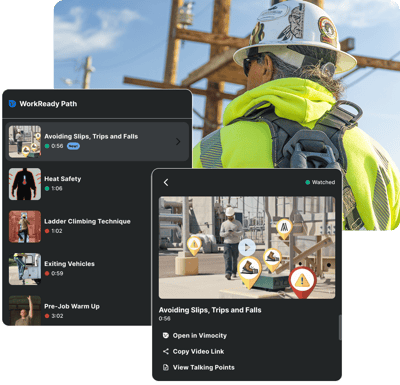
Sponsor (Vimocity): With Vimocity, utility leaders are cutting injuries by up to fifty percent, keeping crews safer and powering stronger operational readiness. Teams stay engaged, your safety impact scales across every work group, and you gain the insights to prevent serious injuries before they happen. Vimocity delivers expert content, seamless deployment tools, and real-time risk data in one workforce readiness platform. Learn more at vimocity.com.
Kevin: Let's bring things back to the frontline worker as it relates to head injuries. They may be at home working in the garage, stand up, hit their head on a shelf, and start to feel a little dizzy, maybe get a headache. What are some of the implications related to concussion and safety?
Simone: You have inflammation because you hit your head, and you have that 72 hours where the inflammation usually heals on its own. But what's happening with that type of hit is compression. You're getting compression on the cranium, and also on the neck, so it's affecting your nervous system.
For compression, we really want to elongate, creating space in your neck with some stretches and movement. An easy one you can do is jaw stretching. There's so much force there, and that compression also affects your jaw, which affects your energy, your sleep, and your anxiety. That compression is the biggest thing I think you want to address.
The best thing to do is put two tennis balls in a sock, tie it up, put it at the base of your head while lying on the floor, and do gentle movements.
Kevin: So you're talking about right at the base of your skull, where your head and neck come together?
Simone: Yes. When you put the tennis balls in a sock and tie them up, they fit perfectly there, and that works amazingly well for headaches. Sinking into them creates space and allows the fascia to open up. The traction happens when you do gentle, slow, intentional movements. Not whiplashing, because that will make your symptoms worse. Just slowly move up and down, on a count of one to four up and one to four down.
Those are things you can do right away that I think would really help, especially if you've hit the top of your head. You want to create that space again.
Kevin: That's great. Those are the suboccipital muscles, the muscles at the base of the skull. You've used the word fascia a couple of times. Could you give us a broad definition of what fascia is, how it relates to the muscles, and why fascia might even be connected to the brain and help in that type of situation?
Simone: Fascia is my lane. I've been working with fascia forever. I have an affinity for it, so as soon as I touch the body, I engage the fascia. So what is it? Fascia is the connective tissue that forms at the very beginning of life, when the egg and sperm come together.
It's what gives you your entire body positioning, what you look like, how you sit. That's fascia. It's around every nerve, every muscle, every cell. There are different layers: superficial, visceral, deep fascia, fascia that protects the bones, and fascia just beneath the skin. It's what holds you together and protects the muscle.
Let's look at working out. If you're very muscle-bound and you don't have any pliability or flexibility, the fascia can actually be like concrete. It's stronger than steel, which is very interesting. It tears at about 7,000 pounds per square inch, which is pretty significant. So it's fluid, but it's also very strong.
If you have that vise around your muscles and you're working out, you'll reach a maximum, because there's no space for your muscles to grow. A lot of bodybuilders get their fascia stripped before they go on stage so all the muscles pop out. If you're working out all the time, especially your calves, and they look flat, that's the fascia being really tight around your calf muscles and lower legs.
So fascia is important for aesthetics, but it's also important for circulation and how easily you move. If your body feels heavy or very restricted, it's because the fascia is tight too. It's the connective tissue that brings everything together, and I believe it's one of the most important structures in the body.
Kevin: A lot of our listeners drive a lot, and they experience sciatic-type symptoms on the right side. A lot of times that's because they're going from the gas to the brake, gas to the brake, and their hip flexors might be tight from sitting. Can you explain how something as simple as sitting could lead to sciatic nerve irritation, and how it's all connected through the fascia, the tension on the nerve, or the muscles firing to compensate?
Simone: The most profound thing about fascia is that it forms to what you do the most. Sitting and driving for long periods is actually the worst for your body. Your lymphatic system, which is the waste system in the body, slows down, and your fascia starts forming to that position.
Fascia is always coming together and going apart. Every time we move, the fibers come apart and come back together. But if you're in one position all the time, the fibers layer on each other and get thicker and thicker, until eventually you can't do that movement.
Why does that matter? A lot of people actually lean to one side when they drive. On top of the leaning, there's the foot moving from the gas to the brake. Most people don't sit straight when they're driving. They're leaning on the console or leaning to the left, and that changes your fascia.
It also changes the lines of tension of the fascia on the nerve. There are fascial fibers that connect to the nerve itself, as well as the muscle. If you keep getting that compression, you'll get compression on the nerve. So from my perspective, you release the fascia, and the nerve relaxes. It's that simple.
Because fascia is one connective system, it changes all the other lines of tension, all the way down to your feet. It's a very bizarre concept, but it's impactful, because we've been so indoctrinated to think our shoulder is separate from the rest of our body. "I have pain in my shoulder." Well, you potentially have pain systemically. If you keep treating the pain and it's not going away, it means something else is going on, potentially in the fascia.
We take out those lines of tension. If you don't do it continually, your fascia will form to what you do the most, whether that's leaning forward or leaning to one side, and that creates pain patterns.
If you drive around today and notice the people around you, every single one looks like a person over 90. They look like grandma, and they could be 20 years old. It's really significant, and that posture affects your nervous system. It affects how you age. It affects how you recover. It's changing people's entire spinal column and nervous system.
Kevin: That's a great tip, because a lot of the frontline workers we work with in the trades spend their day working in front of them. The work is down low. They're looking down, their shoulders are forward, or they're driving. They put on a lot of miles driving from job site to job site. Your shoulders are forward, and your head tends to go with your shoulders.
What role do the pec muscles and the fascia in the front of the chest play when they're chronically tight from working in front of you or looking down at your phone? And what can people do to stretch or work out the fascia in the front?
Simone: The fascia trumps the muscle, and the fibers are getting thicker and thicker. That's your posture. If you're looking down, the way to do it effectively is to engage your lats to pull your shoulders down, which then helps you engage your core.
You're doing it right now. You notice it as soon as you do it. When you do that, your core is engaged and you're not rounded. It's that simple: just engage your lats. Your lats pull you back down, and a lot of people have lost that function because it's so overstretched. Over time, it will come back.
Can you engage your lats right now? Pull your shoulder blades down, not back with your rhomboids. It's a very different movement. It's a brain, muscle, and fascia connection, and it helps you when you're doing forward work. Whether you're an electrician or doing gravel work or whatever it is, staying in that position will really help release the fascia over the pec. It also gives you longevity, because in that position you're neutral.
Kevin: I think adding the breath is a really important piece too. We often teach people box breathing with that lat engagement, pulling the shoulders down and back so you can also get expansion of the rib cage. What are your thoughts on how breathing plays a role in the fascia, overall health, and posture?
Simone: Breathing is super awesome. The more you breathe, and the deeper you breathe, the healthier you are, because of your lymphatics. Let's say you're building a house. You have the waterway: the bath, the kitchen sink, the dishwasher, and the toilet, which is very important. That's the waterway of a house. The human body has that too, and that waterway is the lymphatic system. It goes around and cleans all the cells and cellular debris. It adds in fluid and takes out waste, and it does this all day long, in harmony with the fascia.
Nothing moves the lymphatics except the breath and physical movement. When people are working and moving their bodies all day long, that's great. But if they're not breathing when they're resting or lying down at night, their lymph slows down significantly. That's why sometimes they feel super stiff in the morning: their lymph isn't moving while they sleep.
Then there are the really dead sleepers who don't move at all. That's not optimal for their lymph, because it's either your breath that moves it or turning over and moving at night. In animals, that's called unwinding. Animals get up and move while they're still asleep, because it's very healthy to do.
So it's really important to be mindful of your breathing. Right now, I just want everyone to breathe. Take a deep breath in. And out. What that does is down-regulate the brain. It gets the brain out of fight or flight with one simple breath. You come out of stress mode, and you can see things a different way or react in a different way. It brings more nutrients into your body to heal, and oxygen is very healing to your entire body: to the fascia, the muscles, and the brain.
Kevin: That's a great tip. One thing in the back of my mind as we're talking is the worker doing repetitive tasks who might use one side of their body more than the other. Let's say they're a tree trimmer constantly working with their right arm overhead, or they're pounding nails with their right hand, or using a chainsaw on one side. How does that repetitive work on one side end up affecting other areas of their body?
Simone: A one-sided sport or a one-sided profession creates asymmetry in the body. Being symmetrical is optimal for performance and longevity. When you create asymmetry, you create pain patterns and lines of tension. One side becomes dominant, and the other side becomes weaker.
What usually happens is that people treat or stretch the dominant side, but the side that's actually compensating is the weaker side. That's the one that has more pain when you get treatment, because it's carrying loads people aren't aware of.
When we look at power, performance, repetition, and effectiveness, I wouldn't necessarily recommend this on the job, because using your non-dominant hand could be a hazard. But for 15 or 20 minutes a day when you're not at work, or at the gym, do extra reps for strength, and do some of that same movement with the other arm. It's very important for us to stay symmetrical, and you can train that.
I'm ambidextrous. I practice writing with both hands, and I work on fine motor skills with both. It's also a brain exercise. Physically, it helps with performance, and it also helps your brain de-age if you can use both sides. If you ever do have an injury, you have another network to go to automatically, so nothing slows down, which is very cool.
Kevin: What patterns do you see in patients who had a severe ankle injury 25 years ago? Where does that injury show up in other areas of their body?
Simone: An ankle injury from 25 years ago creates a lot of compensation on the opposite side. The injury could have healed, but maybe the brain doesn't think so. If the brain isn't retrained to know the ankle is 100% solid, it will start favoring the other leg, and you don't even notice. But you can see it in your gait and in your muscle development.
This is the wonderful thing about the body: it adapts until it can't. Part of the mindset is, "I'll get better. I'll move through this. Over time, it'll just go away." Well, it doesn't actually go away. The brain just down-regulates the pain so you can survive. The brain focuses on only one primary pain at a time, and it asks, "Is this life-threatening?" It prioritizes.
So the injury doesn't simply disappear. It goes almost latent, but never really dormant. Latent means you only feel it when it's touched, pressed, or activated, and the body is a master at that. Here's the thing: if you had an ankle injury and were given exercises, you don't stop when the pain is gone, or after six weeks, or after 10 weeks. You should do mobility work for the rest of your life, and do it on both sides. Doing all of your rehab on both sides of your body is optimal.
Kevin: Simone, we've talked about the brain and the fascia, but where you've really pioneered and innovated is nutrition, especially as it relates to neurotransmitters and giving the body exactly what it needs, in a very specific amount and type of nutrient. Can you talk about how you do an assessment, and what a nutritional protocol looks like beyond what we'd typically think of as supplementation or just eating a certain amount of a certain food?
Simone: I call it capacity. If we don't have the internal capacity to heal, then we don't heal, or we don't recover from a concussion. That's where nutrition comes in.
What people have forgotten, or maybe never knew, is that everything we eat turns into a biochemical cascade inside the body. With real food, the body goes, "Yahoo, that's super awesome. We can use this." With food that isn't real, like anything that comes out of a plastic bag, looks bright pink or all sorts of fancy colors, or tastes really addictive, the body first goes, "That's a toxin." So it has to process it as a toxin before it pulls out any food quality.
With natural food, the body knows exactly what to do. With fake or processed food, the body treats it as a toxin first, then tries to get whatever nutritional value it can out of it. I'm not telling people not to eat fake food. I'm just saying natural is better.
I created a lot of this for people with ADHD. About 85% have hypermobility, and hypermobility also affects gut motility. It's the opposite of everyone else: people with ADHD who have that flexibility actually need to move to digest, not rest and digest. The movement helps with motility and absorption.
Nowadays you really can't eat enough, because if you're busy and overwhelmed and eating in your car, your body has to digest the food and then absorb it, and in that state it's hard to do. We could also go into minerals, minerals in the soil, and overplanting.
But if you're not getting the nutrients, or you feel like you've lost your edge, that sharpness, or your muscles aren't as pumped as they used to be, then you can look at supplementation. How do we feed your body and your brain and bypass the things that might interfere with that, like anxiety, fight or flight, or just being super busy?
I partnered with a medical doctor who created this test, and each question relates directly to a neurotransmitter. Neurotransmitter is a big word. What it means is that neurotransmitters dictate your personality, how you see the world, how you sleep, how your brain ages, and your pain.
Each question relates to one of four neurotransmitters. The first is dopamine. Everyone's heard about the dopamine thing on social media and the runner's high. Dopamine is really your sense of self. It also determines your balance and how easily you maintain muscle mass, which is really important for people with physical jobs.
We also look at acetylcholine, which determines your brain's age and how quickly you can recall words or react. Then we look at GABA. GABA is one of the only neurotransmitters that down-regulates your brain. It stops your brain from thinking all the time, and it's outnumbered by all the other excitatory neurotransmitters. So how do we get that GABA into your brain?
You are producing it. You don't need to take it, and I want to say that clearly again: you're producing all of these. You don't need to take them. You just need the delivery system to get them to the brain. I've read thousands of papers, and I found the delivery molecule, which is a nutrient. Some people call it a supplement, but it's really just food in a pill.
The last neurotransmitter is serotonin. Serotonin determines your sleep quality and your ability to experience joy. So those are the four I look at.
The test is called the brain health assessment. I also have a brain reset program, which includes the test, the program, and a consult with me. Anyone can take the test, and when you do, you get an e-book on how you can help yourself with certain things in your own home and with your food.
With the program, I designed it so that within three days, you notice. I know that's a huge claim, but 100% of the people on the program improved within three days. I'm not saying 100% healed. I'm saying they noticed a difference. I did a clinical trial, and I'm turning it into a white paper. I collected data on people for eight years, and within a month they improved anywhere from 40 to 60% on their major pain point, which is pretty significant. The data is the data, and I'm just putting it out there.
We want it to work. If it doesn't work within three days, we change the dosage or the timing, and if it's too much, we change the dosage and timing. That's why people see all this stuff about supplements and say they don't work. Most of the time, you don't know if they work, because there's no measurement. "I think I feel better." "I've been told I'm supposed to take 50 pills a day." You don't know what's working.
So we keep it simple. They get three things to take, and they retake the test in a month or six weeks to see what's changed. If the program's working, we stay on it. If not, we change it up a little, maybe add something in, because as one neurotransmitter starts to improve, the rest all shift. It's been an amazing program to watch, and in several people it has helped prevent suicide.
Kevin: Can you explain the test a little further? It's very accessible. My understanding is it's under $30. People can take it, they get a workbook, and they can understand where they're at from a nutrient deficiency standpoint.
Simone: Sure. The test takes about 15 minutes online. You just sign up. I designed it for people with ADHD and concussions, so there's one question per screen, and the answers are true or false. Each question relates directly to a neurotransmitter, whether it's a behavior or the types of foods you like. It all goes back to a neurotransmitter.
Here's something people should know: if you don't finish it within 15 minutes, it starts over. It's your medical information, and we delete it for privacy.
At the end, there's a button that says "Work with me," yes or no. If you click either one, the guide is sent to you right away. It goes through several things you can do right away and what your result means. You get one result, the area where you're most deficient and need the most support, because we don't want to overwhelm people with too many things to do. Too much change at once might not last. You're creating a habit and a behavior change, which is a lifelong journey, not something you do for a couple of weeks and you're good.
Kevin: We'll make sure to link to the test so people can learn more. Bringing it back to the frontline worker from a macro nutrition standpoint, what's one change someone can make tomorrow? A lot of these workers are on the road, working 16 hours a day, eating out of gas stations. What's one small shift that would benefit their fascia and their brain health?
Simone: One strategy is, when you go into a convenience store, know that they do have real food in there. I advocate for having five colors a day. You could have an orange, an apple, and a banana, that's three colors, and then you could have a meat. I know a lot of convenience stores have deep-fried food, and I say, "Don't starve yourself. Make the healthiest choice you can, and add a couple of natural things at the same time." The natural things will give you more energy, because the other food will probably crash you in about four hours, depending on how you digest fats.
Kevin: How does hydration play a role in brain health and fascial health?
Simone: I think it's one of the most important things, alongside breath. You have to breathe, and you have to drink water. People will tell you to drink lots of water, but what does that actually mean? It varies depending on where you live. At altitude, you need more water. In dry climates, you need more water. It also depends on how you drink.
I use the analogy of a thunderstorm in the desert. The monsoon comes in, washes all the topsoil off, floods everything, and your tree ends up in somebody else's yard. That's the same thing as guzzling water. The best way to do it is to sip water every 15 to 20 minutes, not guzzle it.
That means you need a water bottle with you, ideally in a temperature-regulated container. If you're working outside and doing a lot of physical work, aim for about a gallon a day, throughout the entire time you're awake, not just at work, sipping every 15 minutes. That's optimal. I do it myself. When I'm working with people, I stop and take a sip of water. It's just a habit I have now.
When you're out in the field, you want to keep the water in, because sometimes you're thinking, "I can't drink that much water. I'll pee all the time, and there's no place to go." So put electrolytes in your water. The electrolytes help hold the water in your body, because if you drink too much water without them, you're washing minerals out of your body. We want that balance, so do half a scoop in your water bottle in the morning and half a scoop in the afternoon.
My recommendation is to do the best you can with what you have, but optimally, sip every 15 to 20 minutes with electrolytes in your water, and work up to a gallon a day.
Kevin: If people want to find out more about you, your training techniques, and your program, what's the best way to find you?
Simone: For direct contact, email info@fasciatraininginstitute.com. You can also go to fasciatraininginstitute.com. There's a lot of information there, with a contact page and an about page. There's also a Brain Health tab at the top. Click on that, and it goes into the full program.
Kevin: Awesome. Is there anything we didn't cover today that you want to make sure we fit in before we wrap up?
Simone: Going back to my story about my hearing: my hearing probably would have been much better if I hadn't put off the recommended treatment. I might not have been deaf for two years, and the damage might have been less. So taking action, no matter what it is, is really the best thing you can do for yourself.
If you know someone that happens to, advocate for them, because what I've found is that people with ADHD, high performers, and people with anxiety aren't the best advocates for themselves. Let's say you're in a car accident. EMS shows up and asks, "How are you?" "I'm great." Half your face could be missing, and you'd still say, "I'm good." I'm saying that in a comical way, but it's true.
Your brain goes into a place of hiding, just like when someone's choking. People run to the bathroom to be alone instead of asking for help. It's instinctual. Asking for help means you're in a state of weakness, and in the animal kingdom, that means you're going to get eaten. So the brain says, "No, I don't need help."
So suggest something for them instead. "Can I take you here?" "What do you think about this?" Offer a suggestion, but don't ask if they need help, because 99.9% of the time they'll say no. It's all in the language. We don't want to push them further into fight or flight or make them feel like they're in a weak position. I think that's the big takeaway.
With a lot of these people, I just start doing, and they appreciate it. "Is there someone I can call for you? Let me do that. Is there something I can help you with right now? Do you need water?" So instead of asking, "Do you need help?" take more proactive action.
Kevin: Simone, thank you so much. And until next time, remember to take care of yourself, take care of your team, and stay work ready. Thanks so much for joining us on the WorkReady Podcast today.
Discover how Vimocity can help keep your crews WorkReady.
One comprehensive platform to help safety and operational leaders prevent more injuries and incidents.