
.png?width=20&height=24&name=Vector%20(15).png) For Leaders
For Leaders For Workers
.png?width=24&height=23&name=Vector%20(16).png) Partners
PartnersSleep is Your Superpower
WorkReady Podcast Episode 47
-
Speakers
James Marsh | SleepVibe
Dr. Kevin Rindal | Vimocity -
View The Transcript
What is the first thing that changes when someone starts sleeping deeply for the first time in years? They're able to be engaged, really connect. It's life-changing. We know that that deep sleep is when the body's actually repairing and recovering. SleepVibe is like the tuning fork for our nervous system.
They're able to get up and go out without having that medication hangover. You can't cheat. Your body really needs to recover. I don't know about everybody else, but I don't wanna be a statistic
I've basically been obsessed my entire career about recovery and performance. That's been where I've spent most of my career, especially in the athletic world. And people always ask me, like, if I could do one thing to optimize my performance, what would it be? And my answer is consistently sleep.
Like, good sleep is your number one performance hack. Can you tell us a little bit more about your background? You're a mechanical engineer. How did youfall into this whole space related to sleep?
I've always been curious. I've always tinkered taking a bike apart and actually putting it back together. In 2020, I was taking care of my wife, who had a form of Parkinson's, so her body was deteriorating, but her mind was okay. And, um, at one point, she was only sleeping one to three hours a night. So it was 2020. We couldn't get caregivers. I was the only caregiver, so I was sleeping less than one to three hours a night, just trying to make sure she didn't get up and fall.
And after several months of that, it's, it's brutal. It really had an effect on me to the point of I had three to four seconds of working memory, meaning if I saw something I needed to, oh, this happened to my wife, I need to tell the doctor about it, I had three to four seconds to write it down or it's gone.
Also my executive functioning as well, and I think, um, I think linemen and, and first responders, you know, understand that 'cause they have to make decisions, and if they're sleep-deprived to the point where, where that's clouded, you know, it could be dangerous for them. It could affect how, how well they do their job.
We tried everything, of course. The doctors threw medication at her. It knocked her out, but didn't give her deep sleep. And we tried sound files. We tried binaural beats. We tried tea. We tried supplements, you name it. None of it worked. It didn't work for her. It didn't work for me.
And part of that was I was hyper-alert. I was always listening to see if, if she got up. So I had a friend that had a, a very serious alcohol addiction, and, uh, he was doing a process. It's a clinical process called transcranial magnetic stimulation, TMS. Um, you go in for like six weeks every day, and you have electromagnets.
You have to put on a helmet and electromagnets. So they trigger parts of the brain to basically rewire the brain. Of course, this is high-powered and, you needs a clinical, but it is FDA-approved as safe. But I heard that, "Oh, magnetic field," and I took magnetic field and combined it with binaural beats. So it's silent, but it still works. And I tried it myself.
I slept all the way through the night, nine hours straight, didn't even move. Did that for the next three nights, and I just started to feel like maybe I'm recovering a little bit. So my wife decided to try it, and again, she's only been sleeping one to three hours a night for months on end.
She slept all the way through the night. So afterwards, um- After she passed in, uh, twenty twenty-two, I, uh, decided to see, see if this thing actually works for more people. Um, so we-- I got, uh, some friends and volunteers. I gave them two units. Uh, one was an A, the other was a B, and I said, "Try the B unit first."
All of them said there's no difference in their sleep. I was glad to hear that 'cause that was a placebo, um, which, uh, I said, "Okay, try, try the A unit next," and all of them said, "Wow, what is this thing?" Uh, one person didn't wanna give it back because she said it was the best sleep she's had in decades. All of them bought one.
All of them are still using it four years later. So, um, it went on from there. Such an amazing story, Jim. And maybe let's go back into the, the science a little bit more. So this thought around magnetic fields and that impacting sleep and biorhythmic beats, these are not new concepts. I mean, this is stuff that's been around for a long time.
Can you walk us through the process of how you thought about bringing all those, uh, pieces together, um, and then actually turning it into a product? Sure. Um, so of course, as an inventor, um, I'm always pulling things from various, various directions, and, uh, one of them was the TMS, the transcranial magnetic stimulation.
I knew I didn't wanna go that strong, uh, because, you know, safety. Um, but there's also a mag-a magnetic field around the Earth, and, uh, lightning strikes all around the Earth all the time. Um, and that energy, um, is actually- blasted every time there's a, there's a lightning strike, um, whether it's cloud to cloud, cloud to earth, earth to cloud, um, whatever.
And, um, that actually... That energy actually echoes in the earth's atmosphere. So it creates, um... It's called the Schumann frequency. Uh, people can look it up. It's about nine hertz. And our... Everything on earth is bathed in this and has been for millions of years, as long as there's been lightning. So, um, so our bodies are used to that.
And another part of my, my thought was my wife's body was, was, um, deteriorating. It was not acting like normal. Um, and there are other things, uh, that, that kind of push us out of that normal mode, right? Um, you know, megahertz, gigahertz on the cell phone. Um, I, I personally think our bodies are, uh, fractal antennas with different lengths of, of tissues, and each of those resonate with, with a certain frequency.
And I think that, that knocks us off a little bit. Um, that's why a lot of people need, uh, grounding mats or, um, you know, removing all the EMF from their room. I, I think those are, those are absolutely great. Adding binaural beats just made sense. Uh, so basically binaural beats is, um, is a really cool aspect of the human brain.
If you hear one tone in one ear, another tone in a, in the other ear, your brain creates, uh, a tone that's in between those two. So that tone is near delta frequency for, um, uh, for Sleepvibe. So it gives a reference point of, uh, that people can, uh, that people's bodies can tune into. The body is very smart.
It needs to go, you know, that 90 cy- 90-minute cycle between deep sleep and waking and back. Your body needs to repair, so that's deep sleep. If you're integrating a learning experience or events that happened during the day, that's the REM sleep, and both of those are important, but at different times. So, um, the phrase that I like to use is, uh, Sleepvibe is like the tuning fork for our nervous system.
It, it just gives us... If you play a guitar and you have a tuning fork, if the strings are, are tuned correctly, they'll start to vibrate without, without the tuning fork touching them. Uh, they'll start to vibrate in, in harmony with different octaves, of course, but... So I'm seeing that, um, that just makes a lot of sense, not only from a, a theoretical point of view, but also what I've seen observationally.
Um, it's been quite a journey to, to learn more about sleep and how important that is and all the aspects of it. No, thanks for that explanation. So what I'm hearing is that the Earth has these natural frequencies, and so the biorhythms beats means that there are these frequencies that our, our brain is trying to basically align with those, those same frequencies.
And so when it does, that allows our brain to calm down so that we can actually get into that phase of deep sleep or REM sleep. I, I think that's exactly right. Um, and it's interesting that, uh, when astronauts go into the space and they're outside of, or further outside of, uh, Earth's magnetic field, they have trouble sleeping Um, as well as other, other things.
So it's a, it's a known issue. Uh, so again, it's data points. I, I like data points. I like to, uh, understand them and then pull them together in different ways. Well, that is a pretty cool origin story to hear about how you came up with that. We, uh, we obviously mourn the fact that your, uh, your wife did pass away and went through that experience.
Um, but I guess the silver lining is that now you have a technology that you were able to create that's impacting the lives of, I mean, so many people. And I just-- on a personal note, I, I ordered a Sleepvibe. I've been using it for the last probably three months now, and, uh, that's what prompted me to reach out to you to see if, if we could have this interview, because, uh, I've tracked my sleep for over five years now, and so I have a lot of data, uh, based on like my WHOOP scores and, uh, sleep scores.
And so it shows me each night how long I spend in deep sleep, how much time I spend in REM sleep. And it's not perfect, but I think it, it also, you know, just gives some guidance. And so I've been tracking that over the last couple months, and one of the things that was very evident for me is that I am spending, uh, like thirty percent more time in deep sleep and REM sleep.
Yes. And we know that that deep sleep is when the body's actually repairing and recovering. And so the byproduct for me is I've been able to push harder with my training, especially lifting and longer runs. I recover better and faster. My recovery scores have been going up. And I was like, "Man, there's something here," and it definitely is directly, uh, related to the people in the trades who are using their bodies every day.
They're oftentimes in situations where they can't get, you know, very restful sleep or they're on the road. Yeah. And, uh, this is something that my wife is also experiencing the benefits. So when I'm on the road, there was a little bit of a, um, you know, who's gonna get the Sleepvibe, and so I ended up getting a second one so that I could actually travel with it.
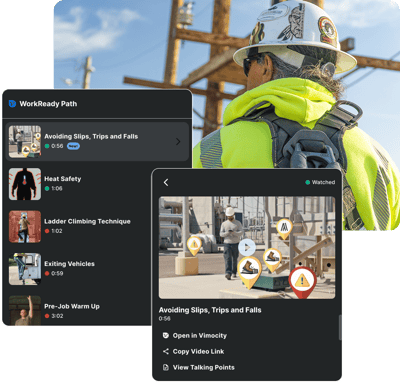
So- Yeah ... uh, it's one of those things that, you know, the data is really what convinced me that there's something here in the personal experience. With Vimocity, utility leaders are cutting injuries by up to fifty percent, keeping crews safer, empowering stronger operational readiness. Teams stay engaged, your safety impact scales across every work group, and you gain the insights to prevent serious injuries before they happen.
Vimocity delivers expert content, seamless deployment tools, and real-time risk data in one workforce readiness platform. Learn more at vimocity.com
And I'm curious of your experience, um, 'cause people, people that travel, um, e- especially internationally, but even, even domestically, uh, when I go on a trip, I just plug it in immediately as soon as I get to the, the hotel. Uh, put it next to my pillow, leave it on twenty-four/seven. But, um, it-- I, I get really deep sleep even in, in a new room, you know?
Uh, people doing international, they... Of course, that messes with our circadian rhythm. Um, they find that their circadian comes back, uh, instead of two or three weeks, it's, it's like a week, and they're, they're back to 100%. So- Well, I travel across time zones, uh, very often, and that historically has been the hardest thing, especially going from West Coast to East Coast.
And so just my ability to maintain a high level of recovery with that, you know, traveling through two or three time zones, 100% that, that has been one of the most noticeable things. So yeah, you're exactly right. As soon as I get to the hotel room, plug it in. I actually wrap the cord around my, uh, my luggage so that I don't forget, Yeah
I don't forget it, uh, in the hotel room, 'cause I've left I don't know how many cell phone chargers over the years. Uh, another component to that is, um, just getting deeper sleep, uh, helps with our emotional stability. Um, I have one person, she, she- Bought a Sleepvibe very early on. Every time I see her, she says, "My husband says thank you because, uh, I sa- I saved their marriage."
And I'm like, "What?" And, uh, she was so sleep-deprived that, um, you know, she was very reactive, and she's the nicest person. But through my experience with my wife, I could see how, uh, sleep depri- sleep deprivation really affects our ability to, to stay on an even keel. Um, so her mood improved, their marriage improved.
Everything's good, so That's, that's a good side benefit for sure. Well, I wanna paint a picture for our audience of what this-- I mean, we've talked about the Sleepvibe and that I carry it with me when I'm on tr- uh, trips, but for a lot of the audience, they may not be able to visualize what that actually looks like.
So can you talk about the actual device? Sure. Um, it's about the size of a deck of cards. Um, and you would just plug it into the wall, wall power, USB-C, so five volts, very low power. Uh, plug it in, turn it on, put it under your pillow, leave it, leave it on twenty-four/seven. People, when they f- first start using it, it takes, uh, three to five days for them to really kind of tune into it and, and sync with the, with the Sleepbud.
Um, but then they can really feel the effect. They see it with, uh, falling asleep quicker, uh, falling back asleep, which is really, really pretty key. Um, and of course, as you said, with Fitbit or Oura or other trackers, um, you can see the actual deep sleep go up, REM sleep go up, wake time go down. Uh, we actually have a clinical trial that is, um, with second shift nurses, um, historically really bad, uh, sleep.
You know, I, I don't know how they do it. Uh, and they're, they're also saving lives. They're taking care of people, and they have to make good decisions. And in the study, we're just starting to get results back, but it is showing, uh, deep sleep goes up, wake time goes down. There's less, uh, times during the night that somebody needs to go to the restroom, and, um, and if they do, they come back, and they're able to go back to sleep, even if they wake up at 3:00 AM, which is, is kind of a, a weird time 'cause a lot of people, their brain turns on, and they can't, they can't get back to sleep.
With Sleepvibe, um, they- It's, it's very rare that I can't go back to sleep Yeah, and personal experience, that was one of the things that was most noticeable to me because I, I would say for the last three or four years, like getting up to go to the bathroom, uh, was a nightly, uh, experience. And probably over the last, I don't know, two months, I can only think of a handful of times that I've actually had to wake up to go to the, the bathroom.
And when I have, I fall asleep almost immediately. And historically, it was wake up, go to the bathroom, and probably, you know, wake up first and I can't go back to sleep, and so then I'm like, "Oh, I'm gonna just go to the bathroom." And so that difficulty falling back asleep, uh, was the pain point that I had.
And I mean, I find if, if I do wake up, I'm pretty quickly back to sleep Yeah. And if, um, you know, it's good for the SleepVibe to be within eighteen inches of your head, uh, either under the pillow or near or hanging on a, um, on the, on the headboard. Um, but if I have trouble going back to sleep, I just pull it closer and I'm out.
You know, one of my questions and concerns when I first, uh, got the device was, you know, does this have EMFs? Do I need to be careful about it? We're really careful in our house about that type of exposure. We try to sleep in-- or have our cell phones in a completely different part of the house when we're asleep.
But what is the, uh, exposure to EMFs with this device? And is that something that we need to be careful about? Actually, that's a really good question. Um, SleepVibe is, is unique in the circuit that I used. Um, it's-- it actually reduces the E component of that, and it's really the, the electrical component of a EMF that actually does damage to our, to our cells.
Um, uh, so that's actually been reduced quite a bit. You can't eliminate it completely, but, um, the magnetic field is, is much stronger. So it's not, it's not a fifty/fifty like, like, you know, most, uh, most devices, you know, our, our routers or cell phones. It's, uh, it's definitely biased strongly to the, to the magnetic field.
And, um, again, it has been safety tested by FDA-certified lab as being below, uh, the FCC minimum. And when I think about binaural beats, I think about like headphones or, or music- Mm-hmm ... and, you know, it's usually like the sound in one ear and the other ear and how that comes together. But your device doesn't have any sound.
Like, how are you able to crack the code of like tapping into that binaural beat without there being any sound associated with it? I think like TMS, the magnetic field actually stimulates the, uh, neurons in our brain. Um, it, it, it doesn't change-- it doesn't rewire your brain like TMS does, but it, it, uh, influences the brain so that, um, it actually can feel the difference-- feel the two different frequencies and create that third frequency, and that's all internal.
Um, we don't-- it doesn't go through the auditory, uh, auditory, uh, channel. Um, people that are older, they have, uh, hearing aids or cochlear implants, um, and they, they still get the benefit of SleepVibe even without those things plugged in while they go to sleep. So it's, it's pretty cool. Anecdotally, have you heard any feedback from, uh, users about how that impacts, uh, sleep apnea?
And is that something that people have maybe noticed improvements in some of these other sleep-related conditions? Yes, absolutely. Um, you know, again, I'm, I'm not a doctor, I'm an engineer, so I, uh, I try different things. I, I make a theory, but I try different things. Um, what we're finding with, uh, that's-- that is not rare at all, it's-- it happens quite a bit.
Um, for instance, I have a friend, uh, her husband is retired army and according to her, snores like a chainsaw. Um, so even if she has earplugs in, she can't go anywhere else in the house because it's still too loud. Um, so the first night, uh, that they tried Sleepvibe, it was silent. He, he didn't snore. Um, he would lay on his back, and you could see him drop into deeper sleep.
She was watching him, and you could see the jaw start to, start to go back, and that's where the snoring happens. He was asleep, but the body was awake enough that, um, it actually prevented him from snoring. Um, we've heard that a lot. I would like to do a, a study to really understand the mode of action, but, um, it's definitely repeatable.
One other thing that you asked me after I'd been using it for a couple months was, "Have you noticed any difference in your dreams?" And I hadn't really paid attention, but then once I started to pay attention to that, I'm like, "Man, I definitely have had way more vivid dreams, and I can remember them more than I ever used to be able to."
And I don't know, is there-- what is the connection there? Yeah, that's, that's another interesting part. Um, so of course, if somebody's really sleep-deprived, the first thing the body needs is to, is to have deep sleep and recover. Uh, typically if, um, what I'm seeing is if people are, are that sleep-deprived, they've stopped dreaming at that point, um, 'cause the body's using whatever time it has to, um, to get the deep sleep.
But once they catch up on the deep sleep, they do start dreaming more, and one person uses it as, uh, as like, uh, lucid dreaming. So they're asleep, but-- and dreaming, but they're awake enough to steer the dream. And, um, so that's, that's one aspect. But like you say, the other aspect is people actually have-- Their dreams are very vivid, and they can remember them well into the afternoon.
Um, before Sleep Five, I would wake up and within, within half a minute it's gone. I, I couldn't remember what I, what I had dreamed that night. But with Sleep Five, uh, into the, into the afternoon, I could have a conversation with somebody and tell them about the dream and all the aspects of it. So, um, so it's pretty cool So let's make this practical.
I mean, a lot of people who listen to this, uh, podcast, they may do shift work, they may work, uh, long hours like 16, 18 hours during a storm. Uh, they may be, you know, first responders who have a lot of disrupted sleep. So practically speaking, what-- how could they benefit from leveraging this technology, and what could they expect by using a SleepVibe?
Yes, that, this is a really good, good question. Um, what I'm finding is that, you know, the day-to-day getting, getting better sleep on a day-to-day basis, um, I no longer needed, uh, uh, you know, a nap in the afternoon. I, I was a big proponent of the power nap, right? Um, but after a while of using Sleepvibe, I realized that I, I just didn't feel like I needed it.
And as a matter of fact, if there was an emergency or I have a trip the next day or, or something, and I don't get a good sleep for the first night, um, I am not dragging for the, for the next day. It's-- I'm still energized, uh, all the way through to the end of the day. By evening, yes, I'm, I'm tired, but that's basically a day and a half, two days of pretty much straight, straight going.
So that says my body's really, uh, working on a very low sleep deficit. Um, and I think that's, that's really important, those, those aspects. So if someone is like, "I don't know if I'm ready to, to purchase something," or, "I don't know if that's for me," what are things that people could do leading up to that to just try to improve their sleep so that they can, you know, test different things out?
It is really important, um, the-- they call it sleep hygiene. Uh, so getting up at the same time in the morning, getting sunlight, uh, early, as early as you can, um, drinking enough water, um, having wind-down time at the end of the night, going to bed at the same time. Some of us, because of our schedule, we can't do that.
Um, but the more we can, uh, we can reinforce that pattern, even with Sleepvibe, that helps. It helps Sleepvibe to get, uh, deeper sleep, which is the whole goal, right? Brought up a, an important point because, you know, some people do rely on medication or some type of chemical, uh, way to try to get sleep, and the quality of that sleep is oftentimes compromised by, you know, chemically inducing deeper levels of sleep.
Yeah, a lot of people, um, are, are moving away from medications, um, especially if they're in a job, um, you know, fire, police, um, other first responders, um, medical people. They, they can't be under the, that medication hangover, um, because people that take those or are using them on a regular basis, they're actually pretty fuzzy all day or most of the day.
Um, and that's-- that would really compromise their ability to, uh, to, uh, do their job and do it effectively and safely. The other, uh, aspect, um, is just all the studies that have come out. Uh, these are clinical studies, and they show that, uh, not getting enough sleep, uh, on a regular basis, uh, really increases your chance of very serious stroke, heart attack, diabetes, um, and, uh, other, other very serio-serious ailments.
So really you can't cheat. Your, your body really needs to recover, needs to, um, to get good quality sleep, and usually that means, uh, medication or even melatonin, um, isn't, isn't effective in doing that. Jim, let's move to the myth-busting section of the interview. So myth number one, I can catch up on sleep over the weekend.
Uh, again, clinical trials show that, uh, you really can't because your body is damaged from the lack of sleep during the week, and also it's, um, it's also disruptive because your circadian rhythm is used to going to sleep at a certain time, waking up at a certain time. So catching up is really-- You're, you're catching up on to reduce your exhaustion.
You're not really rebuilding your body, and, uh, that, that takes a toll. All right, the next myth, six hours of sleep is enough. I've just always been that way. Uh, again, I'd go with the studies. Uh, I would say if maybe six hours if you're getting really deep sleep. But a lot of people don't. They, they spend part of the time waking up.
They spend part of the time rolling around. Um, so it's not really six hours of sleep. And that's what, uh, that's what I found too, is I always thought I, I just don't need as much sleep as maybe they say that I need. But then once I actually started to sleep at a higher quality- Yeah ... I realized that my body actually craved more time.
I've mostly been a six to seven-hour person, but man, when I get eight hours and that deep sleep and REM sleep are higher from a percentage standpoint, uh, my recovery's better and I just feel so much more refreshed. So I, I just think I got so used to inadequate sleep that that just became my norm and my reference point.
Next myth is I'm just a light sleeper. That's who I am. Again, it's, it's what our bodies are used to. Um, I can only relate, relate it to my experience, which was I was hyper alert. Um, and I've seen this with, again, fire and police. They-- Even when they're off shift, they're waiting for that, that bell to go off and, and they're always hyper alert, so they don't get deeper sleep.
Um, and again, not to keep promoting Sleepvibe, but the, the effect that we've had in our pilots with Sleepvibe is that they are able to get deep sleep, and when the bell goes off, they're able to, to get up and go out without, uh, having that, uh, that medication hangover. The next myth is sleep optimization is for athletes and executives, not for people on the tools.
I think, uh, you know, obviously people, especially linemen, I mean, they're 40 feet up, and, um, they make a mistake, they forget to tie off, and, uh, that's a bad day. It's-- So... A- and again, um, do we wanna retire at 40 or 45 because our body is-- hasn't recovered, and we can't do the things that we really want to do?
Um, again, going hunting, going hiking, uh, mountain climbing, whatever. Um, it's, it's really important to keep our bodies up to, up to, um, as healthy as possible. Great. Well, Jim, let's move to the rapid fire round. So I'm gonna ask you a series of questions, and again, just whatever comes to mind first. So Jim, what is the first thing that changes when someone starts sleeping deeply for the first time in years?
They start enjoying life more. They're able to be engaged. They, they are able to be-- uh, really connect with their, um, with their significant others, with their family, um, and not be emotionally reactive. Um, it's really-- it's life-changing. It's-- I see it over and over. So Jim, if a foreman told you his crew's running on five hours a, a night during a big project push, what is the one thing you want them to know about the SleepVibe and sleep?
I think I would point to, um, to statistics, and I think Vimocity has, has this as well. Um, you can see error rates, you can see, um, you know, safety, um, safety situations that happen when people aren't getting enough sleep. You could see a correlation between safety and, um, and the quality of the job that people are able to do if they're, if they're well-rested Yeah, I think there's this hidden ROI with sleep as it relates to performance output from an operational perspective.
You're gonna be more productive, the quality's gonna be higher, and the injury risk is much less. And so, again, this just is such a-- I think the low-hanging fruit when it comes to improving the operational, uh, capacity and the safety of your teams. So- And, um, and- Yeah ... one, one extra point if I can. Uh, I was talking to somebody who works with executives.
She, she was a high-tech executive. She burned out, and then she realized, oh, she needed, um-- she found the importance of sleep. So she's got a whole program for the last fifteen years that, um, these executives actually get deeper sleep, and they're able to be more, more effective during their, during their day job.
So, um, so I wanted to bring that up as well. And Jim, the final question here is what, what are you most excited about for the future of sleep research and how we can use this as a performance tool for the workforce? I think the exciting thing is there's, um, there are alternatives to medication. Um, there are-- It-- The importance of sleep was number one, because, again, as our society, we thought we could cheat.
We thought productivity was, uh, superseded just laying in bed, getting a good sleep. But we're finding that that's not true, and, uh, that's an important realization for everybody. And again, it's-- comes down to quality of life, not only from a, a safety perspective, but for those that are, uh, that are close to us.
Absolutely. And again, I come from a sports medicine background, but I've worked with linemen and utility workers and construction workers for the last ten years, and that's why we developed this whole approach through Vimocity of, uh, helping workforce athletes, because we see the men and women who do the frontline work as athletes.
And every athlete knows that recovery is more important than training. And if you just train, train, train and don't focus on recovery, you're gonna hit a point where there's diminishing returns, and you're not gonna be able to achieve your, you know, what you wanna achieve, and your body's gonna break down.
And I see that same thing with the workforce. When the workforce is just pushing day in and day out, and they don't have the capability to get that high-quality rest, recovery, it leads to breakdown. And that's not only gonna impact how they perform on the job, uh, but it's also gonna start to put them at a higher risk for an injury.
And ultimately, uh, it's gonna cause them to get to the end of their career more broken down than they need to be. And we only get one body. And if we're not doing the maintenance, if we're not, uh, getting that right amount of sleep and recovery, it's, it's gonna impact us and our quality of life. And you talked about this, the hunting, the fishing, the camping, the spending time with our families, just even our overall attitude, the way that our brain functions, our emotions, all those are impacted by the ability to recover well.
Absolutely, yes. Jim, what are three things that you'd like to leave our audience with? I think the, the importance of sleep as a foundation. It, um, it really supports our recovery, it supports our health, r- r- um, relationships, so many things. And another would be, um, just redefining what good sleep is. I would ask people to question, um, uh, i- is there another level or two, uh, to what their sleep is?
And, um, just getting deeper sleep is, is really magical. Um, and I think the other is, uh, just safety. Uh, the, you know, the-- Like you said, the, the quality of sleep, uh, affects us on the job, and we can see that through statistics. And, um, I don't know about everybody else, but I don't wanna be a statistic. I wa- I wanna have, you know, a good h- good life, and, um, when I retire, I wanna go do things that I wanna do.
Jim, how can f- people find out more about the SleepVibe? Uh, our website is the SleepVibe, V-I-B-E, .com. Um, we have a lot of information. Uh, we're adding new, uh, new clinical, uh, trials related to sleep, uh, just to give people more information. Uh, and of course, they can, they can order one too. And Jim, if people wanna connect with you, where can they find you online?
They can connect through the website. Um, they-- There's a box that you can, you can add that in. Um, and that gets routed to me if, if the question is, is needed. So that, that would be the best way. But I, I would look forward to people's, uh, feedback, their, uh, experiences, um, and, uh, and their questions. I love questions.
Jim, I so appreciate your time. I know that I learned a lot through this process, and I've personally benefited from, from your invention, and so thank you very much. And for those listening today, thank you so much for joining the podcast. If you haven't subscribed yet, make sure to go to either Apple iTunes, uh, Google Play, or even go to Spotify or YouTube.
We're on all the different platforms. Make sure to subscribe so that you can get the latest episodes. We release a new episode every Tuesday. And until next time, take care of yourself, take care of your team, and stay work ready.
Discover how Vimocity can help keep your crews WorkReady.
One comprehensive platform to help safety and operational leaders prevent more injuries and incidents.