
 For Leaders
 For Workers
 Partners
Pain Isn't a Rite of Passage
WorkReady Podcast Episode 60
-
Speakers
Alex Wakeland
Dr. Kevin Rindal | Vimocity -
View The TranscriptKevin: Most people in the trades expect to be broken down by the end of their career. They call it a rite of passage. Alex Wakeland doesn't buy it. He's a journeyman lineman with 17 years on the road and on helicopter crews, and the worst he has to show for it is a couple of broken fingers. That's not luck. It's a decision to stop accepting pain as part of the job.
Today, Alex shares how he treats his body like the one tool he can't replace, and how a crew that stretches together, eats together, and looks out for each other stays ready for the long haul. This is the WorkReady Podcast.
Kevin: Alex, welcome to the WorkReady Podcast. So happy to have you on today.
Alex: Thanks for having me.
Kevin: Take us back to the beginning. You had kids young, college wasn't really in the picture, and it all came to a head in 2008 when the recession hit. That pushed you into the trades. Can you give us more of that backstory?
Alex: I thought I was going to go to college, but life had different plans for me. Like you said, I had kids really young, and I was trying to make it through college. Then 2008 happened, and there was no money left, so I had to figure something else out.
Luckily, I had gotten together with my future wife, and her dad was a lineman. He said, "You should go somewhere that has actual health insurance. I'm going to help you become a tree trimmer." He didn't want to get me into line work right away, so he put me into tree trimming. A couple of years later, the boss of the tree trimming crew told me, "Your father-in-law told me that if I can wash you out, I should." He didn't want to be responsible for me getting hurt.
Luckily, I didn't wash out. I climbed the ranks, became a journeyman tree trimmer, and then switched over into the apprenticeship to pursue a line career. I kept working my way up the ladder, trying to become a lineman. Then I saw the helicopter work, and I thought, "Clearly those guys are at the top. I need to go do that."
I finally got that shot around 2015 or 2016. I got to go out to Hawaii to do it, and after that, I was hooked. It was the most fun thing ever. I thought, "I can't believe I get paid to do this. I'm going to do this forever." I've been doing it pretty consistently now for about 10 or 11 years.
Kevin: And before this part of your journey, you grew up with a bunch of brothers who were probably always beating up on you, and you were involved in MMA. So you've always been in roles where you're playing hard, working hard, and trying to rise to the top.
Alex: Yeah. Your body is the tool, and it allows you to go do all these fun things, so you've got to take care of the tool. I learned that young as a wrestler. The food you eat, the water you drink, everything was the path, because you had to watch your weight.
Wrestlers actually do really well in the trades, because they have that mental toughness. It goes hand in glove with transmission work and helicopter work, where you're physically uncomfortable but you're not injured, and you use that discomfort to get better at the trade.
For example, I'm climbing ladders every day, so I think, "I need to work on this in the gym, so when I have to do it cold, I don't get injured and I can still keep up." That's the big thing now. I'm working out to keep up with the younger guys.
Kevin: I would imagine that with helicopter work, there's the physical demand, but the mental demand too. You're probably in some pretty precarious situations at times. How did the mental side of being an athlete in combat sports translate to working on helicopters?
Alex: It's not always going to be fun. Sometimes the job sucks, and you just have to accept that it's going to suck. Sometimes your body doesn't want to do what you're asking it to do, and you have to know your limits. You have to know when to look at your ladder buddy and say, "Hey, man, I don't have it today. You're going to have to help more." And they have to carry you.
But there's the flip side too. Sometimes your buddy is going to look at you and say, "I don't have it today. It's on you." And you have to say, "Okay, I'm jacking the hoist all day today, because my buddy's tired for whatever reason." It's almost a next level of toughness to know when to say when. Jiu-jitsu and wrestling teach you exactly where your limit is. Anything more than this, and you're going to pass out. So you get really comfortable knowing where your limit is.
Kevin: I imagine the travel work and helicopter work push that limit, because you're working a lot of hours each week. Is that true?
Alex: Oh, yeah. With the helicopter, you're working more than the pilot is, because the pilot can only fly during daylight. He's got his time limit. You need to be ready as soon as he can work, and you work until he says, "Hey, I've got to leave." Then you clean everything up. So you're working more hours than the pilot is. Don't get me wrong, he's getting tired too, because he has a limited number of hours. But you're trying to maximize those hours for as much productivity as possible, so you're cramming in as much as you can.
Kevin: Give us one story from working helicopters that really pushed your limits, both physically and mentally.
Alex: This was probably my third helicopter job. We were out in Hawaii pulling pole butts with a helicopter, and I was still pretty new to helicopters, so it was super high stress for me. We had to build an A-frame, and the helicopter would hook onto the pole. We'd already cut it off at that point. Then we had to jack with two 12-ton hoists to get the pole out of the ground so he could pick it up and fly away with it, because there was no access.
Talk about stressful. There's a Sikorsky above your head hooked up to this big pole, and in my mind, I'm thinking, "If he doesn't have a lot of fuel, I need to go as fast as I can."
I think I was 150 pounds at that point, so I'm not very big. I wasn't heavy enough to pull the handle down, so I'm jumping up on it, and my buddy is jumping on the handle too, trying to get it down. Then we figured out you could flip the handle so you could push it up, so now you're just doing squats over and over again, trying to get this pole butt out of the ground.
You finally get it out of the ground, and you're exhausted and wiped out, and they say, "All right, good job, guys. Let's go do it again. We've got six more." And you're thinking, "What? This is not what I signed up for. I thought the helicopter would do all the work." That was definitely a bait and switch, and I was very tired after that day.
But the thought of not doing it just isn't there. It has to get done, so you keep doing it. I think I needed about three days' worth of rest after that.
Kevin: I talk to a lot of people in the trades, and injuries are super common. Almost everyone has the mindset that you push hard, you do it for 30 years, and you're broken down at the end of your career. But one thing I found intriguing as we were preparing for this is that you've worked 17 years, and other than a couple of broken fingers, you haven't had any major injuries, nothing that's holding you back. What's the secret?
Alex: It's not me. I was lucky to marry somebody who studied physical training and fitness, and she used that degree to police me throughout my career.
I'd come home from a long stint on the road, and she'd say, "Your shoulders are rounded forward. You need to bring them back. Here are the workouts you need to do to fix that." Or I'd be rubbing my back, and she'd ask, "What's causing this? What are you doing at work?"
We never just accepted that you're supposed to be in pain. The philosophy in my house is that your body wants to be healthy. If you're doing something to make it unhealthy, you fix it. So you figure out the proper stretching and the proper body mechanics, the proper way of moving, how to brace your core before you start, and how to roll your shoulders back into position before you stretch out.
Those things were ingrained in me over time, luckily, because of her. But now that we have the internet and a network where everybody can talk, there's no reason everybody shouldn't be doing that. I was lucky, but it doesn't have to come down to luck anymore. There are programs out there to do this.
Kevin: That's so interesting, because when you say it, it makes so much sense. But I go to job sites all the time, and people are so resistant to doing their stretch and flex, or even basic stuff. What's behind that? Why do you think that mentality exists?
Alex: My daddy did it, his daddy did it, his daddy did it. They all have bad backs. I'm going to have a bad back. Everybody's shoulders get blown out. It's almost like a rite of passage. Once I get my shoulder injury, I'm part of the club in this trade. We need to change that mentality. They did it. We don't have to do that.
I think one of the big things is that both of my parents are fairly healthy, along with my wife, and the reason is that they kept moving into old age. They didn't slow down. And she's always been there to harp at them: "You're moving wrong. Don't lift with your back. Lift with your legs." That kind of stuff.
You think it's a joke until you're in a position where you either should have been injured, or you see somebody get injured, and you think, "I don't ever want that to happen to me." Then it becomes real and more visceral.
Kevin: Dr. Kevin here. If you're finding value in this conversation and you aren't already subscribed to the WorkReady Podcast, I'd be grateful if you'd take a minute to hit the subscribe button on YouTube, Spotify, Apple Podcasts, or wherever you listen. We drop new conversations every Tuesday, so this ensures you never miss the latest episode. Okay, let's get back into it.
Kevin: I love what you said about how the body wants to heal and recover. We are self-healing organisms. You get a cut, and you don't have to think about your finger healing itself. It just does. If we put our body in the best position and give it the right inputs, it's going to heal and recover. In sports, we call that durability. The people who are durable can take hits. You know this from MMA. You see those guys get crushed, and two days later they're right back at it. That's because they're training for durability.
So when you think about the trades in general, and maybe speak to an apprentice out there, how do they start to break that generational mindset of "You're just going to get broken down, so accept it"? I think we can totally remove that mindset from the trades if we really want to.
Alex: Absolutely. If you're looking at your journeyman or your foreman, and you're watching the way they move, and they're moving in pain, don't take it as a knock on them, but you should be thinking, "How are they moving that caused that? What are they doing that I need to avoid?"
Everybody says the same thing: "I jumped off trucks when I was your age," or "I was lifting with my back when I was your age." Okay, those are the easy ones. But what are they doing every single day? You get up in the bucket and watch the way they move and brace themselves, and you think, "Man, that looks like a hell of a strain on a lower back." It probably is. You should probably figure out a different way of doing it.
That's one of the things I've really dug into: the ergonomics of how we actually work and move. It's nice to stretch. It's nice to do your stretch and flex. It's nice to work out. But the movements you do every single day compound over years. Even if you're just standing and your shoulders are rotated forward, you know there's a problem. You can see it in a mirror. You should fix it before it becomes a permanent problem. That's my philosophy.
Kevin: There's a concept in sports medicine that says, "Don't overload dysfunction." That's exactly what you just said. If my shoulders are rounded forward and I do a ton of repetitive overhead work, and my shoulder isn't functioning the way it's supposed to, it's like going on a road trip with your vehicle's alignment out. It's going to wear everything out faster.
Sometimes it's as much about what you don't do as what you do. You restore proper shoulder motion, and then the resistance can actually build you up instead of breaking you down. When you're an athlete in the gym, you're there to break your body down so it can build back up better. But every squat, every bench, every fly, you're doing with proper form, so your body breaks down and heals up stronger with the right movement patterns.
So what's your opinion on how a flip in mindset could actually make people in the trades stronger instead of broken down?
Alex: We're in a rare career where you're literally getting paid to work out. That's what we do. It's a physical job. It's not as physical as it was in the past, but it is a physical job. So I look at it as an opportunity to stay in shape on somebody else's dime. I don't have to go to the gym when I'm working seven-twelves on a highline job, because I can just pick things up the proper way.
There are people who pay good money to go pick things up properly, and here I am getting paid to pick things up properly. What a novel idea. So I make a little joke about it when I'm around guys who are resistant to it. I'll say, "Oh, look at you, big guy, going to the gym. I'm just going to do my gym right here." You get that teasing back and forth going, and it really starts to break down the barriers and the resistance you sometimes get. You catch more flies with honey than with vinegar, so I always try to steer in that direction.
Kevin: There's a part of the day, at the start, where people could take five minutes to prepare their body. Every athlete prepares. The coach doesn't have to tell them to warm up and get ready for the game. So what are the barriers? Why doesn't that happen on every job? Is it the foreman? Is it leadership? Is it the people working the job who say, "I don't want to do this"? Why do you see it not happening?
Alex: It's whoever is leading at show-up. It's not necessarily the foreman or the GF. It could be a journeyman lineman. It could be a favorite apprentice. There's always somebody who sets the tone. He's the cool guy. Everybody wants to hang out with him, and that's the guy who has that ability.
I've been lucky to go to several different jobs with my group of guys, and when we get there, the other guys want to be part of our group, because we're such a tight-knit group. But to get into our group, you have to conform to what we're doing, and what we're doing is stretching. We're getting ready to go. We want to be the best. We want to be the tip of the spear. We want to be as efficient as possible. We're talking about that while we're moving and stretching, and when somebody outside the group shows up, they have to move and stretch, because that's what everybody else is doing.
So you find whoever that leader is. Like I said, it's not always the foreman. I'm not always the leader where I go. A lot of times it's one of my buddies, because they're younger, better connected, and harder workers than I am, to be honest. They always make me be the foreman so they don't have to do paperwork. But they lead in a way that makes everybody else want to be better with them. It's not a competition. It's "let's all get better together." Once you get that mentality at show-up, you can't not win.
Kevin: You and I have talked a lot about being your brother's keeper. How is maintaining your physical readiness part of being a brother's keeper?
Alex: That's the thing. You're out here with these guys. You might be living with them, working seven-sixteens together. You grow very close to each other, and they become guys you love. You want to protect them like a band of brothers. That's where the brotherhood comes from.
If I'm in bad shape and I'm dragging them down, then even if I don't want to maintain my health for me, I'll maintain it for them, because I don't want to be a burden to them. It becomes almost an obligation to take care of yourself so you can take care of the people around you.
Linemen are good at that by nature. Most of us send all our money home while we sleep in a truck, so our wives and kids have nice cars and all the food they can eat, and meanwhile we're eating hot dogs at the gas station, living like a trash panda. You have to get to the point where you realize, "If I don't take care of this, I can't take care of them." Once that clicks for somebody, they think, "I need to start doing that." Unfortunately, it usually takes a couple of years before guys figure that out.
Kevin: That's a good segue into things outside of stretch and flex and ergonomics. How do you fit in proper hydration, nutrition, sleep, and recovery when you're working seven-sixteens? What would you tell somebody on those crews, after 17 years of doing it? Because pretty soon those checks start to come due if you're not putting the investment in the right place.
Alex: Right. You can run on garbage food for a really long time, especially when you're young, but your habits are who you become. When you're young, you're the most malleable you'll ever be. So make the healthier choices while you're young, and when you're older, you'll do them by nature, because you've already built the habit.
Energy drinks are probably the hardest habit to break, and I'm super guilty of it. When I was young, they were new, and everybody drank them all the time. Now we're finding out how terrible they are for you. The younger generation is already in that trap. So breaking that habit as early as you can will give you the most benefit over the long term. It's like a retirement plan. You put money in early, and it grows. Habits are the same. You have to break those habits as soon as possible: get away from the energy drinks, get away from drinking all night, that type of thing.
It's hard, and I'm not going to pretend it's not. But on the road, there are healthy options. It just takes a couple of extra steps. Maybe make your lunch the day before, have a couple of snacks you can throw in a lunchbox, and force yourself to drink water if you don't like water. Whatever it takes. They have healthier energy drinks now too. You can get what you need. It just takes a little planning, instead of, "While I'm here, I'll just grab a C4," or whatever energy drink you like, and chug it and think you'll be fine. You have to do a little planning.
Kevin: Alex, let's tell some stories from the field, because this is stuff most people don't hear. What's the reality of people drinking five energy drinks a day? That's not uncommon, is it? And what are you seeing in terms of health impact?
Alex: It's usually somebody in their mid-20s. At 20, they'll have one or two, but they're still young, and they feel energized. As they get older, the habit grows, partly because they build up a resistance to caffeine. I noticed I could drink coffee all day long and not feel a thing. I could drink coffee right before bed, because I'd become so resistant to caffeine, and it's the same with this younger generation.
So you start off young, drinking one or two. Then you get to about 25, and you're trying to work like you're 20, so now you're drinking an extra one every time you get tired. Then you hit about 28 to 30, and you realize, "I'm addicted to these energy drinks." And then the health problems show up.
I've seen guys in their early 30s with heart palpitations and high blood pressure, all kinds of things, and they tell me, "I quit energy drinks, and it all went away." And I think, "Imagine how much healthier you'd be now if you'd never done that to yourself in the first place." Now they're sensitive to caffeine. That's what scared me, seeing somebody become sensitive to caffeine after being resistant to it. I thought, "Whoa, this is a real thing. I need to get away from these." I haven't sworn them off by any means, but I'm no longer a two-energy-drinks-a-day guy.
Kevin: I've spoken with safety professionals about documented cases where someone has had five energy drinks in 110-degree heat and gone into cardiac arrest. That's not an uncommon story. It's a reality. It's taxing your adrenal glands. You're constantly in fight or flight, living off chemicals instead of your body's own ability to function properly.
Alex: Absolutely. It's terrible for you.
Kevin: You mentioned packing lunches and making good decisions. How does somebody successfully do that on the road, when they're probably going to gas stations, they're limited on time, and maybe they're staying at a Travelodge without a full kitchen? How did you navigate that during the intense periods of your career?
Alex: The best way is with a group. Usually when I'm on the road doing a project like that, there will be three or four of us. We all rent a house together and stay there together. There's always at least one guy who's trying to cut weight, because he's overweight or thinks he is. He's trying to be healthy, so we all try to support him. If he's going to eat a salad, we'll eat a salad with him. It's kind of a misery-loves-company thing. While he's making lunch, I'll be in the kitchen making lunch with him, so he's not in there alone.
It comes right back to that group mentality. It's the most powerful thing we have out here, and not using it is probably the biggest missed opportunity we have.
Kevin: How does relational stress start to compound when you're on the road? You're living on FaceTime with your family. You're working really long hours and maybe getting four to six hours of sleep if you're lucky. Nutrition may not be dialed in, and finances might be tight. How does all of that compound and turn into mental health issues people might experience on the job?
Alex: There's something I like to tell guys about working those long hours, because you won't notice it yourself. When I go on those long hours, I basically take all my relationships and everything going on at home and set it up on a shelf. "I'll get to this later." I don't have the mental space or the time. I put it on a shelf and focus on my job. It's very good to be able to do that, because the job takes a lot of focus.
But the problem is, all those relationships, all those people, all those kids, all those responsibilities you put on the shelf, they're not static. They're living their lives while you're at work, and you don't realize it until you finish that long stint, take a breather, and come back expecting everything to be the same. Meanwhile, they're hurt. They're upset. "You didn't call me for the last two weeks."
And to you, it's like, "I didn't even notice time passing. Every day is Groundhog Day. It feels like I just talked to you yesterday." And they say, "No, you've been gone for two weeks, and I haven't heard from you. What's going on? I thought you were mad at me." "No, I'm not mad. I was just busy." But your kind of busy and their kind of busy are completely different.
Most people don't work seven-sixteens. They've never experienced it, and until you do, you don't know what it's like. The passage of time starts to mean nothing. You lose track of everything. I've called people on a Sunday and said, "Hey, man, what are you doing?" And they say, "It's 6:00 in the morning. Why are you calling me?" "Well, aren't you awake?" "It's Sunday, man. I'm sleeping." "Oh, I didn't realize. I didn't know what day it was. Sorry." I've lost track of what month it was, because you're just working all the time.
And those problems and relationship issues don't go to sleep. You come back after seven-sixteens, look at your phone, and you've got 35 text messages from an angry wife. Or your buddy says, "My wife's going to leave me. We need the money, so I have to do this job, but she said she's going to leave me if I don't come home. What am I going to do?"
And you say, "I don't know, man. That sucks, but let's figure it out. Maybe you do need to go home. Maybe the money isn't worth it this time." "But they'll take this, or they'll take that." "Yeah, but you're going to lose your wife if you stay here. Go home. Get rid of the truck." You have to have those heart-to-heart conversations with some guys, and it's really jarring, especially when you're young and you see it happening to the older guys you look up to. So you try to figure out how to navigate that path and avoid those pitfalls. I haven't avoided all of them, but I've tried to avoid as many as I can.
Kevin: When you see a brother or sister on your crew going through that, what's your first inclination? A lot of people think, "I don't know if I want to get involved. I don't know if I should ask questions." But it can start to impact how the crew performs that day, and it can impact safety. If you're stressed and thinking about everything else, you're not thinking about the hazards out there, and you might miss something. How do you, as a crew member, support your brother or sister in that situation?
Alex: When we say brotherhood out here, that's part of the safety. Part of the safety is that I care about you like a brother. I want to know what's going on at home. I want to know how you're doing. I want to know who your wife and kids are. I want you to tell me those stories, because if those stories stop, I know there's a problem.
I'm the youngest of eight, so I'm okay with being the annoying little brother. It's always been my role. Even if I'm older than you, I'll act like your annoying little brother: "Hey, man, what's going on? What are you doing at the house? What's going on this weekend?" I'm just like that by nature, and it's helped me get close to people that a lot of others never got close to.
Then you figure out that they do have a lot going on, and that's why they're growly or grouchy or upset. Now I have a lot more forgiveness for them, so when they bark at me or lose their temper, I don't have to take it personally, because I know it's not about me. He's got other stuff going on. But I also know to keep an eye on him, because he's having a rough week. Meanwhile, everybody else says, "That guy's a jerk." That's not being your brother's keeper. You have to figure out why he's acting that way. Does he have a reason? Because then maybe you can have some understanding.
Kevin: How do you keep from getting reactive with that person? Somebody might bite back at you, and your instinct is, "Dude, I'm done with you," even though you know it's out of character for them. How do you lean in, see past the offense, and go back to support them and find out what's going on at a deeper level?
Alex: Like I said, being the younger brother has given me a lot of perspective on that. When your older brother gets mad, you can't fight him. He's bigger than you. So what do you do? You leave, let him cool off, then come back and state your case again. I already had that mentality, and it's helped me immensely in dealing with different people and different personalities.
There are a lot of Type A personalities in line work. They want to be the biggest and the baddest, and they want to go as hard as they can. When they see themselves hit their peak or reach their limit, that's scary for a lot of guys. So you have to be there to say, "Hey, man, it's cool. I'm not going to think any less of you. Here's my story."
I'm probably more open than I should be. I'll tell them, "Here's the messed-up stuff going on in my life. What have you got?" That way, they don't have to feel like they took the first step. I'll be vulnerable first, and in exchange, I expect you to be vulnerable with me. That's the best way to get guys to open up: show them your throat before you ask them to show you their flaws.
Kevin: Alex, "I will carry you if it's too heavy." What does that look like on an actual job site?
Alex: That comes from "He's not heavy, he's my brother." It's something we say all the time. I think it comes from an old movie. A girl is carrying her little brother, and a man says, "He looks heavy." She looks at him and says, "He's not heavy. He's my brother." To her, not doing it doesn't make any sense. This is my brother. He needs to be carried. I'll carry him.
So this is my brother. He's not heavy. Even if the task is hard, I'm going to do it no matter what, because I care about this person. That's where that comes from.
Kevin: I love that image. I'm going to start using that.
Kevin: Alex, one thing I've enjoyed is following you on social media. You're all over TikTok and Instagram, and you've got some really good stuff out there. One of the things you're great at is pushing hot buttons and making people think. One I've seen, and I'd love for you to talk about it more, is how companies say safety first, but it isn't always the case. What's a good example of non-genuine "safety first" language?
Alex: The first telltale sign that a company isn't really safety first is if there's a camera in every truck but no AED in every truck. If they're so worried about having cameras in the trucks and not worried about having AEDs in the trucks, they care about liability. They don't care about safety.
That may be the case for the company. It doesn't mean the management, the foreman, or the GF is that way, but the policies are. That's where I start having trouble swallowing the propaganda, and I start pointing these things out. I ruffle some feathers when I do it.
Kevin: If there's an executive listening to this, how do they reconcile that disconnect?
Alex: Don't lead with the cameras. Maybe lead with, "We have an AED in every truck because of X, Y and Z. We also have a camera in every truck, because this is how it affects your safety and how we think it will help you." If they lead with that, it's a lot easier to swallow than, "These cameras are in every truck. If you mess with them, you're fired." That's just going to make everybody mad in the first place.
I understand why the cameras are there, and the data even supports putting them in for our own good. Something like 80% of the time, the footage sides with the driver and protects the guy driving the truck. That's great. You should tell us that part. All the other stuff is just chest-beating, and that doesn't go over well, especially with linemen. They're very resistant to that.
Kevin: Another thing you're very outspoken about is how workers can speak up about unsafe conditions. We always say everybody has a voice and everybody can speak up, but sometimes there are consequences. Where do you see an opportunity for companies to create a safer environment for people to actually speak up when they see something unsafe, and to empower workers to lead and own safety themselves?
Alex: A lot of it is that they have to back the person who's bringing up the issue. If an apprentice brings up an issue and I'm the foreman, I immediately become the one bringing it up, because he's the lowest man on the totem pole, and he's the easiest to get rid of. To protect him, whatever safety issue he raised, I'm now the one raising it. He has nothing to do with it. I'll go to management and tell them. In exchange, my whole crew backs me up, because if everybody has the safety issue, they can't single you out and they can't fire you. If anybody is uncomfortable with what's going on, we stop until everybody is comfortable.
I've been in situations where an apprentice shows up and says, "Do you think we need more cover?" "I do now." "What do you mean?" "You said something. We now need more cover." And they say, "Well, I'm just asking. I'm not telling you." "No, I've already decided we need more. If you have to question it, we now need more cover."
Then, after more cover is in the air, I'll go back and explain, "Here's why I was going to do it this way." Maybe then they'll say, "Okay, I'm more comfortable with it now," and on the next one we'll use a little less cover. But on that specific job, I never want him to feel bad about speaking up. I want him to think, "He has my back immediately."
As soon as you say, "I don't know if this is safe," it's, "Okay, what do we need to do to make you comfortable that it's safe? We'll do that right now." Then, while the work is going on, we'll talk about my plan and why I thought it was safe. If we can't agree on that, the new plan is now the plan, and you don't have to feel bad about it. You can have those one-on-one side conversations while the work is getting done. It doesn't have to interrupt progress much.
What really gets in the way of progress is when somebody brings up a safety issue, the other guy argues against it, and they're at a standstill until they decide. Don't do that. Just do the safer thing, whatever it is, and then talk about why you thought your way was just as safe or good enough. If they don't agree, the job is still getting done, so you don't have to worry about slowing things down or anybody getting singled out. And the next time they see something, they'll bring it up right away, because they know that's my mentality. I've got your back no matter what.
Kevin: Can you think back to a time early in your career, as an apprentice, when you brought up an unsafe condition and were reprimanded for it, and how that shaped who you are as a leader today?
Alex: Absolutely. I was a high step, about ready to top out, and we were working right outside a hospital. We were working on a switch, and for whatever reason, they said we couldn't get new copper for it, so we had just rolled up the copper switches. They were down, the Macs were up, and they were going to Mac it out.
The bottom of the switch can swivel, because that's how it's designed. When the guy went up, he put one side of the Mac on a Mac stand, but it had swiveled over into ground, and he didn't notice. The proper procedure was that we'd do one side and he'd do the other. He had a new journeyman with him, and I was the apprentice with an older journeyman.
We were getting our bucket set up and starting to boom up, and I said, "Shouldn't we yell at them and tell them to wait?" The journeyman I was with said, "He's not going to listen anyway." As soon as that came out of his mouth, the other guy had a phase-to-ground about five feet from his head.
It scared him, and he fell to the bottom of the bucket. The other journeyman had to fly him down. We had to get out of our bucket and go pick him up and out. Luckily, we were right next to the hospital. Unfortunately, we took the hospital out of power. We were working on the ties, so we took out both of the hospital's feeds. But he got to the hospital right away. He had second-degree burns on his face, and I think a little bit of burning in his lungs from when he got scared and inhaled.
Ever since that event, I decided I don't care how annoying I have to be. I'm going to make it an issue. If I think you're doing something unsafe, I don't care if I have to turn the truck off. I'm going to make sure it doesn't get done while I'm around. And that has carried me through my career without accidents or injuries.
Kevin: What would you say to a new apprentice who hasn't had that personal experience, if they run into something like that, try to speak up, and get shut down? What should they do in that situation?
Alex: Unfortunately, that's happening a lot. I just got a call about it today, and it makes me extremely upset. It's a failure of the journeyman every time it happens, because if the journeyman said, "No, I'm not going to let this happen," the apprentice would have a leg to stand on, and the foreman would have to recognize it.
The best thing an apprentice can do is find somebody at the hall they trust, or a journeyman they trust, and talk to them about it and get guidance. I've seen it several times: an apprentice works with a group of guys who convince him, "This is just how it works. This is how it's done." Then he tops out, goes to another crew, and says, "This is what I was taught to do." And they say, "No, that's completely wrong. Who taught you that?" Then he's trying to play catch-up and break those bad habits. And again, it's much harder to break bad habits than to just do it right the first time.
Unfortunately, the trade doesn't have a good system for that right now. It's so easy to catch a one-man layoff because you're annoying or you cause headaches with management, whatever the case may be. We need to do better as an industry, because we're actually weeding out the people who stop accidents. Nine times out of ten, nothing happens. But that one time, the guy who was going to stop it, you laid him off four times ago. That's the problem companies don't realize.
Kevin: Alex, I think your social media platform has been an avenue for you to help the industry change its mindset and break that "this is the way we've always done it" thinking. You've got the younger generation watching clips of you showing how to do things. You've got America's Favorite Lineman and all these other people out there showing a new way, using social media as a tool to educate people and give them a place to have a voice. How have you found social media as a tool to impact the next generation?
Alex: Social media is the amplifier. I can teach my crew how to dead-end, but if I take that same process and put it on TikTok, I can teach a thousand crews. I can have one good lesson at work, and we talk about it at show-up. I take that lesson to TikTok, and a thousand people know it by lunch. That's the difference.
It's an amplifier of anything. If it's a bad habit, it'll amplify that. If it's a good habit, it'll amplify the good habit. So it cuts both ways, and I understand why companies are hesitant about social media. Luckily, I was a contractor, so by the time a lot of my videos came out, I was already on to the next contractor, and they'd say, "Well, whatever. He's on to somewhere else by now." Staying ahead of it like that, and delaying when I post my videos, has worked out really well for me. And that gave other guys the courage to start taking videos and posting, and then you get people like America's Favorite Lineman and Jesse and all those guys growing a following.
That's where the kids are. We say we want a pipeline for the younger generation to get into the trade. They're on social media. If you're not on social media, you're not talking to the younger generation of the trade. They're not reading newspapers. They're not going to job fairs. They're scrolling through TikTok. That's where you'll find them.
Kevin: And with the energy demand we have as a country, the trades are such a great profession to get into. No debt. You get paid while you learn. There are incredible benefits to joining the trades. What's your one-minute pitch to a young person who's trying to decide, "Should I go to college, or should I go into the trades?" How should they think about it?
Alex: AI is taking over all these different jobs, but it can't build power lines. Maybe a robot will eventually be able to do it, but even then, if we just wrecked out the old stuff in the air, I've got 30 to 40 years' worth of work. So if you're looking for stability and career development, this is the place to go.
And I'm not saying you need to come here and stay forever. I don't plan on being a lineman for the rest of my life. Once you're a lineman, you're always a lineman, but I don't plan on staying in the field the rest of my life, because you can use this as leverage to go somewhere else. If you want to go into sports medicine, you can probably do that, using a lineman's salary to fund it. A lot of people don't realize that. This isn't a coffin you climb into for 30 years. It's a launchpad to anywhere else you want to go.
Kevin: When you think about legacy, Alex, what do you want your legacy to be in this industry?
Alex: I don't think I'm going to invent a new tool. Line work is done the way line work is done, so it's not like I'm going to come up with some revolutionary new way to do it. But for me, the digital infrastructure I'm trying to build for linemen themselves, that's what I want my legacy to be.
Kevin: Can you tell us more about JNCTN and the project you're working on, and how it has the potential to change things, especially during storms and for traveling linemen, in how credentials are managed? It sounds like it's bringing everything up to speed with where we are as a society.
Alex: It's amazing, because like you said, we built the infrastructure. We built the internet. We connected all these different databases. And then everybody said, "But you guys can't use that." What? It doesn't make any sense to me that I still have to carry a folder of all my documents everywhere I go, all the way across the country.
I can work for a company in one region, go over to the same company in another region, and have to do another 16-hour new hire, because they can't share information. That makes zero sense to me, and it never has. So I reached out to a company called JNCTN to try to solve that, and now it's mandatory in Local 876, soon to be 443, and we're showing that this can work.
It's not a problem that's too big to solve. It's like every other project I've been on. You take little bites and keep going until you chew all the way through it. All these companies want the same information from me, but they have to check it a million times. I just want them to leave the checks with me, and I'll give the information to them so they can trust it.
And like you said, with storm work, I can verify the people I'm with, because there's a way to do that now. I can scan it and know that this person is actually a journeyman lineman, or the boss can confirm that this is a three-man crew that's qualified to do the work they're being asked to do. All of that quickly becomes possible, but we have to build the infrastructure first. We started doing it piece by piece, and I think we've finally got it figured out.
Kevin: It's amazing how much of this industry is still on pen and paper in 2026. It's insane. Being able to digitize all of that just feels like it's bringing everything up to speed.
Kevin: Alex, let's wrap things up. If you could give one piece of advice to every young person entering the trades about being physically, mentally, and operationally ready to work, not only today but 25 or 30 years down the road, so they can retire strong, what would it be?
Alex: I'd let them know that your body is the only gear you can't replace. You never get another one. This is the only one you get, and you have to make it last your entire life. You can make it last well, or you can be in pain, but you don't have to be. That isn't a foregone conclusion. It's up to you whether you retire in pain or not.
Kevin: Where can people find you and connect with you, especially online?
Alex: I'm on pretty much all the social media platforms. You can just search my name. I also just launched a new website, which is my name too. It's really easy. You don't have to copyright anything when you use your name for everything. If you look up my name dot com, I'm right there, and it has all my socials listed. I try to be as easy to find as possible.
Kevin: Alex, thanks so much for this conversation, for all you do for the trades and the next generation, and for the way you keep investing in this community. And to everyone listening, thanks for listening to the WorkReady Podcast. Until next time, remember to take care of yourself, take care of your people, and stay work ready.
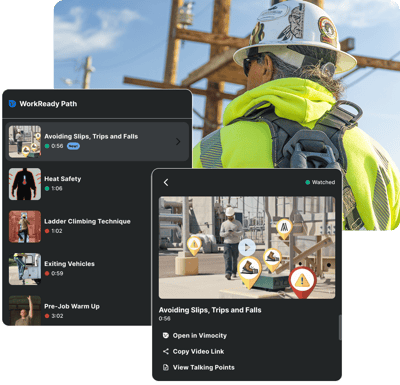
Discover how Vimocity can help keep your crews WorkReady.
One comprehensive platform to help safety and operational leaders prevent more injuries and incidents.