
.png?width=20&height=24&name=Vector%20(15).png) For Leaders
For Leaders For Workers
.png?width=24&height=23&name=Vector%20(16).png) Partners
PartnersThis Gear Could Save Your Life: The PPE Wake-Up Call
WorkReady Podcast Episode 11
-
Speakers
Dr. Kevin Rindal | Vimocity
-
View The Transcript
In the trades, your PPE is sometimes all that stands between you and a life-altering injury.
If you have to use my stuff for what I built it for, it's arguably the worst day of your working life. With over 25 years of experience in protective clothing, Derek Singh breaks down how mistakes happen and why building a culture of accountability, not enforcement, means everyone goes home safe. We want to fit in. We don't want to be the odd guy out where the leadership is dialed in. Everybody else is dialed in 'cuz they're going to emulate what they see. This is the WorkReady Podcast.
At the end of the day, it's not just about getting through another shift. It's about having enough left in the tank for your family and building a career that lasts. That's why we created the Work Ready Podcast. If that's the kind of life you're working towards, subscribe and walk this journey with us. Every episode is one more step towards retiring strong, not broken.
Hello and welcome to the WorkReady Podcast. I'm your host, Dr. Kevin Rindal, and today I'm joined by Derek Sang, a leading voice in the world of flame-resistant protection and safety education. Derek's helped thousands understand not just what to wear, but why it matters. I'd love to hear a little bit more about who Derek Sang is and walk us through your athletic career and what brought you into the world of FR here.
I think first and foremost, athletics teach you grit, teach you determination, teach you resilience, uh, and there's a natural bond to folks who do that professionally. And when you look at the folks uh, that power our world, and that's who we protect. We protect those that power our world. If you look where our shirts, pants, and coveralls go into as PPE, it's in oil and gas. It's in refineries. And uh, our subject matter here today, specifically, our line workers, our utility workers, those that uh, keep the lights on. So you look at the folks that are successful in that space, they they have a common foundation. And I think it's easy to see uh, grit, resilience, uh, adaptability, uh, be able to think on the run to have a general idea, uh, a playbook, so to speak. And I think we all we all have those. And when we go out into the environment, I think all those things that make athletes successful uh, also make those that power our world successful. So there's a natural uh, connectivity there. I think um, I know you've seen me present a couple times and I definitely relay that athletic background as kind of a a connection tool, even though that my my kids are more than happy to remind me, "Dad, that was a hundred years ago." and I try to tell them, "It was only 35." But if you look at it in the context, if if you were looking 35 years in the past of when I played in the in the late 80s, early 90s, you'd be going back to leather helmets and no face masks. So, I use part of that evolution when we talk about PPE, especially in the football environment. Uh, you look at all the things that we've learned and how things have evolved, uh, from shoulder pads to helmets to cleats to surfaces, all those those things that we've learned about. Um, what's the connection? Unfortunately, we've learned about those by giving people lifelong injuries or having to deal with stuff. Well, long after they've retired and and the parallel is is uh, you look at our retired line workers from 10, 15, 20 years ago and you can see the limps, you can see the aches, you can see the the elbows that don't work so good, the shoulders that aren't as flexible and and that directly correlates to uh, especially my peers when we sit there and talk about how the aches and pains are every morning when we roll out of bed and it takes us a little bit longer to to warm up every morning. That's our line community of the same time period. So when you and I delve into what can we do better today? Well, we've got we understand ergonomics. We understand uh, the limitations of the human body. We we develop better uh, equipment to do things easier to protect us better so that when we do uh, get to the end and actually while we're in, we're nowhere near as banged up uh, as we used to be. Uh, so I do see a lot of promise. I do see a lot of things that have changed. I look at where where you folks are and and bringing into that, you know, just the whole musculoskeletal approach to longevity. I mean, here we are. We we ask these guys to get up on, you know, the crack of dawn in the middle of a storm, throw a whole bunch of PPE on, climb into a fall harness, and work 30 feet up in the air when the wind is howling and the all that stuff. And then you you wonder why that they, you know, they don't feel great five, 10 years down the road. So how can we mitigate that? Uh, we've talked about extending careers. Uh, one of the things that we touched on, I mean, investing in your people. What it takes to get someone to be a journeyman lineman, all the skills, all the investment, everything. And if you could extend that career 5 years by nutrition, better uh, understanding of their musculoskeletal system, utilizing all their PPE, lighter, more efficient PPE, so it's not as strenuous. If I can get five more years out of every single line worker with all the needs that we're going to have in the next 15 to 20 years, wouldn't that be beneficial? So, you take an extra 10 minutes to warm up every morning. Uh, you put an extra x amount of hours uh, in the week to take care of themselves uh, to hydrate, to do all the things necessary, it can't be anything but beneficial. So, I think there's a lot of parallels in in what we talk about. And some of it may be, I don't know, outside of what people would normally stereotypically think what those boundaries are going, why is there a PPE FR guy talking about longevity and talking about prot, you know, musculoskeletal stuff? Because it all it all adds up. I mean, I talk about, you know, my 20 plus concussions, and people are always shocked because we didn't have concussion protocol back in my days. It was smelling salts and get your butt back on the field. That was your concussion pro. If you got to play off to get your head right and coach said, "How many fingers?" And you always said two, 'cuz he told you, "I'm always going to hold up two fingers." So, just say two. That was concussion protocol. Could you imagine? Here we are 35 years later, you know? Could you imagine trying to get that past the medical staff? No, you wouldn't even think about it.
So, give us the details on on your playing career. You played for San Diego State. Tell us a little bit more about your position. Sure. Uh, folks always think, you know, and it's it's it's a nice compliment. You're a tight end. Well, yeah, I'm 235 lbs now today, which probably is not even a pro tight end weight, but believe it or not, as a 300 lb offensive guard back in the day, pulling around the corner, trying to find targets in the middle of the field, uh, doing all those things that you you see on Saturdays and Sundays, getting in people's way, and trying to stop other angry human beings from getting to their uh, success, which was either knocking down my running back or taking out my quarterback. So yeah, that was that was pretty much it from the time in high school all the way through till it uh, it finally ended. Unfortunately, I had a career-ending injury in my it didn't catch up to me till I got my my try out, but it did limit my capabilities at my try out. I ended up having a career-ending neck injury back in the day. So, yeah, that was uh, 10-year investment like a lot of folks and kind of gone took me down a different path. Uh, so yeah, somehow I ended up in this uh, very niche, very cool little place in the PPE world that when folks asked, "Well, how do I get to do what you do?" and there is no road map. You know, I went through I never worked a day in my career. I walked into a counselor's office and go, "What is the fastest degree I can get and get out of here?" And uh, the goal of that time was then got into sales uh, ended up uh, migrating into uh, arguably the top uh, uniform supply company and renter of work apparel in in uh, the US. Did that for just a little over a decade. Kind of got my uh, foundation there. And then someone introduced me to this FR piece way back in ancient times. I mean, where we are today to compare it to 25 years ago when I started, we had about five fabrics in my day. You had the two FR cotton 100% and 88/12. You had an import from uh, Europe, Carmemell. You had DuPont's NOMEX which dominated the market. And then you had this stuff called PBI Kevlar, which you don't see in garments anymore today. Where you see that primarily is the outer shell or firefighter turnout gear. So those were the five things we had to play with. Uh, we worked in oil and gas and we worked in the steel mill. That was it. I mean, if you remember back to watching Rudy and all those guys running around when he was working for his dad and his brother in a steel mill and they had all those green kind of shirt jacket things on, that was the secondary market. And then the primary market was our oil was our oil refineries. Other than that, no one really used FR. And it wasn't until 2000 when NFPA 70E said, "For our folks working on energized electrical equipment, you need to be in FR clothing," because that was the term at the time. Uh, 2012 that terms changed to AR, arc-rated clothing. And then it wasn't until 2014, it wasn't mandated into our line workers until 2014 to where the final rule went through some revisions. FR was going to be a big piece of that. And then it finally came down in 2014, April 1st of all dates. Okay, that's April Fool's Day. They announced that the outermost layer of your garments working in and around energized equipment, you had to have your correct PPE on. So, we're just been a decade plus now in our utility workers where it's been mandated. There was hybrid forms before that. Uh, the biggest thing obviously you're allowed to wear was cotton. No meltables. That makes absolute common sense. The downside with cotton is it will insulate up until it ignites. Once it ignites, it's going to contribute to injury. So, it was a really weird concept back in '94 when they wrote that before they changed it. So, the hybrids we had were cotton jeans and lightweight. And at that time, the most common was FR rayon shirts. Okay. At least they would self-extinguish. They weren't protecting you to the incident energies because we didn't even talk about incident energies back there. But making sure we put ourselves out was good. Unfortunately, in the lower half, you're wearing fuel. So, along with a lot of research back in the 2000s with KMED kind of started it off up at KMA Labs doing the very very first live arc flash uh, testing visually with dummies in or excuse me, mannequins and buckets, mannequins in in underground vaults, mannequins up against equipment. Uh, West Texas at that time uh, took over and did a whole bunch of low-voltage quote unquote stuff. That continued now with our folks at Tindale. Scott Margolan and his team still do a ton of work out there helping educate our electrical workforce against the hazards because people knew of folks that were getting in arc flash hazards. I mean, there's probably on average you can look at 3,500 or so arc flashes every year. You can say about 600, less than a thousand that cause injury. The fatalities at that time were pretty high, probably, you know, 100 plus. Uh, we've got that way down. We're still having arc flashes. We're still getting people hurt, but the fatalities are way down because the PPE is better. Uh, back in those days, you were catching fire. Uh, one of the common misunderstandings or uh, misinterpretations is is people think you wear my stuff, flame-resistant, arc-rated clothing to protect against arc flashes because that's the hazard. Well, that's not the hazard. That's just the ignition source. In a fire, you need three things: oxygen, ignition, and fuel. Well, we have tons of oxygen, thankfully. Uh, we have this huge ignition source, and then we had people wearing fuel, and that time the fuel was was cotton. So, what the hazard is is catching fire and continue to burn because that's ultimately what causes catastrophic body burn, which leads to a whole bunch of complications in the burn unit, which ultimately leads to potentially fatal. So you have an ignition source that can cause a fatality by you wearing fuel, which is the other piece of the triangle. So we have oxygen in the air. We have a big ignition source, and here I come wandering into the to the ignition source wearing a big cotton blanket. We have you're basically a candle wick. That's what causes massive body burn and that's what ultimately leads to potential fatality. Take the fuel out of the equation. You no longer have a fire. So, by self-extinguishing at its core, you now have a protective uh, equipment, personal protective equipment that I wear into that potential ignition. I don't catch fire. I mitigate those injuries. Little or no chance of fatality from body burn. Now, there are some extenuating circumstances. There are some strange things that can happen. Vaporized copper can get in our lungs. Vaporized copper can get in our eyes. There's lots of other injuries that can happen. But the vast majority of all fatalities from ark flash were clothing ignition, a.k.a. body burn situations. So if I can mitigate that, if I can virtually eliminate that, if I can take third degree down to second, second down to first, first down to none, if I can take 60% body burn down to 15% body burn, you can see how my chances of survivability are going to dramatically increase. And ultimately at the end of the day, that's the simplest of why you wear this stuff and how it works and how it kind of got into where we are today. As a safety leader, you have more risks to cover than hours in the day. That's where VIMOCITY comes in. We give you one platform to scale your impact. Delivering expert curated safety campaigns on everything from slip, strips, and falls to heat stress and soft tissue prevention. You'll reach every crew through the channels they already use while gaining data insights to guide smarter prevention. With VIMOCITY, you can boost awareness, prevent serious incidents, and keep your workforce ready for the job. Scan the QR code or visit vimocity.com to learn how leading utilities are cutting injuries by 50%.
That was the part that really stood out to me when I heard you present for the first time. For some reason, I didn't put two and two together of the fuel source being the clothing was the main reason uh, from a protection standpoint. You didn't want that fire to continue to burn when you're someone was exposed to an arc flash. You go all around the country uh, speaking on this. When you speak to groups, especially linemen or people in the electrical trades, do you think that people understand the full picture and the reason why behind the why behind uh, wearing the proper PPE when it comes to uh, working in those high-hazard environments or is that something that you you feel like even when you go and give those presentations, it's it's new information for some of the people? I would say 99.9% of it is it's all review. It's all refresh. Uh, we're not taking anything dramatically new that their internal folks, their their own safety folks, their supervisors, the people that now understand and are protecting them on a day-to-day basis aren't already saying. But how I talk to when I go, "Well, why should we have you, Derek? We talk about ARC flash PPE all the time." My my correlation or or my oversimplification is is, "How many times did your dad tell you not to do something and you did it, but your coach told you and all of a sudden you came back and go, 'Well, why are you doing that?' 'Well, coach told me.' 'Well, I've been telling you that for two years.' You know, when you get, you know, square up over the plate, swing the bat this way, you know, straighten out," and you refuse to do it, but here comes in this third party uh, that all of a sudden has a little bit of cache 'cuz they stand on a stage and they're elevated and all of a sudden there's a little bit more go and they go, "I I never knew that," or, "Yeah, you you know that 'cuz you're you're they've been telling you to button up your FR and they've been telling you to roll down your sleeves ever since you got the stuff," but somehow hearing it from a stage from a third party has a little bit more emphasis. So it's a way of complimenting the message. Uh, we're not striking new ground most of the time, but it's just another voice. And when you can impart that uh, message in a in a in a completely different way, here, here's a prime example. I talk to folks all the time and when I talk to my utility workers, I go, "You're some of the, you know, the brightest and smartest that we have to be able to think on the fly, do math on the fly, do algebra on the fly and figure out everything else and where to safely put your bucket truck and everything and look at erosion and test poles and the 90 things that you have to do just in order to get 30 feet up in the air. You're some of the the smartest people that we have. Secondly, in order to do your job, arguably the most important tools you have are this one and this thing. Look at the fantastic engineering that is in this piece of equipment. Now, let me ask you, how much skin do you have to sacrifice before you're into muscle and bone?" I go, "'Cuz once you're into muscle and bone, for our triage folks, for our folks that work at our burn centers, if you come in with fourth and fifth degree burns, which are muscle and bone, they're the easiest for them to triage. They simply market for removal. So, if you don't have a lot of depth before you're into muscle and bone, how long before this tool is no longer capable of doing what you need it to do?" So that's when we we correlate that into your arc flash clothing, your rubbers, your leathers, your hard hat, your your safety glasses, your hearing protection. All these things matter because at the end of the day, they're preserving your ability to do what you've been trained to do. And rubber gloves with leather protectors are very insulative uh, because they have to be closest in many times to to that arcing fault. If I'm telling you that arcing fault is 5 calories at my chest, what is it when I'm hands-on? It's a heck of a lot more. But we haven't calculated for hands-on. But thankfully, these uh, rubbers and gleards are up to 50 plus calories before they start registering any kind of damage that could potentially correlate to to that that hand. But imagine putting that hand in there unprotected. I mean, when we take that that rubber and leather ensemble and we take it under our arm and we slide our hand out because we don't have the dexterity to do our job for that, "Oh, I'm only going to do it for a couple seconds." That's what we want folks thinking about. Uh, I had an incident uh, very very similar. We had a pad mount transformer. We were working on it. We were in our arc-rated clo. In fact, the gentleman that got in this incident had just gone through our training. He had his Arc Raid shirt was tucked in. It was buttoned up, sleeves rolled down, rubbers and leathers in the equipment. But guess what? There was no overhead hazard. It was outside. It was a sunny day. Guess where his hard hat was? In the cab of his truck. Guess what he had on his head? Your ball cap. He ended up in a burn unit with third-degree burns from his melted ball cap. Imagine. Imagine spending all that money across all those wares and making that that one simple mistake. And that's some of the stuff that we talk about that people don't directly think about when uh, the the flame-resistant arc-rated clothing guy comes in to talk. We talk about the ball cap on the head. We talk about the hoodie that we're wearing under our approved. It's in our catalog. Very expensive 40 cal brown duck coat on a cold day. Well, what's that hoodie that's sitting on the back of our head? Did we just grab it off the back of the door? Is it something that is not part of the program, but it's a little bit more insulation today 'cuz it's a tad colder than it was yesterday? Well, on the surface, that doesn't sound like it's a huge deal. I got this very, very protective coat. Well, first and foremost, that hood is on the outer layer. It's on the outside. Needs to be flame resistant, arc rated. Secondly, what do we do or what are we taught to do or when we think about cold stress that we don't talk as much about as we do heat stress, but on a cold day, what's the one thing we don't want to do? We don't want to sweat. So, when it goes from minus 20 to plus 10 in the afternoon, what are we taking off? That very protective outermost layer. Now, do we remember that that hoodie underneath is non-FR? It's just like simple things like those those little little nuggets that we want them to take away. So, back to your original question, why why do folks that talk about this stuff on the regular, why do uh, journeyman linemen who have been, you know, on the job for five plus years and are very well entrenched in all their safety stuff, why do they need to listen to some third-party folks? It's the taking away of those tiny little nuggets that we have learned from other folks that do their job where they made that one little mistake that resulted in unnecessary injury that could potentially uh, shortcut or cut short that 25, 30-year career to where now they're having to be retrained to where now they're they had built a lifestyle around their income level as a 10-year journeyman lineman and now they're going to have to be retrained on something that's not going to compensate them anywhere near that level and all that ripple effect as we go on. So, if we can get someone just to take a step back and just think about something or hesitate when they go to remove some PPE because it's cumbersome or happens to be in the way or it's too hot today or too cold today, whatever, whatever the mitigating factor is that they're going to communicate to their safety person on why they did something unsafe. Let's stop that process so that that conversation never needs to happen because they they thought twice. So, long-winded way again of saying what we talk about or what I talk about necessarily does focus and does talk about that, but you're actually talking about much broader things. You're actually talking about something a little bit wider and a little bit deeper because everything you're saying correlates to all the other PPE that that they need to interact with on a day-to-day basis. Whether it's making sure your gas monitor is calibrated, whether it's making sure that your uh, your fall harness, that all your straps have no rips, frays, and tears, because we bring that up and we talk about taking care of your PPE and and taking care of your flame-resistant arc-rated clothing. I tell people all the f time, do you allow rips, tears, frays on your fall harness? Do you allow your fall harness to have a faulty D-ring? Absolutely not. But we allow rips, tears, frays, holes, buttons missing, snaps missing, Velcro missing on on our flame-resistant arc-rated clothing and don't give it a second thought. So, I'm not asking them to, you know, to treat this stuff like it's, you know, like it's crystal and they have to be ultra safe, but I'm saying give it a second thought. When you've got two, three holes in a garment, get it replaced. When you've got a big rip, get a new shirt. So again, trying to make those parallels outside of shirts, pants, and coveralls and where it connects with them and try to go from there. Man, so many great uh, recommendations there. As we're you're going through that, I just kept thinking of like an airplane pilot. You know, you have so much going on in your head before you go out there and do this critical task. What is an easy checklist that someone can go through in their mind to just make sure that they have all the boxes checked? Because like you said, oftentimes it's just one of those things. I need to throw in an extra sweatshirt and you you just don't think about that or the I just need to take off my gloves so I have a little more dexterity for 20 seconds, but it could be that 20 seconds that um, you know, bad things happen. So, what is something that somebody can do from a personal accountability standpoint to just uh, have that checklist? Easiest thing to do with our stuff before you put it on, just a simp it's a don't overcomplicate. It's a simple scan. Scan the front, scan the back. Check that you've got all your buttons. So, integrity. Are there rips and holes? Secondly, fasteners. Are all my buttons, Velcro, and things intact? And then fit. Uh, believe it or not, we don't want it tight because air gap is a great insulator. We don't want it super loose that it's a hangup hazard, too. But that that there's a sweet spot in between. So, as you get bigger or garments get smaller, make sure that that they're fitting comfortably. Again, with what you're required to do on a day-to-day uh, basis, no one wants to be fighting their their shirts and pants. That leads to fatigue and other things. So, make sure they fit correctly. Make sure all your fasteners are in shape and make sure the integrity of the garment is able to so that you can tuck, button, and uh, sec roll and secure and you're good to go. How do you create a culture of accountability that doesn't feel like somebody's constantly looking at you trying to enforce rules, but instead holding each other accountable? So, I'm just thinking of like a foreman or even a safety professional when they see somebody who's maybe not wearing PP like air clothing properly, how can they create a culture where there's that personal accountability so that they don't feel like they have to be policemen? That's a great question. Uh, one I don't think I have the gray matter depth and width to give you a full answer to that because uh, I remember back when I was learning this stuff from uh, Darren Llewellyn who was uh, Llewellyn Technologies, he was my kind of mentor in this, and he told me a couple things. He goes, "One, uh, the hardest thing to coach on, the hardest thing to to get is culture. You can't put it in a box. You you can't deliver to somebody. It is it is the single the hardest thing to do." So to answer your question, I'm a big believer in setting the example and and this usually resonates to when when you first came out of whatever academy you're in, whatever training academy, whether it's fire, whether it's police, whether it's a military branch, or if you're coming out of a line school, you've been told by your instructors, "This is how you're to show up." So, you show up day one and you're you're suited and booted. You got your brand new Redwing leather boots on. You've got your arc-rated denim. You're tucked, you're buttoned, the appropriate belt. You're you're I mean, you are a poster child. And you walk into the line room and they're unbuttoned, untucked, laying back, hard thing. How many days do you think it's going to take you before you look just like them? Because the number one thing for human beings is what? We want to fit in. We don't want to be the odd odd guy out. So flip that. If you walked into a squad room, if you walked into a firehouse, if you walked into your your barracks coming out of OCS or wherever and everybody was booted and suited and singing from the same piece of music, you're going to fit right in and everybody's tight. So that tells me that as a supervisor, as a foreman, as anybody who has a lead position, whether it's by title and or tenure, look the part. And all those young people, all those new people to you, everybody will look the part because all I got to do is look at how my leader looks and guess who I want to emulate. There's very few organizations that I've seen or that I've been part of where leadership is dialed in that I have to worry about how everybody else is dialed in because they're going to emulate what they see. And so so does the opposite. When you see unsafe habits and when you see people just saying to themselves, "Oh, we only put it on when we need it." Good luck with that in an arc flash. I mean, that's like saying, "I only clicked my safety belt right before the accident." Okay, we The safety belt analogy to me I probably used since I first got into this uh, role because it's the most logical for my very very simple brain. I'm going to click my safety belt from the time I was 15 to the time I'm 75 and off the highways 100, 200, 300, 500,000 times. How many times am I going to use it for what it was built for? Hopefully none, but I'm definitely not going to be able to just to snap it right before I identify, "Here comes the hazard." So the correlation is is I wear my flame-resistant arc-rated clothing exactly the same way every time to what? Maximize its performance, mitigate my injuries because in the off chance that there is an arcing fault, I've done everything I can do to make sure that I get home to my family. Number one. Secondly, that I still have a role in the career that I have that I have built uh, with no intent to ever have to use it. So again, I want you wearing it, but never having to use it for what I built it for. I tell people all the time, I build life-saving pieces of equipment that just happen to look like shirts, pants, and coveralls. And if you have to use my stuff for what I built it for, it's arguably the worst day of your working life because what I built it for is to save your life in that extreme thermal event. Now, that being said, the only way it can maximize and do all those things, I have to be suited and booted as if it was going to happen and trust that we're doing everything to make sure that it doesn't happen. Just like driving in that car, I am doing everything. I have the latest technology. I have uh, everything else going for me, my defensive driving. I'm scanning. I'm not distracted. My phone's turned off. I'm doing everything to make sure that I can get to my destination safely, but there's always that X factor that that there's that unknown. There is that car that careens and spins out of Corolla, jumps the divide and literally lands right in front of us and there's nothing I can do. Well, that safety belt now is saving my life. Even though I've done everything else correctly, there's always that X factor. And that's what we wear it for lots of times. We don't wear it for knowingly going into an accident or knowingly going into a thermal event. That's what firefighters do. Firefighter turnout gear is built for knowingly going into a thermal event. They don't wear that turnout gear back at the station. They're kicking back. Until that claxon goes off, there's no PPE involved. Now, the claxin goes off, they're dawning it, and they're out the door and they're going into a thermal event. In our industrial world and especially in our utility world, we don't knowingly go into thermal events. Believe it or not, arc flashes aren't supposed to happen. They're accidental. So unless you can predict accidents, it's very, very unlikely that you can put it on when you need it. That you'll button it up when you go up into those energized lines. And we know that they don't because we have all these statistics and we have all the injury data to show that you don't. The one cool thing about thermal energy is it's easy for forensic folks after the fact to tell you what you weren't doing. If you were literally burned from your elbow to the top of your gloves, you can't tell me you had your sleeves rolled down. If you've got second-degree burns and a big V-shape on your chest, it you can't sit there and tell me you had your Arc RA shirt buttoned all the way up. So to my point is is again we want to make sure that we're doing everything right because these are unpredictable. One of the things that I appreciate about your communication style is uh, communicating the bigger why. So if again, if I'm a foreman on a crew and I want to move from enforcement to encouraging others to to take personal responsibility. Why is communicating the bigger why of wearing your PP properly so important? Well, again, the the the goal, I think, on any safety program is to get me home the same way I came to work that day. Good, bad, or indifferent. Everybody comes to to work as a mechanism to provide for what their bigger why is. I mean, that might be their family. It might be their kids. It might be their grandkids. It may be getting so and so through college. It may be getting, you know, the wife through culinary school. It may be a lot of different things, but it's going to be different for everybody. But it's definitely I'm not doing this at the end of the day to ultimately have something that is career ending or possibly worse, life ending. So when we look at why and when we look at all the protocols that we have and we can argue whether they're overcorrective or whether we shift in a certain degree, getting that a lot of that is noise. What's the goal? The goal is for my organization to do everything possible to get me home the same way I came. And then it's my responsible to do everything within there to maximize what tools I've been given and what guidance I've been given in order to do that. So, I and and I do think there's been a shift and I know that you've seen this as we look at the next wave, the next generation, the next nuance. Work is a tool in order to accomplish whatever the lifestyle I want to have is. It's a mechanism to provide the funds in order to do that. So, I want to be able to ride my ATV on the weekend. I want to be able to go see the kids. I want to go hunt. I want to go fish. I want to, you know, be able to be a playwright. Whatever you may want to do. I don't want anything in my day-to-day to impact my ability to do that. So, I see a shift in consciousness towards the PPE. But you've hit it on I have to know the why, especially with this the new generation coming in. Back in the old days, it was wear this. Because when I if I did this presentation 10 years ago, I would have had people walking up and going, "That's the first time I've ever heard anybody explain why I need this stuff." I don't get that anymore. What I get is, "Thank you. That was never heard it that way before. That was great. That really connected with me. I understand a little bit more, but I don't have the, 'Hey, I was just handed this and told to wear it.'" So you're seeing that shift and I think we are we're responding as a safety platform, especially when I see the next generation of safety folks coming in to deliver the message. The message is in and around the why. It isn't it is in and around what the greater is because it's not just this is what you do to do the job well. Okay, that doesn't correlate with, you know, our 25 to 30 year olds today. I mean, it barely correlates with the 30 to 35s. They just kind of tolerated it. But in today's world, you really really, and this is where I see my safety communicators, those that are in the management roles, that are in the director roles and that, and I really see them shifting because the tonality of a safety meeting today when you get introduced in front of the team to talk about it, it's always about, hey, remember this is we're bringing these people in. We're bringing in these subject matter experts so that you can better understand what we do and how important you are to us at the end of the day. So you can go on for whatever your why is at the end of the week. Right now we have like three generations in the workforce and as you mentionedBridging Generational Gaps in Safety Communication
you know the most experienced generation, they were some of that just rub dirt on it, just get out there, work. We don't talk about our feelings. And then you've got, you know, the 18 to 24 year olds coming out who have just been raised in a totally different environment in a social media based world where everything is instantaneous and it's short form. What are some of the things that you have found effective for communicating and kind of bridging the gap between those three generations? That's a really broad question in in in the sense of how do we as folks that are in my demographic communicate to folks that are in your demographic who then have to cascade it down into the next demographic. Uh, the toughest thing is, and I think we're we're bridging the gap in a lot of what we're doing here right now today, in podcasts, in in shorts, in in LinkedIn, in Instagram. I'm seeing a lot of quote unquote influencers who are still hands-on in the trades disseminating a lot of that information now into that 15, 30 second, no more than a minute uh, format so it can be consumed and so it can can be understood. Uh, I do think there is obviously a a lot of value in those extended contacts in front of folks, but the hardest thing is is for folks like myself who have had, believe it or not, 61 trips around the sun now. How do I package my message that's going to be 45 minutes to an hour, in some cases 90 minutes, to where we can keep that attention and keep those talking points relevant. And that's why I think it's so key for presenters and instructors and trainers to stay as relevant to their audience a as possible. You know, in in my particular case, and this may not be the best answer for your question, is trying not to have death by PowerPoint, trying to have, you know, enough variety of media within there to where someone gets a nugget. Uh, I don't think there's any perfect format. I think it's very very difficult and challenging to take that uh, you know, that veteran who has seen everything onto his safety and/or superintendent who may be a generation below him but he chose to take a leadership path where where our veteran never wanted to be in management. So we have those two, and then we have just, you know, I just got my journeyman ticket. And I'm coming out and I'm still, as the old saying says, white wet behind the ears and I'm just happy to be here and I'm all, "Just tell me what to do. I'm ready to go." And bring all those together and that's why it's not easy. I mean, anybody that thinks that there is a boilerplate solution to uh, safety and/or communication, that's why I think it's necessary to bring other voices in. Uh, how how you communicate, how your colleagues communicate, how I choose to communicate is different than than my peers and those that are doing very very similar. Uh, I look at uh, the folks in in our space, the Jason Brozens, the Brandon Schroers, who are bringing their message because they actually had an incident, got hurt, survived and have have a tale to tell. Well, there's that piece, and then there's a quarter century of me being in it, and it's that piece. And I think it it takes all formats and uh, the hardest thing of course that that you hit into it is how how do I create that team dynamic? The first and foremost thing as a as a as a dad and as a grandpa as dad is I go get that handheld device out of the crew room. Get that handheld device out of, you know, I if we're traveling somewhere, these things are locked up and we're talking and we're talking about the job and we're talking about the challenges and we're talking about the last job and what we need to bring to this job. The worst thing we can we can do in my opinion is allow that little black device that we can hold in our hands to be the primary teacher. The toughest thing, and I go, you've seen the numbers. We are losing three to one right now. For every three that are retiring, all that knowledge base that is leaving our utilities, we're replacing with oneThe Future of Trades and Workforce Challenges
right now. Uh, the staggering numbers I just heard is we have globally, we have 10,000 data centers. And I know up where you are data centers are a big thing, right? We're going to need a 100,000 data centers just to deal with all the AI and all the other requirements that we're going to have. Well, who's laying the foundation? Who's putting up the frame? Who's dropping in the plumbing? Who's who's wiring it? And then who's maintaining it? And who's educating on all this stuff? And who's going to bring all those resources? Where are they all coming from? Because it's great that you want to do all these things. And I tell you, robots ain't going to be close to doing it. Not where we're not where we're putting these things in remote isolated areas. Then how are we going to power them all? Well, there's folks now talking about these micro reactors. We can pop those in in all the remote places on the planet and we can run 10 data centers side by side. Okay, that sounds great. Then they're talking about the water needs on that. Now, how are you going to plumb it? Where are you going to get all the water? How are you going to get all the AC to work in this place to keep all that stuff cool? So you start looking at that chain reaction. If A then B then C, by the time we're down to having a fraction of what we need, how many electricians is that? How many plumbers is that? How many concrete foundation builders are there? So I mean, I had, as silly as it sound, I had three of my friends whose whose kids are a little younger than me. They're like juniors, freshman, sophomore, juniors in high school. I go, "Put them in the trades tomorrow." I mean, the second that they have a chance to get into a trade school, their university degree is always going to be there. You can go get that at 40. You can go get that at 45 if you need to check that box. But between 18 to 22, get yourself a trade from 25 to 35. Go make six figures minimum a year. You've got no student debt. You've got a house. You've got all, you know, that that is the re revitalization of the American dream. It's literally sitting right in front of us because the trades are we're retiring out more than we're bringing in. And robots. Yeah, you can have a robot welder in a manufacturing facility, but you can't have him offsite 200 miles away from X, Y, and Z. That's got to be an actual hands-on, you know, welder. Well, you're spot on, though. I mean, everyone talks about AI taking jobs, but when we look at the trades and the needs to support AI, I mean, that's one of the greatest opportunities I think for this next generation coming up. So, definitely I I'm very well aligned with you. We we've got to be pushing uh, the next generation into the trades. So, Derek, you you get asked to speak all the time. I mean, you're you're on the road. It seems like every time you and I connect, you're you're heading somewhere. What are the when you get those invitations, what are those companies or organizations wanting? What's their pain point for why they're bringing you in to speak to their crews or to their company? Uh, what are the problems that you're helping them solve? Uh, I think it it it dovetails or circles back into having an alternate voice. I I do think there is I do have the advantage that folks want to train on this particular hazard every couple to three years. So there's a lot of folks now 15 years into this with with Bulwark. I've got I I get a lot of folks that you know, "Hey, keep coming back." I'm on that three to five year rotation. And then a lot of it is folks who have have heard me at conferences want to get that that message into their team. Uh, I think everybody is anxious to learn. Everybody's anxious to hear it from a a different perspective. Uh, everybody's looking to we have 12 safety meetings a year. I mean, you we have 7,000 utilities give or take across the N. That's a lot of spots where folks would like to hear someone else bring some information. Whether it's the fall safety guy, whether it's the uh, you know, the boot guy, whether it is whoever it is, there's lots of opportunities uh, in our space uh, to get that message out. And as long as you're bringing the message that it's I tell folks all the time, I don't I have a strong bias. I would love to see as many triangles in the field as I can, but at the end of the day, get good stuff, take care of it, wear it right, and it'll take care of you on that unfortunate day. At the end of the day, there's a lot of good companies in our space doing a lot of things right that are going to protect folks if if things go wrong. And I've got no problem problem sharing that. Uh, when we first started this role and when I was first given uh, the ability to implement my vision because when I came on I was a regular business development up and down the coast sales guy and my goal was to sell as many units as possible and I happen to have a supervisor boss at the time said, "Well, what's your vision?" I go, "Well, I'm a coach at heart." You know, like they said, "If if you if you can't make it, teach it." So, I didn't ultimately make it. So, I love teaching it. And uh, with that said, I I had a vision of raising the tide so that all boats rise. And I think that servant kind of leadership mentality uh, that's talked a lot about in our space today when it comes to folks who uh, are giving of themselves when they're I mean, and you talk about it, it's out on the road. It's I mean, I've got 36 36 events already confirmed for 2026. Uh, I went through this year with 52 and something. I've got colleagues that have a lot more than that. And when you are giving of your time and you're taking that away from wherever you quote call home, there's a certain amount of sacrifice is a strong word. I think people like to use that. But there fundamentally is if it's in the truest sense, you are giving up something in order to do something else. You have choices. I could be doing something completely different than this, but I choose to do this. Regardless if it is X amount of flights a year and 80 plus nights in a hotel and all those things to get the message out because I think our goal is is when we see the when we see the devastation that these events can have either, even if it's just injury, even if it's just, "I'm down for 6 months and I'm slowly coming back," it's the hours and hours that the family spends at the ICU and been unfortunate enough to spent 12 days in ICU. I know for me those 12 days flew by. My wife and kids and my friends had 24-hour v uh, uh, visuals at my bedside and in that hospital while I drifted in and out of 13 different operations. You look at folks that go through that, that ripple effect that it has on the family, friends, every person that's affected is a brother, sister, son, daughter, aunt, uncle, nephew, whatever the case may be. Uh, anytime that you've ever seen, whether it's firefighters, whether it's uh, police officers, utility workers, anytime any of them are injured, you see that gathering and there's there there's no room for anybody to sit. There's literally hundreds of bodies going in and out there because Joe's hurt. And that camaraderie that that that that family that that that sense uh, and having it disrupted by something that could be mitigated or something that could have been changed. I think that's what drives all safety folks at the end of the day. They don't want to be that safety guy in that waiting room. And I think when they put their heads down at night, they want to know that they've done everything possible so that that doesn't happen. And when they look to the field and they look at subject matter experts that can bring and echo that message because when you boil it down, what what I'm talking about and why I'm talking about it is at the end of the day it's get you home safe, mitigate any potential injuries and god forbid if the worst thing happens, we've done everything that we can so that the end of the day I know I did everything within my ability to mitigate that. And I think that's what I want I don't want to say haunts, but I think that's what sits underneath the surface of every safety professional, everybody that's involved in PPE, everybody that's doing things from the big picture is I don't want I don't want that to happen to anybody. I don't want any parents to have to worry about their their their sons and daughters. I don't want any wives and kids to worry about mom and dad and significant others and all that that ripple effect. I want that to be as mitigated as possible. And I think that's what drives me to be on the road all those days, to be in those hotels away from my wife, kids and my now my eight grandchildren. Uh, I think that's what keeps me on the road.Derek's Personal Drive and Gratitude
Derek, if we were to go down one layer deeper, what is your driving purpose in your life and what has been the thing that has guided you uh, over the course of your life?
I think I I I think I've hit uh, on a lot of it. Uh, and I know you said get a little bit deeper, but but as I think about what we've said up to this point and and I think again what connected uh, you and I together is I think we saw some parallels there in uh, whatever your greater calling is. Uh, whatever that voice inside you that drives that spirit to put yourself out there and uh, be a voice uh, be a voice in in a space that that that makes a difference. Uh, I think it, however you want to look at your score sheet, however you want to look at your tallies, uh, when everything is said and done, when when you hang up when you hang hand hang up, you hang up your shield, you hang up your armor, and uh, you walk off that field, whether it's your helmet, your shoulder pads, whether it's your duty belt, whether it's your, uh, climbing gear, your fall harness, no matter what your role is or or where and what you went to. I think at the end of the day, you just want tally sheet to be a positive. Uh, people talk about legacies all the time. I I don't know what that means. Uh, I don't really have an understanding of what that is, but I just like to think that uh, intrinsically you've made a difference. I think that uh, walking with purpose, engaging with purpose, uh, I don't know what else I could do other than actually be hands on the ground in a much more forward-facing serving role. Whether that's fire, whether that's police, whether that's military, I'm kind of that two or three levels down. But I think I I have the same mindset. I think I have the same uh, the same heart and goal is to uh, to have something that was greater than me, something that was bigger than me. How can I magnify what I have intelligence-wise, what I have knowledge-wise, put that with the same grit and ambition and everything that dragged me, you know, off the high school fields in a small school up in Burnaby, British Columbia, to where I was sitting in, you know, starting every game in a D1 college, which I didn't realize was that big a deal. I mean, I it wasn't until much later and it was took a lot of other people to explain to me going at that time there was 103 Division One schools. There was only 515 starting offensment in the hall and you're one of them. And I didn't see the world that way. I didn't realize what that was. That was just I I came down here with a per with a goal and an ambition and I was going to work as hard as I could to make that happen. And I was fortunate enough that it did. Uh, so with all that, how do I take that drive and then that ambition and go into a workplace and not give back and not be thankful for everything that I've had? I mean, I look at this marketplace and I look at my line workers and I look at those that power our world and I look just how much they've given my family by me being able to help me help you in a very very small way. And I look at how much they've allowed me to have, my family's allowed to have, the roof over my head, and I kind of think of all those things. And again, I don't know if I'm answering your question. I don't know if it's deep enough. Uh, but yeah, at the end of the day, I'm very very grateful. And that just keeps keeps driving me. Yeah, a consistent theme that I hear when I ask that question is thankfulness and gratitude being at the the heart of who that person is and part of their purpose and it it definitely gives you a different lens on how you approach life. So, well said, Derek. Are there any final thoughts that you want to leave with the audience? Uh, again, just echoing what you said there, grateful for the platform. Uh, it it's a nice little uh, boost in uh, to be able to be recognized and see what you've been doing and what what you're creating that uh, I was included to be one of those folks that could continue to move your message and move this platform forward. Uh, I'm excited to see where it's going to be in, you know, two to three years. Uh, so I'm just glad to have been part of it and I'm glad to have earned the uh, the kind of recognition from you that I'd be one of your your uh, first picks. So, uh, thank you for that. Yeah, Derek, I I just have so appreciated getting to know you and like I said, your passion for for serving other people and delivering really really important messages to people in a way that I think changes the their approach and how they they view these things. It gives them that courage to, you know, follow the system and follow the the rules because of the bigger purpose to to keep themselves safe and healthy. And um, you do such a good job of that. How can people find you and what are some maybe some things that if you know people have questions, how can they leverage you as a resource? Uh, easiest way probably right now unless I we're flashing up emails and things that find me on LinkedIn. Uh, Derek Sang, pretty easy to find. Bulwark, pretty easy to find. Uh, reach out to me that way. I'll definitely connect and uh, get you my email. Uh, bulwark.com. That's an easy way, too. So, if you're in this business, you know who bulwark.com is. You know who Bulwark FR is. You can find us that way. And definitely uh, if you're so inclined, LinkedIn's the easiest way.
Derek, thanks so much for your time. We're all better for it. And uh, thank you for helping to keep the workforce work ready. And until next time, this is the Work Ready Podcast. I'm Dr. Kevin Rendall, and we'll see you next time.
Thank you so much.
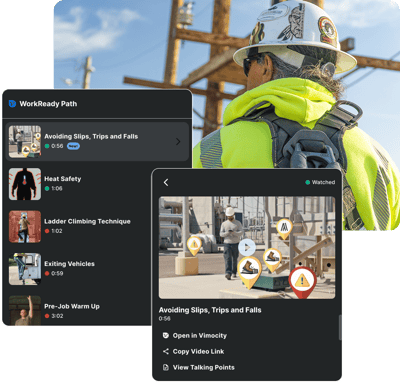
Discover how Vimocity can help keep your crews WorkReady.
One comprehensive platform to help safety and operational leaders prevent more injuries and incidents.