
.png?width=20&height=24&name=Vector%20(15).png) For Leaders
For Leaders For Workers
.png?width=24&height=23&name=Vector%20(16).png) Partners
PartnersKeep the Job From Breaking You Down
WorkReady Podcast Episode 51
-
Speakers
Darren Morris | inochi Longevity
Dr. Kevin Rindal | Vimocity -
View The Transcript
My grandfather worked as a pipefitter for 40 years, and by the time he hit 65, he was so broken down that my grandmother had to take his boots and his socks off at the end of the day. And unfortunately, his story isn't unique.
My guest today is Darren Morris, and he's a health span and longevity expert. He's gonna break down seven areas of your health that you can start improving today through small, practical choices.
You'll learn what you can do to protect your strength, mobility, energy, and independence. And this isn't about chasing a personal best or living forever. It's about small compounding choices that let you keep doing the things that you love on your own terms. All right, let's get into it.Darren, you focus a lot on longevity, healthspan research. What do you hope people get out of this episode? So you have a lifespan, which is how long you live, and a healthspan is how long you live in the best health that you can before any major illnesses, chronic diseases, life-limiting conditions. It's not necessarily about trying to live forever or trying to stretch your life as long as possible because I do buy into that that, that sort of logic that I hear quite a lot where people would say I don't really want...
What's the point in living forever if you can't do, if you can't do anything?" That's where healthspan comes in, right? So it's not about, it's not about running marathons necessarily, although I'd love that to be the case. It's about having that freedom and independence to be able to live a life that you want to be able to live and not one that is just dictated by, by illness.
So let's dive into that a little bit more. The fact that, a lot of people think that chronic disease is inevitable or our genes determine what what life is gonna look like for us. But you just said that, there's a huge lever that we have to work with in terms of just lifestyle and the decisions that we make.
What are the big levers that, that we can control in our daily life that would improve our healthspan? Yeah. Yeah. So I typically, and it's not, again, it's not just me. These are the ones that have been proven to be those biggest levers that we can pull. But in my area, I always talk about seven major pillars.
The first one's movement. And again, I use movement very deliberately, not exercise because mo- movement incorporates cardiovascular exercise, strength and conditioning sort of training, or sort of strength and resistance training balance, flexibility, mobility, all of those different and complementary areas of movement that all work together to make sure that we are able to move freely and free of pain in most instances ideally.
So that's the first one. And again, we can come back to some of these, but, you know- They all do different things. Obviously our cardio really works on our heart and our sort of respiratory system responsible for transferring oxygen all around our body, and every cell in our body needs oxygen, so it's really important to keep our cells healthy.
Strength and resistance. It's often called the longevity organ because it has so many processes that it does other than obviously, again, being the thing that gets us from sitting to standing and walking around freely, but also how it helps our metabolism, our sort of insulin sensitivity and all of those sort of things are really important as well.
So nutrition, again, that's not just about the food we eat. That's a big part of it obviously and trying to maintain as much as possible a whole food diet which gives us a full spectrum of nutrients is really important. But again, nutrition is also where things like hydration come in.
It's not just food. It's like what we eat. It's when we eat, the timing of day, the quantities, all of those aspects, not just necessarily the stuff that we put in our mouth. It's the whole sort of system and rhythm around that. Third one is sleep. Really important. Very much undervalued by the majority of people.
But essentially I would say that is the biggest lever that we can pull is sleep and the recovery that then obviously instigates across our whole bodily system. Stress and sort of stress optimization. A lot of people just think of stress as as a bad thing. But stress can be good as well, and we need a balance of both But more often than not, the majority of us are walking around day to day feeling okay, but actually our stress system is overloaded.
We can increasingly keep an eye on that and have a window into our physiology to be able to see how we're coping with stress and how we can modulate the stress and recovery, 'cause both of those are needed in pretty much equal measure. Brain health is another area that's really important.
So everybody kind of likes to immediately think about I don't- I'm not fit and I need to get fitter, and things like that, and they think about our body. But obviously, our brain is just as, if not more important in, in certain aspects. So doing everything that we can to be preventative with our cognition and our brain health because again, we probably all know somebody who in some shape or form has been affected by diseases like dementia and Alzheimer's.
The other areas are emotional wellbeing and that incorporates things like having a clear purpose, a reason for getting up in the morning, and a reason for for being. Includes social connections includes belonging, relationships, all of those things because again, the stats are very stark that loneliness is one of the biggest causes of aging and disease, more so than smoking or more of a barometer of how likely, how long you're likely to live than blood pressure, so it's it- it's hugely important now that we have a sense of purpose, a sense of belonging and having good relationships. And then the last one is our environment. We are... Me stood here today, I think, m- my house is a nice sort of safe place and hopefully touch wood it is, but we're surrounded by lots of invisible things that we can't see that actually bombard us at a cellular level.
You can't feel it but it happens, from the air that we breathe, from the water that we drink from the sort of cleaning sort of sprays that we polish our house with, from the air fresheners that we have, from the plastic that we store things with. All of these things do have an impact on us at a cellular level and if I was to put things in some sort of order, they would probably be at the bottom, but it's still really important to be mindful of these.
And you group them all together and you've got those seven pillars there of things that ultimately are in your control to a large extent and make more of a difference to our health than any pill or anything that's put out there as, as potential solutions to a quick fix That was such a great description, and I think the key point is that there's no one thing.
Everyone wants a silver bullet. They want a, a pill that they can take. They want something that's gonna, you know, drive the outcome that they want. But it's the synergy between all of these that come together and really impact our health from a positive standpoint. And it can sound overwhelming to think, "Man, I have to focus on seven different things."
But- Yeah ... it, but it's, honestly it's small choices that are compound over time. Totally. And it doesn't have to be overwhelming. So I think maybe a really good direction that we take this conversation is talking about those seven pillars, and just small steps that people can take that are gonna have the greatest impact.
And so I love starting with movement. I, movement is more my background than anything. Yeah. And, I have a great story. I, my wife's grandmother passed away last year, 102 years old, and talk about health span. She was literally, as healthy as could be up until two weeks before she passed away.
She it became evident that she had cancer, and then she passed away two weeks later. But her quality of life was unbelievable up to that point. Yeah. And I remember asking her, what's one of the secrets of your success?" And she said, "Never stop moving." And she's "As soon as I saw my friends stop moving, that's when that's when I saw them start to decline from a health perspective."
And so she had a garden. She would go outside. She'd e- exercise. She volunteered at her church, and she'd clean the homes of her friends who were in their 70s and 80s. She's 20, 30 years older than them, and she's still moving. She's, she has that purpose. So she kinda lived out- Yeah ... a lot of what you're talking about.
But movement was key. She would, every day she'd be washing her dishes in her kitchen sink, and she'd stand on one foot and practice balance, but she had the counter- Wow ... to grab. She's- And- She's the role model, right? No, totally. And it's one of those things where it's like, okay, now you start to see how important mobility and balance, all these things are.
You know- And she, yeah, she, she- Dynamic movements. Yeah, exactly. Yeah. And she had, sh- like you say, she had the purpose there. She was part of a community. She had something she was part of a church group, something bigger than herself that she kinda d- so all of those magic ingredients, and we hear about blue zones, right? She was living the blue zone life. I- in Hastings, Nebraska, which was not a blue zone for longevity and quality of life, let me tell you. But, Yeah ... but she f- was able to put all those pieces together. Dr. Kevin here, and if you're finding value in this conversation and you aren't already subscribed to the WorkReady Podcast, I'd be grateful if you'd take a minute to hit the subscribe button on YouTube, Spotify, Apple Podcasts, or wherever you listen.
We drop new conversations every Tuesday, so this just ensures that you're never gonna miss the latest episode. Okay, let's get back into it so let's dive into, to the movement piece as well, because there are a couple key things that research sh- shows us. Number one, believe it or not, grip strength is actually tied to longevity.
And when you think about your ability to be independent from a living standpoint, your muscular strength, and particularly grip strength, is something that's really important. Yeah. Balance is also important because we know that if you fall and break a hip the statistics are not in your favor in terms of, Yeah
recovery as you age. But then also just muscle mass in general. We know that there's a higher correlation to longevity if you have a larger muscle mass and you're not, letting your muscles waste away. But then also one other interesting fact is your ability to get up off the floor with the least amount of touches is what they say.
Yeah. So it just means that you can get up from sitting on the floor and it's, it doesn't require a ton of effort. Again, it goes back to your ability to have that independence in living. So could you share a little bit more about, how people should think about the movement health side of things, no matter what stage of life that they're at, and what some of those fundamentals are, especially, maybe as they get into their 40s, 50s, and 60s.
What should people focus on? Yeah. So I'd say the s- the start point is strength and resistance training if people don't do that. And I guess a lot of your audience are physical anyway, right? They'll be probably lifting things as part of their day job, carrying things around, and sort of all of that sort of stuff.
So I guess maybe as part of their sort of working day, they're moving a lot, and they're being physical, which is already a bit of a head start on, someone who's maybe sat behind a desk all day, for example. But it doesn't mean it's job done. So even if people have physical jobs, there are certain moves and movements that will benefit us later in life.
Being able to squat at least our own body weight on our backs, is ideally what you wanna be able to do. And this isn't, again, this isn't about being crazy. It's not about every session trying to get a personal best. It might reach a stage where you think I'm happy here.
I'm pushing myself, and I don't need to keep going and going." But you need to challenge yourself because our bodies respond to load, and our bodies respond to stresses. That's how we grow in all different aspects. But in terms of our, in terms of our musculature and our sort of strength, we need to put them under tension in order to grow.
And then underneath our muscles, the bones as well, the bones, bone density, they respond to load and to a certain degree impact as well. But it's why it's not just impact. If you just run, a lot of runners don't carry a lot of muscle, and they're like I'm... it's good for my bones."
Yes, it is to a certain extent, but not as much as it would be as if you were also building the musculature around those bones in order to protect them from potentially falls or kind of injuries later in life, which may well happen So making sure that we can squat the kind of the hinge movements is the other one.
So again, the, the typical one is the deadlift. And a lot of people are scared of the deadlift because of, lower back and sort of back injuries. But again, it's important that we- if people are starting from a start sort of point, we build up to that so that we get the technique right.
But there are ways of making it safer. For example, with some people I recommend using a hex bar rather than a, a sort of a barbell because that just means that you can still get, the hinge movement but without as much pressure on your lower back. But again, this is where I always want to challenge people because I don't want people to avoid things because they think it will be bad for them or think that it will- they'll get injured.
If you do this properly, if you build up to it, if you get proper advice on your technique, then you should be doing barbell not just hex bar. So something that people need to lean into but not just crash into and think, that they can do it and then get injured and then that sets them back and they don't go near it again because they're scared of getting injured.
So there is a process on this and it's whatever the start point is for every individual. But yeah, squats the deadlift bench presses when we're talking about upper body. These are all things, again, a lot of your, a lot of your listeners may well know this but these are the compound movements, right?
That are really important because they recruit almost every major muscle group in the body in order to do those lifts properly. So bench pressing military press overhead for our shoulders, barbell rows for our sort of back. If people want to work on the glamour muscles and do the biceps and all that sort of stuff, that's fine.
I'll always recommend that we have a core program of working those compound movements because they're the things if we think about what do we need to do in life that those movements train for. It's walking upstairs using our quads and our glutes. It's getting up unaided from the floor, i'm 51. A lot of people take for granted at this age still, but actually if you don't train your muscle then you're losing 3 to 5% of that sort of every five years that that, that pass if you don't do anything. So it's really important that we don't just think, "Oh, I don't need to do that.
I've still, still got a bit of muscle on me," and things like that. It will degrade if you don't train it so you have to train it just to stay where you are now. I think a key point is that it's- there's never a bad time to start You know, exercising, doing resistance training, I wanna be clear about that.
And a lot of the tasks that people who are in the trades perform, they are doing physical work all day, but oftentimes it's very repetitive. It's using the same muscle groups. It's not- yeah ... challenging different parts of the body. So I think it's important to also highlight that the variation- Yeah, definitely
is a part of the equation. There are some philosophies that says you have to change everything up every six weeks in order to, t- trick your muscles into growing. That's not true. You don't have to do that. But you still need to incorporate these core movements because these are the things that you'll always need and will make the biggest difference.
So yeah just build movement into almost everything you do, but start with muscle Add mobility, add flexibility I do wanna highlight on mobility as well, it's just a quality of life issue as well, 'cause when you think about getting dressed, your shoulder mobility and your ability to reach your back, for instance, or to cross your legs so that you can put your shoes on and off.
And so again, it's one of those kinda use it or lose it things. So let's talk about VO2 max and cardiovascular conditioning as well, because again as we get older or even just with day-to-day work activities we may stay in like zone one or zone two heart rate level a majority of our life. But there, there's a lot of benefit to pushing our cardiovascular system and maintaining what we call VO2 max.
So can you define for us what VO2 max is? Yeah. So VO2 max is essentially a measure of your cardio respiratory fitness, and what it does, it it tells you how efficient we are at transport- taking in oxygen and then transporting it through our body to our working cells and our working muscles. And so it's measured in milliliters per body weight in kilograms per minute.
So it's a bit of a kind of, you know, formula and formulation, but there are different ways of measuring it. So some of these devices approximate it. They're not 100% accurate, but they'll give you a fairly decent measure of what your VO2 max is. And basically it is it is VO2 max, it's when you are at maximum capacity, how much are you trans- transporting around?
So it stands to reason that the higher your VO2 max, the better it is because that means that when you're at rest, you're more efficient at again, getting oxygen to all the different parts of your body. So if you can train your VO2 max to increase, it just means that you are super efficient, whatever you're doing in your day-to-day life at transporting oxygen to all of your working muscles, so you can do everything without getting winded kind of all of the time.
We're made up of 37 trillion cells, and all of those cells need oxygen to function and to generate and to power us. So if we can't take in oxygen, process it, and transport it everywhere, then it stands to reason that we're not gonna be particularly healthy, right? The best way to train your VO2 max is primarily spending most of your time in zone two training.
So zone two, again, to give a, a softer description of it That's the zone where if you're running or cycling, you're able to hold a conversation. Might not be as easy as this kind of conversation, but you're able to talk to whoever you're out there with relatively fluently rather than having to stop and and get your breath.
It's it's that base training that really helps. But then what you have to do is every now and then as part of a VO2 max training, you have to really push yourself. The good news is you only have to do that for a relatively short period of time. So the typical protocol for this would be if you do whatever it is, whether it's running, whether it's rowing, whether it's cycling, you do minimum of two zone two sessions a week Maybe for, let's say, an hour, 45 minutes for an hour, zone two.
And then you do your zone four and five session. And as I say, the typical protocol for this is called the Nordic sort of training where you will do four repetitions for four minutes. You will go flat out. And I'm not talking about ramping up, so the first minute you're okay. Or you will be in the first set 'cause you'll be relatively fresh, but you go flat out as hard as you can for four minutes, and then you recover for four minutes.
Some people like to stop completely. I'd recommend just walking around for a bit, just keep moving or whatever it is for four minutes, and then you repeat it again. Flat out for four minutes, recover for four minutes, and you do that four times. If you do it properly, that is the best thing combined with your zone two training.
That's the best thing that is known to improve your VO2 max. So talked about pillar one pretty extensively here. Let's- Yeah ... let's talk about some key things that people can do from a nutrition standpoint. So particularly as we're getting older we talked about muscle loss. Strength training is one part of it, but the other part is making sure that we are at least protecting, if not upping our protein quantities.
We don't need to go crazy. It's not about kind of putting powders in everything. I'll always try and get people to get it from whole foods, but it just means with every meal, try to get about 30 grams at least of good quality protein in that meal, and that typically is about a fist size of protein.
So protein is fine from whatever source you're comfortable having it from, as long as it's clean protein, sort of whole foods. But enough plants and plant diversity as well. Really important in terms of getting all of the polyphenols, all of the nutrients, the vitamins and minerals, they primarily come from the diversity of plants that we have.
And we also know that the diversity of plants feeds our gut and our gut bacteria, the good bacteria in our gut. People who don't have that level of diversity typically don't seem to have as good gut health, which then, again, m- more and more evidence is coming out that the guts basically holds about 90% of our immune system and also the gut-brain axis means that if we don't have good, healthy gut bacteria, then it can affect our mood it can affect our mental health, all of these sort of things.
Some people might think that sounds a bit kind of woo-woo, but, the evidence is clear that, the gut is basically where all the magic happens for us. The other really important part of that, and where the plants come in as well, is making sure we have enough fiber. 'Cause again, fiber is our natural GLP-1.
A lot of people are reaching for GLP-1s these days with the sort of various brand names that they're under. But all that is basically it does the same job as, as, as fiber, right? Fiber lines our guts, so it means that our kind of food is digested slower.
We feel fuller for longer so we're not reaching for food as regularly as possible. So really important not only to feed the gut bacteria that line our stomach, but also to regulate our our appetite and our eating as well. So pillar number three, I believe, is that s- Sleep? Yeah. Yeah. Okay. Sleep. So again, re- really simple rules about this really is try, which may be a challenge for maybe a lot of the people that you work with who are maybe shift workers, but try and keep your consistency of sleep as much as possible.
So going to bed at the same time ideally, but certainly trying to wake up at the same time or within maximum a half-an-hour window kind of in each of those Not always possible for everyone, I realize that, but the science behind it is around our circadian rhythm. We are still linked inextricably at a cellular level to our ancestors who used to rise when the sun came up and disappear into their caves when the sun went down.
And and our bodies still work on that. In fact it's been proven that within all of our cells we've got... i'm sure it doesn't look like a, a clock, but essentially it is a signal that is a clock that tells us when things should be waking up and when things should be slowing down.
But as we know, we're surrounded by artificial light, by devices, screens, noise, all kinds of things that really help disrupt that natural rhythm that we're all hardwired to, to do. So the big challenge is how do we try within all of this hyper-stimulated world that we live in, how do we try and still maintain that circadian rhythm?
And the best way to do that is to keep our bodies in that regular light and dark routine as much as possible. But if you were to pick one, try and make sure you're getting up at the same time every day, even on weekends. Hard to do, for a lot of people who work busy lives and they're up at whatever time, and they're going to bed at whatever time.
Weekends is usually the thing where they think, "Oh, thank God I get a lie in." It's actually the worst thing you can do for your body because just as your body's getting into a weekly routine of knowing what to do, you completely mess it up and it has been likened to, to jet lag. So mild level jet lag every weekend because just shifting it out by two hours, that's the same as, flying across a couple of time zones, right?
If you're if you're normally getting up at 6:00 AM, let's say, and on a weekend you're getting up at 8:00 AM, your body doesn't know quite when to release those hormones that it's meant to be releasing and, right? So it just messes up your whole sort of circadian rhythm. So the best way to do it is to make sure that you're still getting up at the same time every day of the week.
When you get up, make sure that you're trying to get some natural light. If it's not light where you are, get a daylight lamp that you can that you can have nearby that you can start to get, because again, that triggers the right hormone sort of pattern and re- and release. And and what you do in the morning, those kind of habits, getting up at the same time, getting natural light behind your eyes, that will all make sure that you're actually gonna sleep better at night as well.
And sleep also is so important for brain health, and it's when our body recovers as well. We have this drainage system that happens when we go to sleep, glymphatic drainage. It's where all of the toxins that are floating around our brain that that appear daily, they're all flushed out through the glymphatic drainage system when we're asleep That tends to happen later on in the sleep cycle.
So if we only sleep for five hours, for example, on a regular basis, then it doesn't have a chance to clear everything out properly, which is why we then wake up with a bit of brain fog, bit of a stuffy head, maybe we're a bit more forgetful and things like that because those toxins are are building up.
And they're the things that are dangerous over time that lead to neurodegenerative diseases as well if our brain is flooded with toxins and we're not able to get them out. So yeah, really important that we're getting our sleep, not just for our, physical recovery, but also for the recovery within our brain as well.
Killer number five ... stress. Stress. Okay, let's talk about it. Stress. Yeah so again, like I said before stress neither good or bad. It's all our perception of whatever that experience is as to whether it's good or bad. So I used to have to stand up on stage quite a lot in my job and do presentations to 5 or 600 people, and it never gets easy.
But there were some people that just used to walk on stage calm as anything and and command the room and be like, amazing. And it's how can you not be stressed about that? So that person's perception and experience of stress is maybe different to another person's who hasn't been able to sleep for the last sort of five nights because they've been worrying about this kind of big presentation that they've got to do.
So those kind of things are probably good examples of the good kind of stress though. They're things... it's got a name. It's called eustress. So there's distress, which is like genuinely bad stress, right? If you're held up at gunpoint or if, something really terrible happens to you that's distress and that is bad, right?
That's gonna cause it to be bad. But then you've got eustress, which might be that presentation. It might be that sort of nervous energy, you may remember if, if you're going for your first date or whatever and you have that kind of nervous kind of like energy.
You've that, that again is a good kind of stress because you're getting ready to actually like fight or flight. You're getting ready to to meet your enemy if you like in that sort of context. And then after the event you can come down And then the next thing will happen, and your body kind of triggers you, and you're back in that sort of moment, and then you come down again.
And what happens, the more you have these moments of good stress and eustress over time you build your capacity and your resilience so you don't fall down to as low a level, and then you come back up again, and you don't fall down to as low a level, and you... So when those genuine moments of stress comes along, the distress moments, we're better able and capable to manage it rather than just fall apart because we've built up over, over years, and years all of these kind of like little stresses.
So I always try to encourage people not to think of most things as stress. Just think of them as useful things that are building your resilience and building your sort of capacity. And I think maybe that's something that's missing a little bit these days is I think a l- a lot of people maybe too easily think of everything as bad, stressful experience.
And I actually like to think actually one of the strongest things that we can have in life is resilience, and we only get resilience by experiencing all of these things that are sent our way that we ultimately have to either run away from or face into. And the majority of things in life Don't require running away from, anybody and again, I'm not judging anybody, but anybody who might be given the opportunity to do some public speaking, for example and they They really feel really stressed about it and ultimately they pull out. They'll make an excuse and they'll say, "Oh I'm sick, I can't make it," or whatever, just as a way to get out of it.
That's fine. I understand that it might have felt overwhelming, but that's not gonna help them in the long run to build that kind of resilience and build up their stress tolerance and their reserves for when something genuinely stressful comes along. Stress is really important for us to be able to, one, be aware of, two, reframe it when we can, but three, manage and control so that we're able to toggle that nervous system to be on when we need it to be, but then to recover when we don't need it to be switched on.
It's all connected, isn't it? Our work- It's all connected ... our nervous system, our our hormones. But heart rate var- variability, just for our audience, that's just how much variance in our heartbeat happens over per second, per minute. Yeah so the heart rate variability is the tiny gaps between our heartbeat.
Again, I think most people would assume that our heartbeats beat in a regular pattern and that's a good thing. When in reality, a healthy heartbeat doesn't beat like a metronome. It's not like boom, ba-boom. It might be boom boom. Which sounds to most people like that's an irregular heartbeat or something like that.
Actually, it's not. It's the gaps between those heartbeats that, that fluctuate and again, what's that, what that's a signal of is how flexible our nervous system is because if we are constant, like metronomic sort of heartbeat, that's the signal that we are constantly activated.
Whereas if our heartbeat is able to... or the gaps between our heartbeat are able to flex slightly, that is a signal that our nervous system is relaxed and and is able to come back down and is not signal that. So it's a funny measure where higher is better- so it's not it's not like your heart rate where you actually ideally want that to be as low as po- well, within reason, lower.
It's actually for heart rate variability, you want that to be high because that signals the variation difference between those heartbeats, so a high number is better. But it's all, all very subjective, so you can't compare your heart rate variability against someone else's because what is high for you might be low for someone else, but it's still healthy for them.
And I think this is a good time to maybe talk about what like biological age is versus what chronological age is. Because when we start to put all these things together, devices like the Whoop they start to take things like your VO2 max and your resting heart rate, your heart rate variability, your sweet- sleep quality your recovery, and it puts all these things together and it at least gives us a signal of are we...
What does our pace of aging look like? Are we, aging faster than maybe we, we otherwise would be, or are we trying to control some of these variables or optimize them so that our body essentially ages a little bit slower than it would otherwise? Yeah. They-- And every device will have their own sort of algorithm that calculates this kind of slight- slightly differently, but most of them will probably do it in a similar way.
So Whoop, for example, it has, I think it's nine sort of key components that make up... It might have changed. I haven't checked actually very recently to see, but it's around nine components that they then put into their algorithm, and they've all got slightly different weightings that have been worked.
I think it was with the Buck Institute in the US who do a lot of work around longevity, and they identified with them what are the key measures And again, our key measure's based on what WHOOP can measure, 'cause there's probably other key measures that, that, maybe are done through more blood tests and things like that, which obviously WHOOP are trying to bring in now to the kind of bigger ecosystem.
But th- these are the key measures that and that, that are influenced by the behaviors that have been proven to slow or reverse aging or certainly contribute to healthy aging. And it, and it is really a behavioral tool. It's not something that you should really walk away and say, biologically, I'm 38.
It's great to have that kind of as a sort of, as a bench and as a guideline, but it's more of a commentary and a proxy to say, "You're doing the right behaviors. Well done, 'cause this means that sort of, you've probably taken this much off your life by doing this." So each of those different things have a score, or a number of years should I say, attached to them.
Now, outside of WHOOP, you can go off and get more accurate biological tests. So I've done various ones. I've done genetic sort of DNA ones, and I've done, It's called Phenotypiqs or blood tests that measure all kinds of different blood markers that are associated with the key bodily kind of, you know, and organs that are key for longevity, and then they give you a, a, a- an age as well.
So there are ways to do it that are more accurate than, than these devices do, depending on your level of interest of knowing. Some people are like, "I don't really need to know. I'm just... I wanna know that the things that I'm doing are actually making a difference."
Yeah. And I've always found that, again, it's just... it's almost like a little bit of a dashboard for your body. It just gives you some data to help encourage the right behaviors and s- ensure that you are heading in the right direction. There's a fine line that you've gotta tread, and intuition is still probably the thing that you should be governed by whilst keeping an eye on your long-term trends that the watch is telling you.
Absolutely. Yeah, and it can lead to that bad stress that we were just talking about. People can- Yeah ... fixate on it. Darren, let's wrap up with the last two pillars of health that we started out with and bring it home. Yes. Yeah. En- environment we'll we'll touch on briefly.
But that is just doing whatever we can that's in our control within our surroundings to make sure that we're minimizing the impact of pollutants. And, they're hidden in a lot of things. We can't escape them. We-- we'll depending on how long we've had some of our furniture, it's in our furniture, it's in our mattresses, all of these chemicals that are on there for good intention, right?
They're fireproof and all of those sort of things, which on the one hand give a benefit, but actually they they kind of seep constantly into the air that we breathe, which effectively are toxic chemicals. Air quality is probably the biggest one, and that will vary massively depending on where people live.
And a lot of people can't change where they live, right? What you can do is make sure that you are investing in sort of an air purifier, for example, and you have that in your bedroom when you sleep, 'cause that's where we spend most of our time, really. So if the air that you're breathing in your bedroom is good quality purified air, then that's one big tick that you're doing regardless of where you live that's actually helping, your body because, you're breathing in that sort of oxygen, which is a lot purer than if you didn't have that air purifier.
I think most people would be well advised to use a good quality water filter with their water because the standards of what happens in the water treatment plants varies massively and and some of the stats are quite scary when you read what's been found in like water that comes out of your taps before it's been passed through a filter Then you're looking at things like the cosmetics or chemicals and things that you use.
Trying your best within your capabilities to maybe buy deodorant that doesn't have aluminum in it, for example, or some of those other toxic compounds that we spread all over our body. Our s- our skin is one of the most porous things in existence, and we often put all kinds of things on our body that then leach in and where does that go?
It all goes to our cells, and it all damages our cells. So trying to make those kind of conscious choices of what we put on our body, what we spray on our body is also really important. But if there are obvious things that you can do to change your environment both at home and at work then do what is reasonable for you, what you can afford, what is sensible for you to do to make sure that you're yeah, you're not unnecessarily consuming, surrounding yourself with things that are gonna bombard you at that cellular level.
Yeah. And again, it goes back to almost what we were talking about of just the lifestyle. It's making small choices, but it's almost setting yourself up for success. So maybe the containers that you're drinking out of are glass or metal instead of plastic. Super easy. It's changing out your cutting board so you're cutting on wood rather than plastic.
It's maybe using a cast ir- iron pan instead of the, the non-stick, and you're getting some, some iron actually through cooking your food. So ag- again, it doesn't have to be stuff that you're just constantly obsessed with. It's just small choices. Set the pur- air purifier up. You hardly have to think about it again, but you're improving your health just- Yeah
just like that. Yeah. And again, with things I'd always say don't go out and throw everything out and buy... There's no need to throw everything out and buy it. But when it comes down to renewing, if you need a new pan, if your old one's got a bit worn, don't just go out and buy another non-stick.
That's your opportunity to then upgrade and improve to, to something like that. Absolutely. And the, the final pillar is the social and the community, the purpose, probably spiritual fits into that, that category as well. Can we just briefly talk about that? But yeah, just to keep it really simple, I think, purpose is where I'll start.
So again, some people misunderstand this. This isn't necessarily about having a huge philosophical kind of conversation with yourself to say, "Why am I here? What is my purpose?" The key is there something that is meaningful enough for you in your life that For want of a better expression, will get you out of bed in the morning sort of doing something.
Some people, even though it's not necessarily what they aspire to do for the rest of their life, and some people might not necessarily always enjoy their job. But for some people, what gets them up in the morning and functioning is that they have to go out, and they do their job, and their job helps other people.
And there is a purpose behind that. It's not necessarily the thing that you want to be doing for the rest of your life, but there's enough there where you think, "I've got to get up today because if I don't, then this won't happen, and this person will be affected," and and things like that.
But the main thing is having a reason to get out of bed every morning. And that is why whilst most people probably spend their whole career longing for retirement is one of the unhealthiest things that happens to people because suddenly they've spent 40 or 50 years building their whole identity around work and who they are and where they are on the ladder and things like that.
And then almost overnight, it's taken away, and suddenly they don't know who they are. They've got no purpose. They have got no kind of structure. They don't have that reason for getting up in the morning. And it's why you often see when people retire, there's a strong correlation with their health declining because they don't have that, 'cause purpose often also brings movement and a lot of the other things that we talked about, movement and social connection and all of those sort of things. And so what I'm not saying is you need to find your purpose kind of now, otherwise you're gonna age and you're gonna get unwell.
What I'm saying is constantly think to check in to make sure that where you are right now, you've got a reason for, for getting up in the morning. But also think a few steps ahead so that, if you do have retirement a few years down the line or if the kids are gonna be leaving the home to go to university and all of these kind of different things, you're not suddenly suddenly have the carpet pulled out from underneath you and you've suddenly lost your purpose.
It's not about going out and inviting yourself to every sort of thing, but it's just about having a clear group of people that you See regularly that you can connect with regularly. I always like to say, "Have you got two or three people that you can phone at 2:00 AM in the morning if you need to that will answer the call?"
'Cause, 'cause that's re- you know you don't need tens or hundreds of sort of people in your circle. Fine if you have, and if but depth of those connections and depth of those relationships is the most important. So making sure that you've got that, but also making sure you're there for others as well.
This is a fantastic conversation. Thank you so much for talking about these seven pillars, and again it can s- sound overwhelming to just think about all these different components, but I kinda think the 80/20 rule plays into effect here where, you don't have to be perfect. It's just small changes on a consistent basis, recognizing that, there's no one s- one solution that's gonna, lead to optimal health and career longevity, life longevity, and biological health. It's just the small decisions that compound over time.
So how can people follow you, maybe on LinkedIn? Yeah so as far as social goes, LinkedIn is the one that I use mostly. I am probably gonna start leaning into Instagram again, but I haven't done a great deal on that one sort of yet.
Darren Morris Longevity Expert on LinkedIn. And then inochilongevity.com is my website. And again, various kind of resources and things like that on there that people can find out. If anybody wants to reach out direct to me can reach out through either of those channels.
Thanks so much for joining us on the WorkReady Podcast. Again make sure to subscribe because this is something that we are releasing these episodes every Tuesday, and there's just so much high value content with the guests that we have.So Spotify, YouTube Apple Podcasts, or wherever you find your podcasts, just hit subscribe and we'll make sure to ensure that you get those updated episodes in.
Until next time, take care of yourself, take care of your team, and stay work ready. Thanks so much.
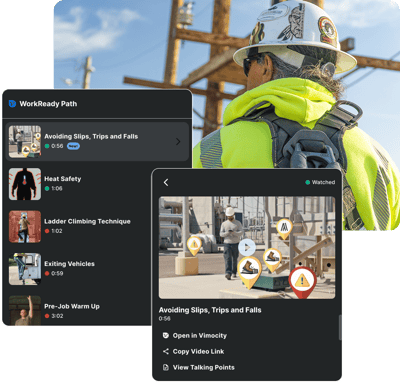
Discover how Vimocity can help keep your crews WorkReady.
One comprehensive platform to help safety and operational leaders prevent more injuries and incidents.