
.png?width=20&height=24&name=Vector%20(15).png) For Leaders
For Leaders For Workers
.png?width=24&height=23&name=Vector%20(16).png) Partners
PartnersStop Running on Empty: A Field Worker's Playbook for Mental Performance
WorkReady Podcast Episode 32
-
Speakers
Nick Magaña | SoCal Edison
Dr. Kevin Rindal | Vimocity -
View The Transcript
Grind it out. Push through. Don't say anything. It feels like toughness, but over time it's costing you more than you know. It is actually detrimental to the team. So you think that making it through the day is the win. Being durable, being present, being there, that's kind of the brother's keeper aspects.
After more than two decades in the utility industry, Nick Magana tells us how to recognize the warning signs that you're losing control, and provides a field-tested framework for resetting your performance when the stakes are highest. That space between stimulus and response, and there's a lot of things that, that can, that can happen.
You tap into the physical to get into the psychological. This is the WorkReady Podcast.
Okay, Nick, so the person listening right now, they show up, they grind, and if you ask them how they are doing, they say, "Fine." What are we gonna give them today that they don't already have? Hopefully we're gonna enlighten them that, uh, m- mental preparation fuels, uh, physical performance, and I think that's a large topic that, um, is often overlooked in the importance of the physical or the psychological feeding the physical.
And so, um, hopefully through the conversation we can help build the awareness, uh, for the listener to see how they can go from a survive state to a thrive state. And so I'm, I'm excited to talk to you more about that. Like I said, Nick, you have, I think... I mean, I, um, work with tons of utilities, but I think one of the best industrial athlete programs in the nation.
Why do you call it an industrial athlete program? Like, what about the work that the men and women at SoCal Edison, uh, what do they do that, uh, you classify them as an industrial athlete? I basically see it as, uh, two different approaches, right? So I oversee ergonomics, uh, for the company as well, so how, how do we make the work less stressful to the employee?
And in the industrial athlete perspe- uh, perspective is how do we make them more resistant to injury? How do we build resilience into them? How do we get more durability? And so that is the same approach that's done with athletes, right? How do you get them to get, uh, a long career and not get hurt in their rookie season?
And so, you know, that's, that's really, um- Our approach is to how do we make them more well-rounded. And I think that there's, uh, traditional industrial athlete programs that may focus heavily on the physical resilience side, which is obviously important. Um, but I think sometimes it's a lens from-- that's kind of brought over from traditional safety because traditional safety looks at, um, physical, uh, hazards.
And so we just look at the physical, the things that we can see. And I think what is gonna, you know, set us apart from what we do is that mental side, which is the psychology, which is the things we don't see, which are the things that are happening between our ears that fuel what we do and how we do it and why we do it.
That is why, you know, we call it an, an industrial athlete, uh, program, 'cause it does take from the traditional sports industry and, um, puts things into the, um, utility space, which is, um, to me is very, uh, high risk, high consequence, um, uh, very dynamic environment, which is also similar to what, uh, it-- different athletes e-experience, um, as well.
Maybe the, the difference is just the jersey they, they wear. What I really like a-about what you distinguish is that, you know, oftentimes when people hear the mental aspect, they think about mental health, and that's obviously an important component, but there's also this mental performance side. It's, it's about being focused.
It's about being ready to perform at the highest level in those critical moments. And so maybe explain a little bit more of how you incorporate the sports psychology or the mental performance i- aspects into your industrial athlete program. Yeah. That's, that's a, a very good question. So I think one of our drivers right now is that, uh, we're embedded in our, our-- in the climbing school at, at, at Edison.
We're teaching them how, how to use their body properly, like, as a tool, essentially. Like another, another, another way of looking at a, at a tool and, and how to use it so it doesn't break down, you use it properly. We, um, we'll, we'll cover m- something mental-oriented in one session, and then we'll cover something physical, and we kinda just have this rotation because it's important to do that because every-- uh, they go hand in hand, right?
So you can teach someone proper lifting techniques, but they have to be-- have that mental awareness of when to apply it, when to be focused, and not, not to be distracted. So you teach them how to be in the moment, how to be more purposeful. And so, you know, this is where we start off. We start them off at, as a grounding.
And then in the ecosystem of our industrial athlete program, we have on-site providers that will, um, help to, to echo these key things that we teach, um, at the climbing school in the field. Um, as well as a, as another way to reinforce these topics. And what has surprised you most in terms of how people have received, uh, this content and this education?
Has, has it been embraced, or has there been a little bit of pushback? I, I, I was, uh, I was nervous to start to deploy this, um, 'cause s- psychology is very abstract and, you know, it's a very male dominant, uh, you know, the other field workers is the... it's a male dominant, uh, population for the most part, and so they're very physical beings doing physical work.
And so, you know, they're used to grabbing things that are tangible, and psychology isn't so, so tangible, so you have to, um, be s- creative in how you walk them through and make them aware of how they think and how they approach different things. I have clips of different athletes from UFC fighters to, uh, baseball players to hockey players to tennis players to different sports psychologists that are, um, you know, we use their clips, and we piggyback off those and have, uh, discussions on talking about the concepts and how they're applied and then roll that into the work life and the different situations that they'll have, um, on the field.
But, um, honestly, it also rolls into off the fields because, you know, you're, you're human and everything sometimes just, uh, collides, and I think that's where they, um, they realize the benefit of it, that it's not something that you can just, uh, turn on for work but don't use it outside of work, that these are essentially life skills.
Uh, the better that you can, you know, manage your inner game, you're gonna manage your outer game essentially. I love that, that idea of the inner game versus the outer game. And we talk a lot about, as you mentioned, physical readiness on job sites, but then if we're talking about industrial athlete mindset, like, on the job site, can you paint a picture for us of what that actually looks like in practice?
So what somebody would take away from some of your initial training and how that translates into day-to-day work. Great question. Um, one of the things or the concepts that, that we teach, and again, I, I'm gonna mention it here a lot, is that, uh, survive versus thrive, um, is that how do you set yourself up for, for success?
And a lot of it is being aware of your habits and routines, right? And so I think that, that is it, is looking at your day as different phases, and within those phases, you're gonna have different things that you're going to accomplish, right? And so you have to be mindful of what you're gonna plug into that and- Uh, what we teach is that that's the, the thrive state where you are planning to do things so you don't feel like you're, um, flying by the seat of your pants, you know?
'Cause there's a lot of the, the culture that you would see is that, um, a lot of guys are sleep-deprived, and they will, um, use a lot of nicotine and caffeine to rev themselves up in the morning. There's something, you know, artificial, and then they'll high-pressure, high-consequence situation, so they're really heightened.
Their nervous system's revved up, and then, uh, they gotta go home, and then now we gotta kind of rev it back down. And if you don't have good routines that are natural, you're gonna use things like alcohol, and then you're gonna be on the screen and, and a lot of dopamine cycles, and then those things are going to keep you up, and then you're not gonna get good sleep, and then you're gonna rinse, wash, and repeat.
So one of the things we do is we break down every aspect of the day s- and show them that you can plan everything that you're doing. And so, um, you don't have that you're flying by the seat of the pants and just, um, reactive. We teach you how to be responsive. All the different phases that things that from, from wake up, things that you can do from when you're waking up, things when you're getting, um, setting yourself up before you go to pre-shift, things you can do to check your, your readiness about being, uh, properly fueled.
Am I a- alert enough? You know, all these things are about building awareness throughout your whole day. And so that, that's really the, the take-home and the things that we help to, um, help them help themselves to build structure into their everyday, um, not just work life, but personal life. Thumosity is more than training.
It's a safety and readiness platform trusted by companies to keep their field professionals strong, healthy, and ready for the job. Now we're launching something new: the Work Ready Community. It's the first online community built exclusively for field employees, a place to connect, learn, and lead the future of our industry.
Join us and be part of the movement.
Uh, on a previous Work Ready Podcast episode with Dr. Jim Bauman, he talked so much a- about routine as helping to calm the brain and just have that predictability when people are getting ready to perform at a high level. But it probably equates very much to when somebody's about ready to perform a high-risk task as well.
What are some of the cues that you give, uh, people, or how do you guide them when they're about ready to perform a high-risk task so that they can recenter themselves and be focused on that so that they can perform it safely? So, uh, two areas that, that we focus in on is, um, self-talk, right? And, um- Using, uh, meditation and, uh, imagery.
And so, you know, from an imagery and a meditation perspective, we teach them how to down regulate their, their nervous system, right? So how do you get out of that, that limbic, uh, and getting nervous and, and chaotic, and how do you, you activate your prefrontal cortex? And we tell them that this is something that you can practice.
And it goes great when we teach our groundmen, for example, because they're gonna have tests at the end to become a groundman when they're going through their classes. And we say, "Guess what? You can practice imagery," 'cause sometimes your brain doesn't know if it's reality or something you've imagined, right?
It's kind of like that stoic quote from like Seneca, you, you suffer more in imagination than reality. And so we tell them, "You can actually leverage that." You can go through situations that you normally do, or even if you make a mistake, and see how would I react to it, how would, how would I respond to it.
And so we do teach them the skill of, of, uh, imagery. Um, and then, but then also in the moment, um, it's not just to be focused, but it's also how do you refocus, how do you lock in? And these are, um, self-talk power phrases. So that's another thing that we, we teach them is, is to be aware of the power phrases that they already use, but maybe they don't think about it in that way, and to come up with different situations to where, um, they are feeling that they're either out of control or losing control, and where these, these phrases can help get them out of an emotion and get them back into a focus.
And so these are the skills that we work with them on and help them build so they have these tools in the toolbox that they can take into those high-pressure, uh, situations that you're talking about, and they can, they can do it. Just, just like a batter where batter's, "Ah, man, I've got two strikes on me already."
They, they, they step out, and what do they do? They look at their bat, right? They're looking at their bat, and all they're doing is refocusing. They step back in, and they take that focus from the bat, and they look at the focus of the pitcher, right? The... And it's all routine. And so we tell them this, these are things that you have control over these moments, and as long as you have a routine to pull from when you get flustered, you'll always have an opportunity to respond versus react.
You talked about, you know, these men and women, again, are in these high-pressure situations. You're working on high voltage. You know, there could be, you know, there's always potential risk there, so you're at that heightened state. You're maybe slamming caffeine, nicotine. Yeah. Everything is, everything, everything is on, on high.
And then the next critical part of the day is walking through your door at home. And h- what are some of the skills that you have taught people of how to, you know, separate that intensity on the job to how to set that aside so that when they walk through, uh, the door at home, they can wear two different hats so that they don't feel like they're in that amped up state?
That one's a, a challenge, and we, we teach them a lot of, um- Concepts from, um, Atomic Habits, right? So that the, the, uh, James Clear. And so we, we tell them that, you know, a lot of things is all your behaviors are tied to your identity. And so it's almost like a, uh, you know, when, when you're, uh, adjusting your environment, it's also a trigger to when, when you're transitioning from one role to the next role.
And so I think it's important to do that, is to be able to do your best to be mindful to leave work at work and where you can, uh, get into a place to where you are not gonna be reminded of work in, in the same fashion that you would do, um, let's say for sleep. If you're putting your, your work boat- or your work boots right by the door or somewhere you can see from bed, it's like, "Oh, yeah, I gotta go to work," and it makes me anxious 'cause I, you know, work can be stressful.
So if you can learn to separate the things that would either consciously or unconsciously trigger, um, things about work and then not allow you to be in the present, um, let's say in like your family life, I think understanding how your, uh, environment affects you is really important, and those are things that, that we would talk about, um, largely with, with routine, right?
'Cause you would build that into your routine of how to, how to do that transition from, you know, being in your sport to being in your home life. You mentioned a keyword there is identity and, you know, oftentimes I think people get their identity from the things that they do or the things that people say about them and they're like, "I'm a lineman, I'm a ground man."
But it's just like that's just part of what you do. It's, it's not your identity. Can you explain a little bit more about how identity drives behavior and how that may show up in different environments like the job site or at home? Yeah. Uh, and that, that ends up being a pretty, uh, in-depth conversation when we have that, 'cause one of the core principles that we teach is, uh, MVP, and that- that's taken from, uh, Brian Cain, who's a mental performance coach for, uh, professional sports.
And, um, so MVP, your mission, your vision. So what are your... What, what's your legacy? What is that big picture that you're doing everything that's gonna fit into? And then what are the accomplishments that you wanna have to work towards that legacy? And then that, the P is like your principles, your, your values.
What are the, what are, what are those things that you operationalize every day that ties into the big picture? So id- identity is huge, especially, um, in the, it, for, like, linemen or the utility space. Um, no different than an athlete where they, they make their identity their sport. And so, so we, we, we have that conversation, like, "Hey, you, you might get hurt," or you might feel that, you know, you're doing this role for five years and you say, "It, it's not, it's not for me," right?
And so you might have to transition, but if you have, um, your MVP mapped out, which is something that we work with the employees to do, you can say, "I, I, I bring my MVP to life in this role, but, you know, this role isn't meant for me anymore. I can point my MVP, my compass, at something else and still get purpose, still get meaning."
Everything that you do is, like, casting a vote for your identity, so you, you need to be conscious of that, and that's something that, that we teach the, uh, field employees. Let's dive into the MVP a little bit more. I think that this is a, a great area to focus on because, again, it's so easy to, to get our identity from all these other things, but not necessarily be grounded in, in something that's your true north and it really dictates who you are.
The big driver and the things that we focus in on is that principles. You know, what are your values? Do you focus on in- integrity? Do you focus on honesty? Do you, uh, courage, um, respect. You know, these, these things are important. These things are, are important to, to, to map out and to look at and to remind yourself 'cause it, it helps you feel that everything that you're doing, um, every day, every week, is pointed towards something.
Um, and that, I think, especially for men, that's that, that sense of accomplishment. Like, if, if you don't know who you are, the world will tell you who you are. Um, and I, I do. I think that, that, that is, that is true. You will, you will rely more on external things to build that framework for you if you're not putting in the, uh, thoughtfulness that you do deserve.
That you, you deserve that, and I think you need to be aware of it, and that's, that is something that, that we push hard, uh, for people to be, um, aware of. 'Cause like you said- Life is hard. It's, it's hard. It's ever-changing, but if you have something to anchor yourself to and have that compass, um, it makes you feel a little more at ease.
It, it... That is part of that, that reset where everything feels chaotic outside of you, like a hurricane. You are still in that eye of the hurricane where it's calm, and you have control over that. Well, Nick, let's move to this next phase of the conversation. I wanna bust a few myths, so I'm gonna ask you a series of questions here, and just wanna hear your, your answers to this.
So myth number one, mental performance is a soft skill. What do you say to the worker or supervisor who thinks that this is soft skill territory? Oh, they all think it at first, so we, we do-- Um, it is something that we experience, and it is, it is something you, you do upfront, um, have to sell. And so a, a couple ways that we have the conversation, right, is that if it was unnecessary, it wouldn't be in billion-dollar industries in the sports.
You wouldn't have dedicated sports psychologists, mental performance coaches that are attending to billion-dollar, um, sports or multimillion players, right? It is important 'cause they're realizing it is high stake and, again, high consequence from a money perspective. And they, you know, if they're... From the business perspective, if they wanna make their money, the psychology is so important 'cause it fuels the physical behaviors.
Uh, they want people to focus on their sleep. They want people to have the right fuel and the, and the right, uh, nutrition. They want people to work on their recovery, work on their strength. Um, that's all driven by psychology, right? I mean, how many people that are listening started a New Year's resolution this year, and it's not happening right now?
It happens every year. I mean, if you go look at the gym, it's busy January and February, and then it stops. Why? It's not because they're not physically able to do it. It's because of the psychology aspect. That is how crucial it is, especially for, you know, if you're talking about field, uh, field employees, they, they work on their skill.
They work on their craft, but their mood and their mental state is undulating. And de-depending on where you, you get, that, that knowledge, it's just not gonna be aware 'cause if you are in that fight or flight and something's going on, something's happening, and you're reactive, and you don't have control over your mental state, and you don't have that self-awareness, errors are gonna be made.
Equipment might be break. Potentially lives might be lost. So it, it is crucial, um, the... I think the, the, the mental aspect is, is really to me that, that, that missing, um, piece Myth number two, pushing through and not showing weakness is what tough workers do. What does your experience actually say about the workers who suppress versus the ones who regulate, and who lasts longer and performs better?
Natalie, just l- just like a sports team, if you're a s- a star player and, you know, you're pushing through, but then also, then all of a sudden, you know, you're a basketball player and you're pushing through a, a shoulder issue, and then one day you wake up like, "I can't lift my arm. Well, if I can't lift my arm, how am I gonna shoot a basketball?
Now my team is down." So there's, there is this, um, short-term strategy for a long-term loss. That, that's, that's really what this, the, the silent suffering does. It, it's, it's short-term... It's a short-term win, long-term loss, and I think that, that's what happens. You will end up working with short numbered in, in crew, which makes you more vulnerable.
It makes you... You're gonna have more mistakes. You might be doing a role that you don't normally do and have more hats on. It is actually detrimental to the team. It's kind of anti-brotherhood i- in a sense, 'cause you're not playing the long game. You're not gonna make it to the playoffs. You're not gonna make it to the championship.
Um, and so you think that making it through the day, um, is the win, but making it through the season, being durable, being present, being there, um, that's kind of the brother's keeper aspect. So I, I think that is, you know, that is the, the myth, and, um, yeah, I'm, I'm hoping through this conversation we are myth-busting it.
I love it. Myth number three, experience makes you immune to mental performance breakdowns. Why is a 20-year veteran sometimes more at risk than new hires, not less? I like to think of it like, um, like driving. So if you look at, at driving, um, if you're driving a route that you've never driven before, you're gonna be really focused on where you're going.
You're gonna look at the signs. You're gonna be looking at your navigation. Uh, you're gonna be really in, in tune because you don't wanna get, you don't wanna get lost, right? So you're less likely to speed through something. You're less likely to deviate, uh, from it. On the flip side, if you're driving that constant route, you know, I think we've all had it where, you know, you're driving somewhere and it's like, "Oh, I'm, I'm at my exit."
Like, when did this happen, right? You go on autopilot. Yeah. Right? And so when you're driving that common route, you'll... you're more likely to go on, um, on, um, autopilot. You're more likely to kind of speed through it because it seems familiar. Uh, you're more likely to do ad hoc shortcuts, and I think- That thing where the, um, routine driving route rolls over to the experienced employee, they'll do the same thing.
They become complacent, right? It's eye muscle memory and right? So yeah, you know kind of what to do, but sometimes the environment does change, and y- when you're not focused and aware of that, that's where things happen. That's a great answer. Myth number four, you can't train mental performance. You either have it or you don't.
What's the evidence that mental performance is actually trainable, and how fast can a worker actually change? You know, how, how long does it ta- take, take to change a, a habit? The simplest way that I look at it, 'cause I think you can change it today if you wanted to. It, it's not everything, but you can start somewhere, meaning that if you can't do...
Oh, I'll give you like a gym example. Um, if you can't do one set of 10, can you do 10 sets of one, right? How can you break things into pieces? 'Cause we'll talk ourselves out of doing things. Well, can you make it very, very small? I can't go to the gym for an- for an hour. Well, can you do a, a 10-minute workout at home?
So I, I think it's, it's, it's a, it's a, it's a mindset that you may have that is fixed to think that, oh, it, it is what it is. But to be able to build your self-awareness through the self re-re- like reflection on all the things that we just talked about, that you are empowered and you can make changes even as, as small as they are.
It's all about momentum, right? You, you can't, uh, the silent sufferer to me is kind of like just trying to white, like white-knuckle it through things, and that if you t- really pan back, you'll realize you don't have to white-knuckle it if you can set yourself up, um, for success and you can do these. It doesn't have to happen overnight.
Do small things. You know, we teach, um, we talk about habit stacking, so start with one small habit and then put another habit on, on top of it. So I, I think the ownership, um, and through the self-reflection and seeing that these skills are actually doable lets it be known that, well, if I don't have it, I don't have it.
I think that that is, it, it, that is, is more of an, of an attitude than, than reality. Great. Myth number five, the final one: If you slow down to reset, you've, you'll fall behind. What's the actual cost of not pausing, and what do the best workers do differently? Great. Great. I love that. It's kind of like, again, I, I love the sports, so if you're looking at the average player versus the, the great players, they know how to stop, reset, um, refocus, lock in.
The, the importance of getting control of yourself and having that awareness that you are getting out of control is what separates yourself from maybe the average player and the, um, elite player. The, the, the depth of your self-awareness is so important. Um, I, I think that is really what, what separates, um, even from the worker's perspective of those people who are really good or great workers, they realize that the mental aspect drives the, the physical aspect.
Yeah, and I love that, uh, s- quote. I think it's a Navy SEAL quote, "Slow is smooth, and smooth is fast." And when you take the time- Yeah ... to slow down, you're not doing rework. You're, you're doing it right the first time. Nick, I wanna double-click on what you said about the impact of s- stress or fatigue and how the brain functions.
So what are some signs that people can look for, those early warning signs that maybe stress or fatigue is starting to, to wear them down? And even though if they have this compass, they, they're grounded in their identity, you know, there are these other factors that may just be chipping away at that resilience in the moment, and it's a warning sign for them to say, "Okay, I need to step back.
This is probably what the problem is. I'm not acting like myself. I need to take care of myself." I think a, a lot of the, uh, conversation that we have is around, um, like coping. Like, to get... You're, you're gonna do sym- you're gonna have symptoms in ways that you're gonna cope from it. So an, an easy one is, like, when you wake up, do you feel like, "I need coffee.
I need my nicotine"? Like, can you live without... Can you go... You gotta, you have to ask yourself, "Can I go a day without it?" Or can I... You know, we do teach to, like, delay your coffee, like, to for like 90 minutes, things of that sort. Um, and I think that's one of the big, the biggest driver is that if you're reliant on an external substance, then that means you're already running on, on, on, on, uh, empty.
That is the, the easiest tell that you can, that you can get, right? And then, um, on the back end, at the end of the day, is that do you rely on having to, uh, you know, doom scroll to kind of mindlessly escape? Do you need alcohol every night? That, that, that's a huge one, right? So now you're trying to suppress yourself so you can relax.
And so that i- and it's so common in the culture that it's, it's normalized. And so having these external things to cope from is a huge sign that, um, you know, you're not, uh, in control of something that you can be in control of, and you can build more structure and routine into that. Um, you won't, uh, be heavily reliant on those things.
So I think those are the, the quick take-home, um, kind of real-world practical applications that they can easily, you know, self-reflect on that we, we talk about. And those, those seem to bring, um, a lot of, like, aha moments when, when we do, um, have that discussion with them. I've heard you talk about a framework when somebody can catch themselves in that moment The five steps trigger, notice, reset, align, respond.
Can you maybe provide a little more color to, to those steps and how somebody might use that framework to be able to, you know, get back on track in that moment? Yeah. That's, that's a great one. Um, I'm a huge, uh, Viktor Frankl fan, so that's that, that, that space between stimulus and response, right? And I just think that that space, there's a lot of space there, and there's a lot of things that, that can, that can happen.
And so we're trying to help them build more awareness, um, again, 'cause if you're fatigued and you're lacking sleep, you're gonna have stimulus and a quick reaction. You're not gonna leverage that space, and you have to create space. So there's... In the most simplest ways you got, you know, you, you, we wanna teach them to pause, right?
Pause and, um, regulate and reset. So what does that look like? So it's pause, deep breath. And to, you know, it's always funny to tell them, "Oh, you need to breathe," but we teach them the mechanics of breathing to re- to tell them, "Hey, like, when you take a deep breath, and you can calm down that vagus nerve because you are, you're in fight or flight."
When you're... And you tell me, what, what does it look like when somebody's panicking? They're shallow breathers, right? They're not get- not getting enough oxygen. They're in fight or flight. Blood's getting pushed out to the extremities. Um, their, everything's right in their limbic system. They're not activating the prefrontal cortex because they're reactive.
They, they need to survive, and they need to run, and they need to fight, they need to flight. So we are, we're just, that's a, in that innate aspect, um, of us, and so we, we teach them that we need to get out of that. And the breath, you know, we, you, you tap into the physical to get into the psychological. And so we teach them that breath.
You can do 30 sec- just big inhale, big exhale, two or three of them. It's not time-consuming. Um, it's not gonna change prod-productivity. And so when you can do that, then you can reset. I can have a power phrase, right? That, that kind of starts to link in all the things that we're talking about. A power phrase, lock in, the same way you would tell, like an athlete would.
Um, lock in, and then again, you can reset with your, with your MVP. How am I gonna move this forward, right? I'm, I'm not gonna succumb to maybe a pressure to, uh, cut corners or anything like, anything like that. That's gonna be the, that reactive just to get it done 'cause I'm worried about being judged. I'm gonna rely on my MVP 'cause I have practiced it.
I know it. And then I'm gonna respond appropriately. So that is that. We, we're teaching them those skills of what is happening in that space between stimulus and, and response. And so once somebody understands that, another framework that I think is, is really helpful is that internal dashboard. So can you share a little bit more about, like, the signal light framework?
Yeah. The, um, the dashboard. We, we teach it Like your car, right? Your car has all these things on the dashboard that tells you what is going on and how it's operating because you don't want your car to break down on you and you're stuck on the side of the freeway. You tell them your mind has the same thing.
You will, um, experience it in different ways of what's happening. You know, you're getting low on gas or whatever, you know, the check engine light comes on. And so we talk to them about a red light, which is like I'm, I'm out of control. Yellow light is I'm losing control. And then green light, I'm, I'm in control.
And so there's gonna be things around your body language, things around your self-talk. Um, and so when they can start to ex- um, experience what they're feeling and experiencing in their body and how, what their mental, uh, state is, is reacting like in each one of those signal lights, then they can put routines to address them, right?
'Cause that yellow light is, is probably the more, the most important because you're, you're probably gonna get into yellow light more often than, than not. But that yellow light is where you're gonna transition into more reds or you're gonna transition back in, into the green. And so you need to be able to recognize that and have that depth of self-awareness.
And so I do tell them like self-reflection creates self-awareness, that increases your consciousness to what's going on. And so that, I think that's the importance of the, the yellow light or the red light, yellow light, green light is it's a, it's a simple framework that you can plug in strategies to help you be more responsive.
So you're gonna make... You're less likely to make errors 'cause when you're reactive and you're acting off of instinct, you're more likely to, to make more errors. So how do we set yourself up for, for success? And that mindset between the red light, green light, yellow light is, is a key way of doing it. So to reiterate, going from green to yellow, it's really critical that people have the skill to understand when they're in that yellow zone.
And oftentimes that may be tough to recognize when you're in the yellow zone. Can you paint a picture for what it might look like for somebody going from green to yellow so that they can understand how to better recognize that? I would say generally speaking- Um, green tends to be like when you're just, you're in a, in, in a flow state almost.
Like, you are just-- you're connected to what you're doing. You're, you're in tune. It feels natural, so there-there's a natural flow. There's, um, more, more positive self-talk. There's enjoyment going on. Your posture's a little bit better. You're not slumped over. Um, so these things are, are, are happening. Um, as you get into it, there's a little bit of a, a, a shock if you start to transition.
There's a, a momentum change that you might, um, experience. It's, it's kind of like, um... The way I like to think about it is, like, you know, if you watch, like, a, um, a, a football game. You watch a football game, and there's one team dominating the other, right? So they're, they're playing to win. But then all of a sudden, ah, there's a fumble.
I, I throw in an interception. And then you can see the way that the, the players are playing. They start to play not to lose. And so how they approach the work or how they pla- approach the, the, the game starts to, starts to change, and so you'll see that. Uh, you might notice, like, how I'm all hunched down, or you start to become aware of your, your self-talk.
It's like, "Ah, I can't make another mistake. I, I can't do this again," right? So you start to have that sliding. Things are sliding through your fingers. Um, you might start to get to feel a little tension in your shoulders if you're a person who holds tensions in your shoulders and your neck. Um, and so you might have these physiological, um, experience that are gonna be different from when you're, you're comfortable.
And so being able to recognize that and to think about those when you're not in the situation is, is, is important. That's why you wanna, you wanna practice these, these skills, um, and awareness of them when, when you're not there, when you're not in, in, in the moment. Um, but that, that's essentially what we talk about is that that's helping them identify and walk through their body language, the physiological responses, the, uh, the, um, the, uh, the self-talk for the green, for the yellow, for the red, and what that looks like for them is, is, is very important.
Um, but generally, I think that that's what they, what they might, um, experience. Do you see a connection between identity and self-talk and how that, uh, impacts somebody's ability to perform in a specific moment? Absolutely. Uh, I think, um, I think it's important to, if you know, if you know who you are and you know what you're...
then you'll, you'll know how you're gonna do things. If you don't know the depth of who you are, then you're gonna react to doing things. And it might be reacting to just, again, if you're in a crew, you're just reacting to how you think they would want you to react. You're playing a guessing game. You're trying to do mind reading 'cause you wanna fit in, and, um, which is, you know, important.
You wanna fit in with your crew. But that, that importance of having that identity, that, that link, that anchor, um- I think it's just crucial in, in all those, um, all those, those high-pressure, high-consequence, uh, situations Why is it important for a crew to have these skills versus just one person on a crew?
And how can somebody, you know, encourage their team members to have positive self-talk or to be reflective about, um, being reactive in a situation or to be grounded in identity? Seems like the team being focused on that and having that skill set is really important for the safety and performance. You want the crew to have a common language in the same way you have, uh, a, a, a football team, right?
You go into, like, a football stadium or you go into the locker room, they'll have their things on their wall that are their shared values. And so it's important that something is also shared amongst the crew or the team that everybody resorts to, so we say, "No, that these are our values. We are all heading in the right direction."
Because they a- they have that, that brotherhood that they talk about, and this is the way to, to reinforce that brotherhood in, in the utility, 'cause if there's anything I can do to step up and help you, I, I want to do that. In the same way I would do on, on a, on a sports team. I wanna look out. And so the camaraderie and the openness to share things like that, I think is, is crucial.
Um, and so I think it is kind of re- reframing, um, you know, what it is to be a, uh, a strong teammate, right? And so when... Yeah, so when somebody sees someone else on their team maybe struggling and they can tell that there's, y- you know, stress, there's somebody being reactive, what can they do in a way that's gonna be productive to approach that person to help lift them up?
I think when all else fails, it's just be, be human, be personable. I think there's a lot of, um, unfortunately, there is a lot of silent sufferers that is in that space where, um, a lot of, uh, we'll just say even just from a society, that men just suppress . Lack of better words, they'll, they'll suppress, so another way of suppressing is that, that silent, um, sufferer.
So we wanna be able to say, we wanna create an environment to, um, where you don't have to be silent anymore. You can, you can ask for help. You can share, you know, some... You don't have to be in, in detail what's going on, but you're just like, "You know what? I didn't get a good sleep last night." You can be honest.
Like, "I, I didn't get good sleep." You don't have to tell everybody why you didn't get good sleep or stuff that's going on at home, but being able to admit like, "I didn't get good sleep. Just, you know, keep an eye on me," I think that's huge. I mean, I, we, I don't, I don't think even that basic thing, you know- Uh, goes on or, you know, where someone can...
We see trouble with people asking for help to do lifting. We talk about paired lifting techniques all the time and support. So I think that is where we need to go. To be able to ask for help is actually seen as a strength. To be able to say, "Ah, you know, I didn't get enough sleep, um, last night." And it's like, "Oh, you didn't?
Okay. Well, cool. I'll, um... I'm gonna keep an eye out on you, and I'll, I'll, I'll make sure to, you know, give you some extra help based off of, you know, wherever the work's gonna be done, and we'll, we'll have better s- uh, strategy of how I can be a, a better teammate to you today." And because all humans work, uh, it's like, "Oh, yeah, I remember you helped me out yesterday.
I'm gonna, I'm gonna pay you back." And then that's how you start to change the culture. It just, it goes, um... You know, so I think un- unfortunately, I think that's a ball that is hard to get momentum on, but I, you know, I think those are the, the easiest, smallest things you can do is just, um, offer help. I think people appreciate offered help.
Um, you know, men operate off of respect and appreciation, so any way that, you know, you can lend a, a helping hand, I think it does go a long way, 'cause there's, there's some aspects of the culture sort of like, you know, nobody really o- offers us help. And so when you can do that, I think it, it, it does... It is meaningful.
It's more meaningful than, than we realize. And speaking of that culture, it seems like we almost reward suppression of emotion and, you know, it's that gritted out mentality where you don't talk about your struggles. You don't talk about what's hard. Uh, how do people get past that and maybe take small steps to, to changing that culture so that you can build that, that bond on the crew?
That's a hard one. I, I, I think it still starts at the individual because every group is made up of a bunch of individuals, right? So in the group, in the culture, they're just reinforcing these behaviors. So a- again, um, men operate off of respect and appreciation, and y- just humans, basically. It, it's... Humans operate off of, o- off of, uh, signaling and, uh, conditioning.
So what are we signaling and conditioning that is getting you the earned, uh, respect and appreciation? Is it the right thing? Is it, is it the medicine or is it the poison, you know? So what are those behaviors that we are rewarding within, um, the culture? And so I think being able to step back and be like, "I, I'm, I'm, I'm gonna be different," and if your MVP is different and you're not gonna reward the poison which is, you know, uh, silent sufferer, walk it off, toughen up- You know, if you're not gonna feed into that, that beast, then you're gonna be the change, you're gonna be the pivot within the group, and I think that's where, where it does start in changing the culture or the dynamics of the crew.
It can be pretty intimidating to get in front of a whole crew and start to bring some of these concepts to them. Yeah, it is. What are some... Tell us a little bit about, uh, some s- some, maybe some of the scar tissue and some of the best practices that you've learned in terms of to h- of how to introduce some of these concepts to groups that, you know, may traditionally not be very open to these concepts.
One of the things that's helped me is to practice what I preach. And so I think it's important for you as, as an instructor, you, to, to show that you can be self-led, and with every single topic, have something about how you're putting it into play, and then that humanizes it, that, that makes it, uh, not so much abstract anymore, right?
It's something that's tangible 'cause they, they hear and see how you're doing it. I think that, that is the big key. So if you're gonna start teaching these concepts, start doing the concepts, because you're gonna run into the same barriers that they are. We all do it. We all talk ourselves out of, out of, out of doing things.
Like, "Ah, two more slices of pizza, I'll be all right. I'll, I'll go to the gym tomorrow," or, "Just one more drink," or, "I'll restart on Monday," or, "I'll do it on the New Year's resol-." We all do that, right? So if you can start to get over those hurdles and you can talk about how you also encountered them and that you...
and this is what you did, they'll see you as someone who's valuable, someone who, who they should listen to, someone who they can, who they can turn to, which is, I think, something that, that's, that's needed. It's kinda, to me, like there's that, that male modeling, uh, aspect, and that's, that's it. If you show that you're doing it, they can do it.
So for someone who is leading a crew, what is one thing that they can do just in the day-to-day work that's reinforcing this with their crew? If you're trying to get the crew to do a pre-work warm-up, it's not gonna work if you're sitting in the back office having your coffee and donut being like, "Oh, did you guys do your warm-up yet?"
It, it's just, it's not gonna fly, right? You have to lead by example. You need to be present. You need to be sharing that, so then when you... Can almost make it like a brainstorming session. "Oh yeah, you know, I was, you know, uh, looking at your red light, green light, yellow light," to have a conversation with one person.
It doesn't have to be everybody, but if you start chipping away at it and share how you're putting it into play, it humanizes these things and it starts to normalize it. And when you start to normalize it, that's where you start to pick, pick up momentum. What is one thing leaders are doing right now, probably with good intentions, that is actively reinforcing the problem?
Production over safety, I think is, is a, is a common thing, right? So if you're putting production over safety, in my mind, it also encourages silent suffering, the, the suppression. I, I gotta get it done at, at, at, at all costs. And, and, you know, men will do it. Men, men will get it done. And if you're giving them earned respect and appreciation, that's gonna reinforce it, right?
That's the signals and, and conditioning. So we need to figure out how to do that and to, and to call it out. Um, 'cause I, I still think that is generally a, a big thing. Do you feel like safety and operational output are in conflict, or can they coexist? The coexistence is the values of a company. I'm gonna give you an example.
Edison has safety as a value. It's on our, uh, performance evaluations. And so, you know, safety has to be a value if, you know, what you do is pr- provide electricity, but how you do it is safely. It has to be valued. Honestly, like a, a big problem that we don't, um, we don't truly have a good conversation on and how the, how optics is fueling production over safety.
You know, is it... When we start having people, um, you know, stop work more often because something needs to, because it needs to be stopped, and because we're not worried about, you know, that challenge of, you know, we're gonna delay putting on the power an hour or two because of X, Y, and Z, and then the leaders stand by it, that's, that's gonna be huge.
But with, if there's still conflict within the leadership of, of doing that, it's just gonna crumble on the bottom. It's gonna cr- it's gonna crumble on, on the operation. So if we can manage optics all the way up the chain, you will start to remove the silent sufferer out of the equation. Love that. So Nick, there may be somebody listening to this, uh, conversation, and they recognize that they're running on empty.
What is your message for them? Survive versus thrive, and being able to, to self-reflect and be like, "Yeah, I am, I am in a survive state. I am constantly running on empty. I'm constantly feeling fatigued." But then having that self-reflection of, what can I get better control of? And again, it starts with what's in here that needs to change.
And, and I, I get it. It's, it's hard because it is tied to your, to some degree, it is tied to your identity. And I would say even, even bigger picture Especially if you have significant people, you know, around you, you know, a g- a family, kids. Like, you are modeling survival mode, and you wanna teach them thrive, and you wanna show them that.
So you wanna be that, that generational pivot in the bigger, bigger picture to not do that. And so I would hope for them is that they can take the things that we were talking about, you know, today and practice some solitude, some dr- on the drive home, 20 minutes, an hour, and really just reflect on what is one thing that you can make a change on that's small.
One thing that you can start and stop and continue, and start there. I'm a big, like, men's advocate, uh, for, for mental health and, um, I think there's, you know, different perspectives and different things that, that we can look at that can help fuel the things that were really why I brought these things to the table to Edison and help out.
And, um, for me, it's, it's such, it's such a positive reinforcement to see how it's being accepted with groundmen and an apprentice and, and how they open up and, and will tell you if you lead by example to, to show them it's, it's okay, and how they will cross-pollinate and, and share ideas amongst each other.
There is so much strength to tap into. Um, I think doing this is, is necessary. I, I really appreciate you taking the lead. I think you're a great example for the rest of the industry in terms of how we can elevate performance. And the thing that I wanna leave our listeners with is, you know, piggybacking off of what you said earlier.
Mm-hmm. I spent 15 years in professional sports and working with Olympians. Like, this mental performance aspect, it was one of the most important parts of their performance. I mean, these teams invested so much money in this aspect because they knew if they could give those, uh, their athletes the tools to be successful, they're gonna have the skills to lift themselves up and their team members, especially during those critical times.
And, and for the Workforce Athletes who are listening to this, those critical times could be life-threatening. And so it- Mm ... it all fits into your ability to be the best version of yourself, a brother's keeper, being able to take care of your team. Nick, where can people find out more about you or maybe connect with you?
Uh, I'm, I'm on LinkedIn. Um, as well, I, I just recently started a, uh, Instagram account to really dive into and share more insights into some of the curriculum, um, that we're, we're teaching. So, um, on Instagram, it's, uh, industrial_athlete_coach. Um, and so yeah, I'd, I'd love to connect to people. I'd love to have more conversations on this.
Like, you know, um, connect with me on, on, uh, Instagram and, and LinkedIn. Um, I'm gonna continue to share more information about what we do, how we do it, and why we do it. Awesome. Thank you so much, Nick. And if you haven't already subscribed to the Work Ready Podcast, uh, check out your favorite platform. It could be Spotify, Apple Podcasts, YouTube.
Make sure to subscribe just because we're-- each Tuesday we're launching one of these new episodes, and we just wanna make sure that you know about all these a- awesome conversations that are happening. So Nick, one more time, thanks again. And until next time, take care of yourself, take care of your people, and stay work ready.
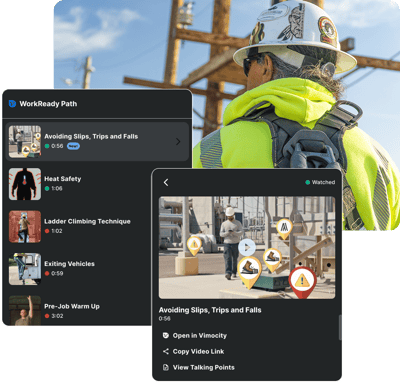
Discover how Vimocity can help keep your crews WorkReady.
One comprehensive platform to help safety and operational leaders prevent more injuries and incidents.