
.png?width=20&height=24&name=Vector%20(15).png) For Leaders
For Leaders For Workers
.png?width=24&height=23&name=Vector%20(16).png) Partners
PartnersPeople First. Legacy Follows.
WorkReady Podcast Episode 54
-
Speakers
William Mojica | Leading A Legacy Book
Dr. Kevin Rindal | Vimocity -
View The Transcript
You build your legacy one day at a time in the decisions you make, the example you set, and the way you show up for your crew. Today, I sit down with William Mojica, author of Leading a Legacy. He's a utility executive with 27 years of experience at some of the nation's largest energy companies, from the field to the boardroom.
Whether you're new to crew or have been doing this work for 30 years, you'll walk away with practical ways to lead right where you are, because leadership isn't what you say, it's what you allow. This is the WorkReady Podcast.
William, what do you hope people get out of this conversation?
Every single day we should be waking up with a passion in our hearts and in our minds to lead a legacy, to make sure that it's making a difference, and transform our thinking from leaving a legacy, which is what most people wait till the end of their lives and, and sometimes just hope that they got there.Transforming people's thinking from that to really waking up every day and saying, "I'm gonna lead one today and take care of the people that, I've been entrusted with," whether it's at work, at home, in everything we do.
William, you spent most of your childhood growing up in Panama, and you had some role models that really influenced your life, and this, specifically this aspect of your life. Can you tell us a little bit more about your growing up and some of the examples that you saw of legacy and leadership when you were younger?
Yeah, I'd love to. I say Panama, people always say, "Do you mean Florida?" And I said, "No, no, no." I mean that tiny little strip, uh, between, uh, North America and South America, the country of Panama, the country that gave me birth so long ago. I grew up there. I lived there for eight years, so I have these wonderful, wonderful memories. When you go to Central America today, to Panama, people still talk about legacy, and one of those legacies is my grandmother. You know, my dad tells a story all the time that I've actually included in the book where she-- Her house was on the main drag in Santiago, Panama.And she saw one evening that police, uh, the, the, the local police of Santiago were brutally beating this man. Um, they weren't stopping. The guy wasn't fighting back. The guy was drunk and probably wasn't doing all the right things out there, but they were beating him to death. And, you know, in her heart, she thought, "What do I do, man?"
She, it felt like her son. She stepped right in, and between those batons that were flying, she took a couple hits, and she forced them to stop. And you think about that small memory, right, that sits in my dad's mind and, and that was talked about throughout our family for so many years. And that's one of many stories, right?
But I think about my grandma's legacy. She, she helped build, uh, basketball courts, and she built, uh, programs for the community. She taught single mothers how to cook so that they could sell that food and then make money from it. I always joke that I go back to Panama even this year. People don't really know who I am.
I left when I was eight. But the moment I tell them I'm the, you know, grandson of Melida Mojica, uh, everyone remembers, and everyone wants to tell me the stories and what they were blessed with. Now, I remember going in the summers. Once I lived in the US, I actually took a summer and lived out in Santiago with my sisters and my grandmother.
And I remember that people would just walk into the house. There was no knocking on the door. They'd walk straight to the house. They'd ask for her. They'd go to the back. People had walked for miles, Kevin, miles- Just to ask for a little bit of money so they could pay for their medicine. And sometimes she would just give them the money.
Other times she would say, "Hey, what can you do? Ca- can you clean windows? Can you clean the yard? We'll make something happen. Let's find a way to help you out." And, uh, you know, that's the legacy she led every single day. That legacy got passed down to my father, and I watched him. I watched him grow, um, in his jobs, in his community, his church.
It was always about people. It was always about making sure that people got taken care of. And it's amazing what individuals can do when they're intentional about saying, "Here are the things that I'm gonna put first." Today I got four sons, right? Ages, uh, 11, 12, 15, and 17, and I watch what they're going through in social media.
You know, just like you, I, I, I know you have a, a young family as well, and one of the things that I hear about all the time is that, uh, social media tells them that making it in life is what you drive, what you make, um, all these things that really have no tangible value in eternity. And, uh, between listening to them, hearing the stories that I grew up with, uh, I'm really intentional about making sure people understand what's really gonna matter at the end of this.
Now you're in an executive leadership role at a, one of the largest utilities in North America, and two things are really a hallmark of your leadership style, and that's taking care of your people and empowering people to become the best versions of themselves. I, I always tell people that everyone wants to get to a high-performing utility or a high-performing company, but the reality is the recipe for getting there doesn't start with the financials.
It starts with placing your people and placing safety at the heart of everything you do. You do that right, everything else follows. In fact, we now know, and I know you know this, Kevin, the companies that start there are the ones that perform the best. And I wanna double-click on a few things 'cause a lot of companies, they s- you know, they talk about safety culture, and they have slogans that say, "People first" or, "Nobody gets hurt today" or, "Zero incidents."
They're all these taglines that are associated with safety. What's the difference between a company that just has taglines versus one that really embraces it and it's em- truly embedded into the culture? Yeah. I, I love that question. You know, I've had the chance now. I've been doing this for, for a number of years, and industry's small, right?
W- I've gotten, uh, the... It's been a blessing for me to just kinda serve in a multitude of areas. And, and I remember advising one CEO that, that was, you know, gracious enough to give me his time, and, uh, they had just gone through an event. The first time I met with him he said, "You know what, William? The year we had the event- We had had a board meeting right before that, and it was our fir- b- our f- best safety year we had ever had.
The numbers were off the charts But when I asked my leadership team how we had gotten there, they couldn't explain it. They could not tell me how those numbers ended up where they were. And their tagline at that time was zero risks. Now, remember that for a minute, Kevin. Zero risks. Not zero significant risks, not zero injuries and fatalities.
You can put a blend of however you want to put that metric, but the, the metric was zero risks. He said, "Man, when I look back, I should have poked more because I think in that we would have figured out we weren't as safe as we thought." Well, I got to g- I got a chance to work for that company later on. And one of the things that I switched when I got there was we went from zero risks to risk reduction as our goal.
And the reason why we did that is good companies do what? They do continuous improvement. It goes back to your question. We have these taglines, right? Um, we put taglines out there like zero risk, and all of a sudden people show up every day wanting to do their best. Their hearts are in the right place, but we've just set them up for failure 'cause the moment they get a cut, the moment they get a trip, the moment they do anything, you've lost that metric.
And I've gone through a change, right? I grew up in an environment where everyone talked about this, this pyramid, that if I have a million events here, I'm gonna have 200 events here and ultimately have 100 events up above that to get to one fatality. I mean, I, I grew up people talking about that. And all this time we were missing the bigger things, the things that could get you killed or hurt.
So I, I think it's really important to understand the data. You know, I, I got this from a mentor of mine a long time ago. You gotta torture the data until it speaks. And when it does, you figure out that what you've been tracking isn't right, the right thing. What should you really be tracking? The industry's had this long shift, and it's hard.
I think, I think it's hard for people. You know, I've been at b- at... I was at that boardroom when we made that change from zero risk to risk reduction as our goal. And at that time, we had a few different board members. We had what was called a quality review board, and one of the members was a very high up individual in the industry.
He was not happy when I brought that up. I, I never forget it. And he was so, uh, you know, upset, I will just put it that way, that I was willing to say, "I would rather have ten cuts than a fatality." That he looked over to one of his board members, an individual who's now a great friend, Captain John Cox.
Guy's got more than fourteen thousand flight hours. Um, he's done a significant number of crashes. You'll see him on TV all the time. He does the analysis on crashes. And he did one of the most beautiful things I've ever seen, Kevin. When they asked him, they said, "Is William correct on what he's saying about this?"
He said, "William's absolutely right. In fact, it's perfectly okay for the wings of an airplane to fall off in mid-flight." And he paused, and the whole room went, "What? This is the aviation expert." He said, "As long as it doesn't happen more than 10 to the minus 9." And with that, he seized the room because what he was saying is there is no such thing as zero risk.
You just gotta make sure the plane lasts till those wings will give out, and make sure you get it out of service before it gets to that point. And that's our employees, right? We gotta make sure that we create enough layers of protection so that when they fail, 'cause they're gonna, something catches them.
And it was individuals like that that actually understood what we were after that helped us start changing our culture. So, uh, just a good example, I think, of, you know, you can't just go with these slogans and not understand what you're saying. People are very smart. Our employees are very smart, and they're gonna call you on it right away when they see it
Dr. Kevin here, and if you're finding value in this conversation and you aren't already subscribed to the WorkReady Podcast, I'd be grateful if you'd take a minute to hit the subscribe button on YouTube, Spotify, Apple Podcasts, or wherever you listen. We drop new conversations every Tuesday, so this just ensures that you're never gonna miss the latest episode.
Okay, let's get back into it
One of my favorite authors is a guy named Henry Cloud, and he's a leadership author. And one of his quotes is, "You get the culture that you create and allow." And so when you say zero risks, what type of culture are you creating and allowing that reinforces that statement? Yeah. You know, Kevin, I think this is just a...
I- it's important to just pause here for a second, right? Like, we're talking about leadership and, and like think about what that means. Like, this is not for everyone. Leadership is this, this, I believe this, this blessing we are given, right? That God allows you to step into this role to take care of people.
Like, that's leadership. Uh, call it servant leadership, and people use all types of terminology now. But what do you create when these people that you've been entrusted with get a slogan or a tagline that doesn't align with what you're really after? You get individuals that still wanna do a good job, and the human being left to themselves will hide injuries, won't tell you about them.
You know, a lot of companies took their safety metrics, blended them with performance, and gave unreasonable expectations that people wanted to shoot for. So what do you saw in... What did you see in the industry? You saw people that didn't want to tell you the truth, 'cause if they told you the truth, they weren't gonna hit their performance metrics, therefore they weren't gonna get paid.
You had people that had families, man, and they wanted to show up every day, and they wanted to provide for their kids. And all of a sudden, you've told them that if they have an injury, and the metrics get shot, they may not have a job. What do you think the human being is gonna do? The human being's gonna run away from that as, as, as, as much as they can.
And I saw that in the industry and, and I kept seeing this, this disconnect. Like, why isn't this working? I've been told my whole life this is how you do it, and yet it's not really working. When you look at our own industry, right, this utility industry where we have the power to power communities and serve them.
You're in a state like Arizona. It's been 105, 110, 115 for those listening for a long time here, right? Since, since March, we've seen temperatures above 100. Not providing good electric power here means people don't survive, and I'm not kidding about that. Is it-- This is an uninhabitable place if you can't serve it well.
So think about that for a minute, right? Look, look at what we are doing. We are asking these individuals that play a significant role in our communities to now not tell us everything that's happening, and we've been tracking the wrong stuff, OSHA, DART, preventable vehicle, uh, incidents, right? And what we told them is, "Hey, we're tracking all that stuff because we know that if we have a million of these, we're ultimately gonna have a fatality."
Look at the graphs, though. The graphs tell you that OSHA, D-D-DARTs, and PVCs came down, but what didn't come down? Fatalities did this, and everyone saw the data. No one tortured it enough to say, "Something's wrong. This isn't working." So how did a culture that didn't allow for truth to be spoken, you know, people to not wanna raise their hand and say, "There's something wrong here," lead to a gas explosion in California, a gas explosion in Ohio of, you know, oil tanker crashing and spilling millions of gallons of oil?
What was the common thread related to the safety culture of those organizations? Yeah, you know, the, the beauty of all three of those incidents and why I use them in my book is that there's actually-- It's not William Mojica telling this ter-story. It's the NTSB, the National Transportation Safety Board, did an analysis of every single one of those incidents.
They're all publicly known. And just to give you a highlight, you know, I think everyone wants to go to Exxon Valdez and right away talk about a captain that was intoxicated. That's what you'll remember all the time. But what people fail to look at when you, when you go deeper and deeper into a culture is that the Exxon Valdez was all around a culture of safety that didn't allow people to speak up, that took people and put them in an environment where Working late, working tired, and not having backups was acceptable, and the moment you spoke up about that, it impacted your performance.
You know, I got to be at Exxon 10 years after that, and I could see how much they had done to change that culture. You think about San Bruno, and you think about that NTSB recommendation. You know, there was always an opportunity to do what we call pigging of the pipelines. Line 132 hadn't gone through that.
In fact, um, if you think about the culture that was there, it was a culture of how do we do the least amount of work so we can maintain, uh, you know, our performance in the market? Now, you think about the people that were there, and that's, that's one thing, Kevin, that I think is so important. The people in those companies are some of the greatest people you'll ever meet.
They were the people that were speaking up, that were saying things, and leadership was pushing them off and saying, "Nah, just put that away." When you have a culture when people can't really show up and be their genuine self... And I tell my team all the time, bad news early is great news 'cause you're giving me an awesome blessing.
You're giving me the blessing to fix something. Bad news late doesn't allow anything to happen. Um, every single incident I've been to, every single one, it's been the company's leadership not creating an environment where people were able to speak up Say something and have that get taken up and resolved.
In fact, it was put to the side so that other more important things, according to the leadership, could take place, the stock market, the ticker price, and all these other things. The NTSB points to that, a safety culture that was broken. You know, I have the incredible opportunity to go on site and interact with leadership and frontline workers all the time, and it's not uncommon to see that there's a big disconnect between the leadership and the frontline workers.
And the frontline workers are like, "Dude, I'm busting my keister every single day out here, and they don't get what I do." And so how do you, as a leader, build that connection with the people who are doing the work and help them know that they can be confident, that they can raise their hand and not be reprimanded, that they can, you know, slow work down or stop work because it's the right call?
Yeah. I, I think it comes in a variety of different ways, right? And, um, you know, Kevin, I, I've only lived in a world of utility employees, right? It's the, the men and women that give of themselves every single day to climb a pole in the-- in, in the middle of the toughest storms that we have in, in, in chaos, right?
When everyone's running from the problem, we're running towards it. Or gas employees where there's unfortunately an explosion or something going on, and they're running to that problem to safely mitigate it. Th-think about that for a minute. You know, these individuals have families, man. They, they're individuals that they're giving you their absolute best, and we're not asking them to scoop i-ice cream at Baskin-Robbins, where if you get the flavor wrong, some kid's pissed off they didn't get chocolate versus vanilla.
Like, gas employee makes a mistake, they're transporting a highly flammable product under pressure. If an inch of it fails, their life could be gone You know, on the electric side, you know, you come in contact with the type of energy we have, um, could be your last day. So, so ground yourself on that for just a minute and, and recognize the fact that it is so important for us as a leadership team to understand, one, the work they do, two, get out there and listen to them and understand what they're going through.
Um, you know, the most powerful part of my job and my career hasn't been negotiating deals or making things happen at companies. You know, those are things I enjoy, and they're fun, and they're needed, and they're essential f- to run a business. Most powerful thing for me has been being out with the, with the field, understanding what they need, understanding what they're going through, championing them.
Um, I worked with a, a, a, a young man, Scott, uh, out of, uh, Pacific Gas & Electric. Uh, hopefully Scott gets to listen to this at one point. I tried recruiting Scott one year, and he wouldn't come over. And I said, "Scott, why aren't you coming over, man? This is a great opportunity." He said, "Dude, I've learned to follow the trucks."
And I said, "What do you mean by that?" He goes, "I never wanna get too far away from the trucks, from what's happening in the field, that I lose track of what's really important." And what's really important is that we're putting these people in some very tough situations. We gotta care for them. You know, you, you and I, the first time we met, we talked about this.
It's like, man, we've been entrusted with these people, and, and we gotta keep them safe. We gotta keep them healthy. We gotta keep them going so that when they get to retirement, man, they enjoy their grandkids, and they have good lives. Um, and we're able to watch them enjoy that. So all in all, Kevin, I would just tell you that for me, uh, the passion really comes from seeing people, uh, be heard and, and people that can show up every day and be their genuine self so that we can help them through, through, through what they do each day.
The other dynamics that I oftentimes see when I go on site is that there's a tension between safety and operations. Operations is like, "We gotta get this stuff done," and safety is slowing us down. How do you balance out safety and speed when it comes to operational efficiency? Yeah. Well, I, I think both of those kinda go a little bit together because I think you prove yourself on how you show up, right?
What I've learned from the very beginning is you can't blow up when people bring you problems. Like, I love that my team brings me problems. That's, that's... A problem is a gift that only a leader gets. Think about that. The higher you go up in a company, the fact that someone's willing to bring you a problem, knowing that they in their heart, in their hearts run a risk of, "Is this person gonna look at me the wrong way?"
Like, the fact that I'm still being brought problems, I consider that a blessing every day, right? 'Cause things aren't being hidden from me. And I recognize there's a filter, right? A senior vice president of a company, there's a filter that's there. But for the most part, you gotta show up, and you gotta be able to say, "Okay, look, when that problem's gonna come to me, how am I gonna react?
Am I gonna blow up and try to solve it? Am I gonna listen? And am I gonna understand that this person truly needs help?" That's my gift. So that's part of it. I think we gotta ground ourselves on that. That tension you feel, I think that that tension's always gonna be there with any company I always say this, though: no matter how much tension we have, safety's always gonna win.
Always gonna win. I know what happens very clearly when safety doesn't win. If you get into a situation where you're having to say, "Am I gonna sacrifice safety, or am I gonna sacrifice the financials or whatever it might be over here?" Safety's always gotta win. And I'll tell you this. If, if that is not your mindset as a leader, you haven't run a company well.
What I've, I've been able to do in my career is I've never taken the easy job. I've always had to have a very difficult road to what we're trying to change. What I mean by that is that when you've seen things come all the way down to the bottom where there's only one place to go, the only way you win that journey with people, the only way you win the hearts, is by saying, "People and safety are at the heart of everything we're gonna do."
Now, that'd be a tough thing to tell you today, Kevin, if I told you, "Hey, but we did that, and the company still ended up bankrupt." I found the complete opposite. I found that I've been able to be at companies where the stock market was saying we were at the very bottom. We were not the highest performing company.
The safety numbers were junk. The compliance numbers were junk. The quality was junk. We focused on people and safety, and we did not deviate from that, and guess what happened? Quality went up. Engagement went up. Safety went up. And at the very end, everyone wanted to buy that stock 'cause they said, "You know what?
We know that company cares about their people. That means they're gonna stay. We know that company cares about safety. That means they're not gonna have an incident. We know that company is gonna last, and that's what we want." If you start the other way, it never works out. So I, I think it's being consistent in your message.
I think you're gonna go through some trials, and people are gonna test you. Um, yeah, I think people test us all the time. I, I talk about an example in my book that I was delivering an award in Indiana, and I was gonna go to these employees, and I was gonna go tell them how proud I was of the work they were doing.
So I had my little award that I was gonna hand out, and I go with the leader. We had a policy, Kevin. The policy at the company, right, wrong, or indifferent, was if you backed in a vehicle, you need it, and you had a second person, that person should be your spotter. If you're by yourself, do it safely, but if you had someone as an extra precaution, have them spot you.
We're backing into the facility, and I tell the leader, "I got you." I jump out And I start guiding him. Think nothing of it. We park the vehicle, we have the celebration, I fly back home. About three weeks later, the leader comes up to me, shows me his phone. There's a video of me. They were standing at the top floor of the building recording me.
They knew I was coming, and we were going through a change in culture, and they wanted to see if leader was doing the same thing. Would the leader do the same thing? And here's what the leader told me. He said, "Dude, I am so glad that you did what you were supposed to 'cause this could have been really bad."
But it goes to show they're always watching. You gotta model that. You gotta live it. Whether it's at home, it's at work, it's not gonna matter. That's what they're gonna be looking for So on this podcast, we talk about the frontline workers seeing themselves as workforce athletes. Why should a company also see their employees as workforce athletes?
Come on, Kevin. That's the only way to live life. You know, you and I have talked about this. Um, some of the most, um, engaged employees, some of the most, I'll say happiest employees, right? Happiness is relative, have been some of those employees that I've seen really take that to heart. What do I mean by that?
Some of these employees we have, have learned that what they do, it's like a gym. Like, if they do it right, they're not gonna get hurt, they're gonna get a great workout. Like, that's how they think. "We're gonna get a great workout, and I'm gonna really enjoy this day." I, I can't tell you everyone's like that, but think about that employee that's, that's gotten that.
That's the employee that's not gonna have a debilitating in, uh, injury that keeps them from picking up their grandchildren or their kids. That's the employee that's gonna feel better at the end of the day. And oftentimes we have to realize that why wouldn't we wanna do this as a company? Th-think about this.
Whether it was in the Midwest where I work, which it gets so cold there that, um, it's brutal. I mean, we send these individuals out to these, these difficult conditions, or where I'm at today in Arizona, like our g- our people don't stop. Our, our men and women keep going. In fact, I, I, I said that when, when the problems happen, they run to them.
Doesn't matter what the weather's like. As a company, we should be driving the safety and the health of our employees. We should be thinking about our employees in such a way that, how do we make sure they make it all the way to retirement, and they still have that energy and that desire and that passion to live life, not in a condition that keeps them from doing everything, but in a condition that keeps them...
that drives them to, to do more? In fact, those should be their best years. And if we really care about people, like, if we really show up every day and say, "This is the most powerful legacy we could be driving- Then every day should be about our people. Every single day we should be asking, "What can we do about that?"
Every single day we should be teaching our leaders that there is nothing more important than people. You will learn everything else. You know, someone may watch this podcast and say, "This is a senior vice president of a company. Why isn't he talking about the financials of the company? Why isn't he talking about compliance and reliability?"
Trust me, I have 27 years doing that. I can do that with my eyes closed. What I think we are missing is how do we take care of these people so well that we see them as our boys, our daughters, right? Our parents, our aunts and uncles. Like, how would you, how would you want someone to take care of your boys, Kevin?
You know how I would want someone to take care of all my boys? In the same way that I'm calling out for this industry to take care of our own people. That's a legacy that we should be leading every single day. So that's where my passion comes from, is they deserve it. We've been entrusted with their care, and we should do everything possible to give them every single tool to be successful in that arena.
I love that. Thanks for that answer. One of my favorite chapters of your book focused on vision, and I think it led off with a, a scriptural verse that said, "Without vision, the people perish." And so why is a clear vision essential in both the good times and through crisis? Yeah, I think, I think we mistake vision so much, right?
We have these beautiful vision statement. Vision, mission, and values is what you always hear people talk about. In fact, every new CEO wants to get in there and change the vision a little bit. And, and I think what we miss, and, and I hear it in employee engagement surveys, I hear it throughout the industry, when a frontline employee says, "What's our vision for the company?"
It's really not what we think. In fact, I, I would tell you what they're really saying is, "What's in it for me, and how can I get you get-- how can I help you get there," right? What they're saying is, "Hey, I wanna know for, for William Mojica, what does that vision mean? What do you want me to do? How do we get there?
What's my role in it?" And, and I think oftentimes we write these vision statements that sound really good on paper. Uh, you can post them on LinkedIn, and they, they kind of get visionary, and you can do all these ch-- you know, have all these discussions about it, and, and that's good for the company. But for the frontline employee, what they're really saying is, "What's in it for me, and how do we get there?"
So I, I've taken a very different approach. I, I always take the vision, the mission, the values of a company, and I try to translate it very quickly into what success looks like. You know, at one company I was at, I took it and I called it the five keys to success People, safety, compliance, quality, and financial stewardship.
And I s- I, I would be very clear with the employees, "That's our-- That's what we're after. That's what it takes." And I knew that it had captured their attention when one employee said, "Say that again? That sounds like our vision." And here's how we would translate. We would teach frontline employees about this.
We would teach frontline leaders, managers, directors, VPs how to tell this. We're gonna place people and safety at the heart of everything we do. Nothing else is more important than your safety and how we take care of you. And if we don't model that, we want you to hold us accountable. Compliance. You know, I worked in a very compliant related industry, and we would say, "That's the price of admission.
That's the ticket to the dance. Without that, we don't have a license to operate. Let's be compliant. Let's do that well." I would say quality. You know, quality's all about doing things right the right way. I don't want you to rush. I want you to do it right the right ti- uh, uh, the first time. 'Cause when we don't do it right, we could put you in a bad scenario, and we're gonna have to do it again.
And then I would end with, "And last, and I truly mean last, we're gonna be good financial stewards." You know, I had a lot of leaders, Kevin, that did this to me. They would say, "Guys, you gotta run this like your business. You gotta good-- be good financial stewards." And they would spend 30 minutes talking about the financials, and at the end they would say, "And remember, William, I want you to do it safely."
What do you think I got out of that message? All I heard was they care about the money. So I think vision is very important. It's how we ground our, our teams to what's truly our true north on our lighthouse, and we can't miss that. Words make a big difference So I'm a, a lineman in a bucket. It's 7:00 a.m.
and already ninety-five degrees in Arizona. How do I live out the vision as a frontline worker? What I would tell you is curiosity is so important because I always try to tell myself this. If I can get every employee to show up every day and say, "Now, what's the worst thing that could happen to me today?
Yeah, I got my wife waiting for me. I got my kids waiting for me. What's the worst thing that could happen to me today?" And then I want them asking, "Man, how often could that happen? Could that happen all the time? Could it happen once in a billion times?" Then I want them thinking, "Okay, w-what controls do I have in place, and what additional controls do I need?"
Now, what I just did, and, and you know this, Kevin, is I just walked through process safety or operational excellence or HOT principles, right, as we've often called them. But I always say, how do you start the day? You start the day with curiosity. You start the day with asking yourself a question that we miss so often.
Now, what's the worst thing that could happen to me? How bad could this thing be, right? How often could it happen? What controls do I have in place, and what additional controls do I need? So I think about this, you know, before I step foot into that job site. I've already th-thought through my surroundings.
I've thought about high energy. I thought about what things are gonna keep me safe. I'm looking around. I'm watching out for my peers. They're watching out for me. I'm curious about what could happen. I'm not assuming I've done this ten thousand times and I'm perfect at it. I'm actually assuming I am gonna make a mistake just like William Mojica has made mistakes all the time.
He's gonna make them again. I tell my field guys all this all the time, right? I collect old Land Cruiser. I talk about them a lot in my book. And I remember I have a FJ60. It's got two hundred thousand, two hundred and seventy thousand miles now. This thing's been with me everywhere. All right? We love it.
It's been, it's been the picnic table. It's, it's been the point of many discussions. We've taken this thing to fishing, to hunting, to every place you can imagine. And I remember I was working on it. I was working on a transfer case, and I forgot one screw that held the ground wire on the transfer case to the main shaft.
And I was in a hurry because I'd been working on this thing for months. And I tell my guys this all the time. I said, "I didn't put the screw in. I should've known better." I backed it out. I went about, uh, you know, two hundred feet, and I ripped the transfer case apart because the main shaft came out. Now, I wasn't, I wasn't trying to do that.
I wasn't trying to fail Kevin, but the human in me did what the human in me always will do, is it failed. And at work, that happens to us all the time. So I beg every employee all the time, be curious about what you do and think about what's the worst thing that can happen to you We started this conversation off about creating a space where people can be honest, where people can raise their hand, and sometimes that, uh, part of that process is giving people feedback.
And not only can it be difficult sometimes to give feedback, but also to receive feedback. Can you share some stories about feedback as it relates to your journey of receiving- Yeah ... it and, and giving it and 'cause it's not an easy thing to do. Well, I, I, I've, uh, feedback and I have been on a journey, I'll say that.
Um, it's a journey of love and hate, and, and it probably started with more hate than with love. Uh, but we're in a better place, uh, today than we, than we were in the past. And, and why I say that is I think feedback was given a, a bad name. I want you to split the word feedback into two words. The word feed and the word back.
And in fact, I want you to-- we're gonna do a little Spanish lesson here, Kevin. The Spanish lesson is what's the word in Spanish for feedback? It's retro, which means go, looking back, alimentación. Retroalimentación. Alimentación is to nourish or to feed. It's the same word, but people rarely split it up, and here's why it's important to, to split it up.
When I was given feedback early on in my career, it wasn't constructive. In fact, it was a way to say, "You're doing something wrong. Don't do it again." It didn't come with guidance. It didn't come with nurturing. It didn't come with care. It didn't come with honesty. In fact, it came with punishment. And I had a phenomenal change in this word when I heard it in Spanish.
In fact, I was at the Hilton in Panama with my dad and my mom. We were at the front desk, and this young lady was on her phone, looking at her phone while we were standing on the counter, and she made us wait for, like, five minutes, and then she was really rude to us while she was checking us in. I could tell my dad was boiling, and he wanted to say something, but his-- he held himself back.
So he waited for dinner. We had dinner at the hotel, and he said, "Hey, can I speak to the manager?" Calls the manager over. He says, "I don't want her to get in trouble. I just want her to give-- to, to be able to learn from what we just went through so she doesn't do it again. Can you promise me she's not gonna get in trouble?"
And the manager at the Hilton said the most beautiful thing I've ever heard. He said, "Mr. Mojica, don't you worry. She won't. We're gonna give her retroalimentación. We're gonna go back in time to see what she did with you, and we're gonna nourish her." Now think about that, Kevin. Do we do that with our teams?
Do we go back and instead of being upset that they made a mistake, that something happened, do we try to really understand the human being who's been with us for so long, who's cared about that work so long, and do we assume positive intent that maybe, just maybe, we created a situation where they weren't gonna fail safely?
Or just maybe we created a situation where we should have helped them out and we didn't 'cause we knew about it. And I'm not saying there's no room for performance management and all that. There are cases for that. But to me, feedback has come full circle. It's changed the way I think. It's changed the way I think and talk to people.
It, it's, you know, I, I use it a lot. I'll tell people, "Hey, can I give you feedback?" And I'll just blow them up with what they're doing well, and they're just like, "Man, I thought you were gonna rip me to shreds." I'm like, "No, man. Feedback's all about nurturing, nurturing the human spirit." And, and I think that's a fundamental shift we need to have, the word feed, the word back, to go back in time and feed someone with what they truly need.
That's actually a beautiful story. I've never thought of feedback in that context. That's gonna stick with me in terms of just reframing how I approach that. So thank you for sharing that. That's a, a terrific story. Like to go back to the book and run through some of your own chapter headers and have you expand on each one of these.
So the first one is lead a legacy each day. And so again, what does that look like for an ordinary person, let's say next Tuesday? How can they start leading- You know, I'd wake up, um, I'd wake up that very next day, and I'd write down what I'm gonna do to lead a legacy today. I would not wait till you got to the end of the year.
I would not wait till you got to the end of your career. I always speak with the guys that just retired, right? I love speaking, "Hey, tell me about, tell me about the 30 years. Tell me about the 40 years." Man, and they... Someone would struggle to tell me, like, what they were proud of. Like, don't do that.
Legacy's today. Like, what's gonna be your legacy? Lead it today. So lead, lead your legacy every single day What is the statement, what you allow is what you teach, and what do you mean by that? You know, I think it goes back to even my example of backing up the vehicle. You know, think about what would've happened that day.
Think about how much trust I would've broken if I didn't back that vehicle up. Think about how my leaders would've had to pay the price for my, uh, lack of following that. You know, people are watching you all the time. My, my employees are watching everything I do, how I do it, what words I say, how I say them.
Do I care for them? Do I not? What you allow is what you teach. You see something slipping, you cause that deviation, you see that deviation, you see that deviation, you see that deviation. You let that deviation go, that deviation now catches up to you at some point. So, you know, it's my way of probably talking about normalization of deviance.
But, um, I, I, I talk in more, uh, of the language that I grew up with, which is frontline language. Um, you know, if you allow it, you're, you're actually teaching people to do that You already touched on this, but I think it's worth, uh, doubling down on. Safety always wins. Why is that the case? Every single day we're gonna battle, and we gotta enjoy those battles we're gonna have, but we gotta understand that no matter how tough that battle gets, um, we're gonna always make sure safety wins.
There is always gonna be a natural tendency. I tell my team, "We're gonna have healthy tension." I also tell them, "If you're gonna bring something to me, and you're gonna sacrifice safety, I don't even wanna hear it. Safety's gonna win. That's, that's our standard. That's what we're gonna live by, and I'm never-- you're g- never gonna have to go home wondering if this guy's gonna make you do something unsafe.
Safety's always gonna win." I think that's, that goes back to vernacular and how we talk to our people and letting them know that there is nothing more important than them. And listen, we can have battles about a lot of things. Employees are gonna tell you they need to get paid more. Employees are gonna tell you they need more of this, more of that.
Those are healthy things we should always be talking about, and we should, by all means, care for them enough to have those discussions. But the reality is, the one thing I'll never sacrifice on, that we'll never have to talk about or negotiate on, is safety. It's always gonna win. Well, I'd encourage our listeners to pick up your book, Lead a Legacy.
And if they do, what do you hope they, uh, learn from that book and walk away differently from that experience? Yeah, you know, I wrote the book in a, in a context where you could actually pick the book, put it down, pick the book, put it down. Every chapter, um, you know, ha- has a Bible verse that I start with.
You know, I'm, I'm grounded in that myself. And I think that helps tell the story about why things are important in life. I think they're very, uh, they tie very closely. But at the very end, it has a get to work section, and I did that very intentionally because I think we need to be doing things every day to get to work.
Like, how do I not miss this? So you can actually read a chapter, work on it for a month, pick it up in another month, go read another chapter, go work on that. And, and what I would tell everyone, it's, it's the tools I've learned from making a lot of mistakes. It's the tools I've gathered from a lot of great leaders that have led companies, CEOs.
I've interviewed people that I've seen make mistakes and come back out of it. And I, I would want everyone to, uh, understand that there's nothing more important than, than our people and, and keeping them safe. If our listeners take away three things from this conversation, what do you hope they are? Yeah, I, I think there's a few things that are really, really important to me.
You know, legacy is, is not something, um, it's not something that is gonna happen on its own. It's something that you're gonna have to create. It's something you're gonna have to work every day towards. And, and I would tell you that, um, that you gotta be very intentional. Um, you know, take that legacy every single day and work on it.
That's number one. Number two, there's nothing more important than people and safety. And I know we've said that quite a bit, Kevin, and I know we've talked about it quite a bit, but I would ask you to really think hard about that. Why is that so important, and how can I do that every single day? And then the last thing is that I, I would, I would have everyone think through the fact that, you know, in 100 years, none of us are gonna be here.
And I talk about, uh, King Solomon quite a bit in my book, and the fact that, you know, he, he tried everything that was known to man, and he talks about it. He talks about building great palaces. He talks about having more wealth than anyone had ever had before him. He talks about the fact that, uh, he even worked hard, uh, which is something we can relate to on this podcast, and he wanted that joy to come out of his labor.
And then after all this beautiful story he tells you about everything he's tried and not worked and worked, he says it was all like chasing the wind. And I think about what his legacy truly was. His legacy was around, you know, having wisdom, and that's how he was ultimately remembered. Um, so I would ask, like, what, what are people gonna remember you by, you know?
And if you haven't thought through that, think about that today, and think about the fact that this is a, a, a short amount of time we got on Earth. Uh, use it to the best of, uh, your God-given ability and, uh, lead that legacy, uh, today. And how can people find you, William? Yeah, a couple different ways. Uh, William Edward Mojica on LinkedIn is probably the best way.
I'm always open to a good dialogue, a good discussion. If you go leadingalegacybook.com, it's, uh, you can find my book as well. Uh, or you can get the book at, uh, on amazon.com or any of the platforms that are out there. But if you'd like to, you know, get ahold of me, feel free to reach out. My email is also williamemojica@gmail.com.
I really enjoyed this conversation. There was just so much gold in it, and I just really appreciate the way that you approach your leadership and that it's people first. And the tagline that I end every single podcast episode with is, "Take care of yourself, take care of your people, and stay work ready."
And this conversation was totally in line with that. So thank you so much for being on the show. And until next time, thanks for joining us on the WorkReady podcast. And keep doing that. Take care of yourself, take care of your people, and stay work ready. Thanks so much
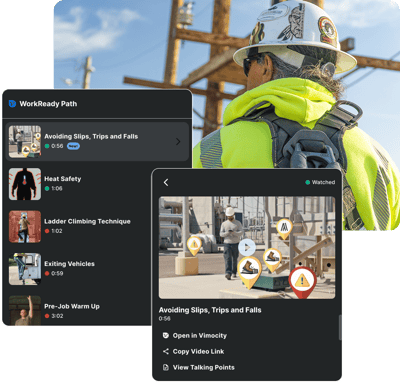
Discover how Vimocity can help keep your crews WorkReady.
One comprehensive platform to help safety and operational leaders prevent more injuries and incidents.