
.png?width=20&height=24&name=Vector%20(15).png) For Leaders
For Leaders For Workers
.png?width=24&height=23&name=Vector%20(16).png) Partners
PartnersHigher Maintenance, with Micah Thompson, CLCP
WorkReady Podcast Episode 42
-
Speakers
-
View The Transcript
The buzzword right now is psychological safety. How do you break through? I can show you numbers, but numbers don't always work, man. You gotta hit 'em not just in the wallet, you gotta hit 'em at home. Authenticity, knowing yourself. People say, "You gotta read the room." True, but I have to read me first. Beck Smith, mental health is not a safety issue.
Total garbage. You and I are designed to carry things, not bury things. Who likes change? Nobody. Anybody wanna lead change? No. Okay, good. Get up, follow me.
My guest is Micah Thompson. He's the director of loss control and training for the Electric Cooperatives of South Carolina, where he's responsible for keeping linemen safe across 18 cooperatives. Micah, welcome to the WorkReady Podcast.
Man, thankful to be here, Kevin. Appreciate it.
Your hat and shirt, it says squirrel on it. Can you tell me a little bit more about the story behind that?
In 2015, as a apprentice lineman, uh, Columbia, South Carolina experienced the flood of the century, and so we had some very significant damage to our cooperative infrastructure, weeks of restoration in underground subdivisions versus overhead infrastructure, and it came one day when we had worked in a neighborhood for many, many weeks and days that it was time to do the restoration on a large section, and my entire company was there almost and, and my whole office was there, and I was working and, and doing what I needed to do, and we were in a backyard next to a giant switch cabinet, and the superintendent whistled and called me over where he was at, and I ran over there, and he put his arm around me, and he looked at me and he said, "Papa needs a squirrel."
And I looked at him like he was crazy, and I was like, "What are you talking about?" And he pointed up a pole that was right beside the switch cabinet, and it was the nastiest C8 three-phase double dead end you'd ever seen in your life that had cables coming down into the switch cabinet. And for all the linemen out there, on the end of the arm was a lightning arrestor blown, but it wasn't blown in the clear.
And that was his way of saying he needed me to climb the pole and change that out. And so I ran back to the truck to get my stuff, and though it could have been a joke like, "Hey, everybody, look, look what Mike is doing," I didn't hear that. I heard a guy in a leadership role say he needed me, and that changed my life.
I couldn't wait to climb that pole. I couldn't wait to be a part of that restoration. When the lights came on, I had skin in the game. When I got my hooks, I was thinking, "Why me? There's 30 other dudes with 100 more years of experience than me." And I tell everybody in the leadership training that I do, he saw something in me I didn't see in myself, and he instilled confidence in me that I didn't have in myself.
And so because he needed me, nothing could stop me. So after I s- told that in a class at a conference on leadership, the following days, man, the boys were blowing me up, "Papa needs a squirrel. Papa needed a squirrel. I need a new squirrel. My squirrel's broke," and sending me photos, and I, I told my wife, I was like, "Man, maybe that would look cool on a shirt."
Hopefully here soon, I'm gonna have my website ready at Higher Maintenance to sell some of it if anybody wants it. It's been... It's catching on pretty good. Such a cool story. Thanks for sharing that with us. Well, Micah, you're one of the people that I follow pretty religiously online. You have a great social media account on LinkedIn, uh, and then Instagram, and you go by Higher Maintenance, uh, on social media.
Where did that name come from, and what are you trying to say with it? So who I am at the core is founded in my faith, and I found a lot in the utility industry when I was a lineman, but especially now as a safety guy, there's an extreme amount of overlap and opportunity for training, learning, and leadership.
Um, and it has, uh, again, some spiritual aspects in it too. So, you know, in my daily life at work, some of that stuff, uh, doesn't have a place, but, you know, when I had the opportunity to kind of branch out on my own and do some things, I just... I had high maintenance as a, an older LLC, uh, when I did side electrical work climbing towers at the school district.
But now through this role I'm in, uh, as a safety training and instructor and doing leadership training, there's so much overlap, uh, for the things that we do in safety, leadership that have spiritual connotations or, or, or the same type of language. So higher maintenance is just something that my wife and I decided to use from an older, uh, part of our journey.
And I believe, you know, that, you know, if we look up, um, we can get some help. And so, you know, it's just part of my heart, part of my mission is to take some of the things that I know cross over in this industry and, and, and change the perspective of it from a spiritual standpoint. So Micah, y- your, uh, technical role is a loss control, uh, supervisor leader within your organization, within the cooperatives, and a lot of people don't understand what a loss control person does day-to-day.
And oftentimes they're like, "Oh man, that's a person who comes in with a logbook. They're gonna audit us. They're gonna, you know, we've gotta be on our best behavior." But how are you trying to change that perception of what a loss control, um, person actually does in the field? For a safety guy now, or a safety nerd, I like to call myself sometimes, yeah, there's a stigma and a stereotype behind the safety guys.
They're not, um, not necessarily with the best reputation. Um, again, to each their own. That's not everybody, but I'm one of two loss control training directors for our association, uh, myself and my, my coworker, Travis Rinwick, and I didn't know what loss control even meant- As a lineman in my co-op, or even maybe when I truly got to statewide, I didn't know until I talked to a gentleman who worked here for 33 years that loss control is one of the definitions of an accident.
It's a series of events that somebody lost control of. And so our department is loss control and training, and so we're trying our best, again, in our department over the past, I'd say two and a half, three years, to shift from just strictly compliance to a deeper dive into why we're seeing trends, why we're seeing the same thing, why it's the way we've always done it.
And we've reshaped the training we've done at our school, we've reshaped how we're going and, and doing these safety meetings. I call it following the bouncing ball. You come to one of our meetings, you're not gonna get the cookie cutter, uh, roll out, you know, slide deck. So it's been fun to have the freedom from our staff and management to do that, and then why do we do it?
People matter. People matter, and we're literally talking about lives and changing lives. Do you think part of that, why it's different for you, comes from your experience of working out in the field and then transitioning into director of loss control versus just someone who's a professional safety person?
Having lived it, having experienced it, having had my own shortcomings, having had my own accidents, my own near miss, my own close calls, uh, is a huge benefit. Um, because one of the things that helps me relate, uh, in a meeting is, "Let me tell you how I know what we need to do versus what we're doing, and let me tell you what I have done and I have seen."
And putting myself on blast, so to speak, as an example, uh, carries a lot of weight in a room full of linemen, especially at 6:30 in the morning when it's safety meeting time. So, uh, it's a huge benefit. And then also, I've sat in those rooms for 15 years, and I've seen the bouncing ball and I've seen what's effective and what's not, and I know what attention span looks like and I know what it looks like when an individual loses the room.
And so I have the opportunity to fight against that and, and work really hard not to do the same. Yeah. Can you share some of those learnings? Like what have you found that's been effective that has kept people's attention or, um, broke the norm of what people think about when it comes to a safety meeting?
Number one is authenticity Knowing yourself. Uh, people say, "Oh, you gotta read the room." True, but I have to read me first, and I have to know who I am first. I, I had imposter syndrome when I got this job because I took over for a guy who was a Mount Rushmore in our state and had been around and done some amazing work, and I struggled for months to go, "Man, I can't be that guy."
And finally, the good Lord was like, "You're not supposed to be. You go be you. If I wanted two of him, I would've made two of him." So number one, be authentic. I would tell that to anybody. Number two, don't be afraid to fail. In a training environment, in a learning environment, it's called failing safe. We need to be able to fail in here and have the courage to try new things in here so that our linemen don't have to try new things and have a fail-safe moment out in the real world.
So Einstein said, "Tell me, I'll forget. Teach me, I may remember. Include me, and I learn." So for the past two and a half, three years, we've made a lot of our training as best as possible with the topic interactive. I'm not standing up here for 30, 40 minutes giving you everything I got, and you don't do anything.
No, you're gonna work, too. And having the courage, again, to try new things. I'm thankful I have safety directors who are like, "Yeah, let's go for it." Um, this year for the first time, I'm gonna try to take the safety meeting out on the job. I have a truck now and equipment to where I can do a quick tailgate, literally, pop-up, 15-minute slide deck, and meet the guys out in the field instead of in the training room, and I got two co-ops that are on board with trying that.
And then even out at our school, last year for the first time, we took a class out and had class in the right of way with camping chairs and, and nailed the whiteboard and everything up on the pole down in the training yard. Get them where they wanna be. Meet them where they wanna be. You and I don't oftentimes like being trapped in the room, so am I willing to do that on their behalf?
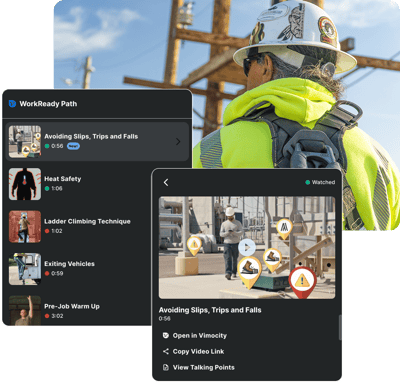
And if it fails, it's my fault. If it's a success, it's 'cause we all did it. As a safety leader, you have more risks to cover than hours in the day. That's where Vimocity comes in. We give you one platform to scale your impact, delivering expert-curated safety campaigns on everything from slips, trips, and falls to heat stress and soft tissue injury prevention.
You'll reach every crew through the channels they already use while gaining data insights to guide smarter prevention. With Vimocity, you can boost awareness, prevent serious incidents, and keep your workforce ready for the job. Scan the QR code or visit vimocity.com to learn how leading utilities are cutting injuries by 50%.
So much of safety feels like people are just trying to check a box rather than really trying to engage people in a meaningful way. And it sounds like y- some of those approaches of k- bringing the camping chairs out, nailing something up on a, a, a pole so that you can actually meet people with where they're at.
How have you seen that, uh, be received by the frontline workers? They love it. They love it. 'Cause I, I'm kinda evil, too. I don't tell them it's coming. Like, we had them in class for a week, and we went out on the training yard to do things we needed to, and then Friday it was like they thought they were gonna finish their classroom sessions, and I, and I just said, "Who likes change?"
Nobody. "Anybody wanna lead change?" No. "Okay, good. Get up and follow me." And they didn't know where they were going, and we walked out the building and down the, down the, the yard there and took a right down the right of way, and there's a classroom set out there, and you could watch them all just doing exactly what you're doing.
They were like, "No way. Okay, thanks a lot." They appreciated it. They appreciated the effort that we were putting into them and their learning environment. So if you can be authentic and, and again, challenge yourself, think outside that box, it's great. Man, compliance is, uh, untraining humanity. I love those stories because, again, it, it meets people with where they're at, and probably helps them feel more comfortable sharing near misses or sharing close calls and so that it become, it can become a learning and not just, again, being scared to speak up because you don't know if you're gonna get reprimanded for making a mistake.
Have you found that that has caused people to open up and share different ideas for how policies can change because now we're talking about it? Yeah, absolutely. It's freedom. It, it's freedom, um, without, you know, retribution or, or, uh, I've heard you talk several times on other episodes about the stigma in our trade about speaking up, about saying something.
And appreciated people, which everybody at their heart wants to be appreciated, from a kid to somebody in their 90s, that's a human thing, not a lineman thing. So when somebody's appreciated, they're more efficient and safer. The guys that I had foreman for me who appreciated me and took care of me, I would do anything for them.
They weren't safety rules anymore. Um, that guy made me know I mattered. And so when you make somebody feel like they matter, then they're, they wanna speak up. Then you get even more ideas from the collective, not just one person. What are some of those, uh, ideas that have come up that are out of the box that you're now starting to implement across all the different cooperatives w- that you oversee?
So, a, a big one that I think the co-ops kind of got ahead of, and, and some people in the industry may have already seen this, but, uh, virtual reality training is big for us, uh, now in the co-op space. We partner with the NRECA, um, who's got, you know, utility software that we can use and implement for, uh, all kind of training, uh, overhead or underground.
So that's been amazing. And then again, just the little things in the weekly meetings, whether we're, we're not even doing a slide deck, we're doing a round discussion, uh, where it's just absolutely everybody gets to share, and we just facilitate the conversation as it goes or, or something interactive where it's, you know, linemen are competitive.
So if you can, you know, if you can make a game out of something, a competition out of something in a healthy environment, that's, that's great. And then there's two national programs that are statewide, helps facilitate for the NRECA and Federated, uh, Rural Electrical Insurance Company that are just game changers when it comes to speaking up and getting engagement and really looking in the mirror and seeing who we are.
And so having the opportunity to run those two programs, uh, is just a blessing as well Micah, you've analyzed injury data, you've looked at injuries that have happened and tried to dissect, you know, all the different factors. What are some of the patterns that you've seen as you've started to, you know, uncover little bits and pieces of, of how those injuries ended up happening?
So I'd, I'd like to speak into that in regards to a session I sat through when I got my CLCP certification. So for years in the trades, uh, there were no rules, and so it took rules to, to start to tear down the trend and the accidents that we saw. And then after that, when we had rules, it was, "You know what?
We need more training. Uh, we need more training." And training curved those numbers again. And, um, again, a great presentation from a, a, a safety professional from Caterpillar spoke, and where they've seen the construction numbers, and even I would say this mirrors the utility numbers, kind of leveled off, and we tracked some of that data through our partners like Federated Insurance.
But man, I think for me, the root of all of it is literally decision-making and why we're making those decisions and what influences it. And I think it's a comfort level, and I think it's a situation where we've never experienced something, and experience drives decision-making. And I also think it's us giving ourselves the physical and mental reward for getting away with it.
And I think utilities is a, is a great sandbox for all that because linemen are all about restoration sometimes and being efficient with getting the power back on. And so if there's 10 ways to do something and I can figure out how to do it in nine, you know what that means? I'm gonna do it in eight. And it's just shortcuts breed shortcuts, and why do we, why do we give shortcuts?
It's habits. It's literal habit-forming data processing that we do from, from things we don't even consider. So one of my favorite safety stories that I have is a, is a cooperative that I went to where a lady, um, stood in a chair, man, and I have this beautiful photo of these giant feet prints in the chair.
And when I took the photos, no one was in the room, and she walked in and saw me take the photo, and she was so mortified that I saw the feet print standing in the chair, and I said, "Why'd you do it?" She said, "I needed to reach the cord behind the TV." And I said, "Okay." And we had a discussion. I said, "Where's the step stool or the ladder at?"
She said, "Way over there in the other building." Nobody's ever said that, you know, "What I need is way over there. I don't have time." So it's priorities. It's getting away with things, and I love to tell my guys, she stood in the chair not to get the cable. She stood in the chair because she stood in it yesterday and nothing happened Micah, one thing that I just keep thinking about, and you and I have had c- these conversations about this concept of workforce readiness, which is being physically, mentally, and operationally prepared for the work ahead of us.
And oftentimes when I talk to safety leaders, they talk about complacency and, uh, that person was just complacent. But I think that takes away from just all the stress that people are under out in the field. I mean, there's the physical stress of, of performing the job. There may be mental stress related to things that are going on at home.
Um, maybe they're not getting enough sleep. They've been working overtime. There are all these things that chip away at that readiness. How much of, uh, you know, the accidents and injuries do you see being related to the workforce readiness, uh, component versus just complacency? The stuff that we see and track here locally, um, even as a statewide association, uh, we don't even get to hear about all of it from our safety directors or our co-ops.
We do hear some of the bigger things that happen that they get to choose to share with us or not. But again, when, when you take a dive into the ones that you hear about and know about, for the most part, I would say our cooperatives here do a great job of maintaining a, a really good safety culture. And the ones that I'm aware of when you look at them, it's never really the huge job It's never the conversion, it's never the, you know, the reconduct job, the quad circuit pole.
It's these little mundane, every day, we've done this 1,000 times, and we let our guard down. Or it's, or it's something that we're not even... You know, like to your point, um, you know, his mind wasn't in it. Well, do we really know why? Do we really care why? Is anybody asking, you know, upfront how we're doing when it comes to that?
Uh, another thing we've had the chance in the last six months to really step into is that mental side of it, and I've got, you know, a couple stories of my own where I experienced it, one as an apprentice and then another one as a crew leader, where I had to... I had somebody step in on my behalf, and then I had to step in on someone else's behalf as a foreman to keep them safe.
And so, man, it's, it, it's a, it's never the giant job, man. I never hear, "Oh, the, you know, it happened on this big job." For us, it's, it's those little ones that sneak up and get us 'cause we let our guard down. And again, some of it we're just preoccupied 'cause everybody's going through something. Mike, uh, you, you've probably experienced this on different crews that you've been a part of.
You can tell that somebody, you know, may be having relational issues at home, financial stress. Uh, they may just be worn down just from like not getting enough sleep. How do you as a safety person, um, and leader bring up something like sleep, finances, or a guy's home life in a safety conversation without it feeling like you're stepping over a line?
Sure. That's, um, that's a definite tricky situation sometimes. Um, so I think there's two things. I think anybody gets the opportunity to do that who's building and establishing relationships through an organization. We spend so much time with each other, we tend to know each other very well. I've got friends in the industry that I've had for 20 years.
Again, we're in the bucket, we're in the cab of the truck, we're in the break room all day, and most of the time everybody is sociable and to each their own. But if you just know somebody on a personal level, then I think you get to do that. And again, it takes courage to do that. Now, number one, you have to have the type of heart to where you see them beyond the paperwork.
And, and you see that again, man, it's not that-- it's not that that guy's off today, it's just, no, something's not normal. And so I've just done some training on this in regards to mental health, and I'm using the analogy of a lockout tagout. Now, you see a lockout tagout on, and, and it's placed on a device where something is not in a normal state.
I've twisted that to lean on and tag out, being able to lean on others, trying to train guys how to be leaned on and how to help others in that way, and then tag out, "I need a break." You have to be an advocate for yourself, too. So I think personally, there's that relationship piece, having the courage to do it.
Now, how do you get that out of them? It's not just gonna be with, "You good?" You, you may be able to do that. It may be little things just by going, "How's your weekend?" And then hearing anything that they may wanna share. And not that you dive right into that, but you just watch and keep an eye on them throughout the day.
See if there's a phone call. See if they step off. See if something happens where it shifts again, and then, "Hey, that wasn't about that thing you told me." And again, none of your business, but if you really care, you can ask that. Or you use yourself. As a safety guy, I get to use myself. So if I have a suspicion where I heard something or I think something may be going on, then I can say, "Man, man, let me tell you in a conversation what had happened to me one time."
And if you put yourself out there and create vulnerability, it may open the door. So that's all number one. Number two, if you're in a leadership role, you have a responsibility to say something. Uh, through your HR, through your work program at your company, at your association, there's parameters set there, there's programs in place, there's help, there's resources that again, having the responsibility of others under your supervision, you have to do.
And I had to do that one time in three and a half years where I made the decision for a guy that, "You don't fly today. You don't go up until we get to the bottom of what's going on." Not easy, not popular, but again, life is in the balance Those are, that's a great example because those are tough conversations to have, and yet it, it was the best thing for that person that day.
And so appreciate you sharing that, that example. It happened to me real quick. It happened to me. I had a foreman hide in the parking lot and wait for me one morning and put his hand in my chest and say, "You good?" And I said, "Yeah, I'm good." "No, I need you to tell me if you're good." And I said, "Yeah, I'm good."
And he said, "Well," and then he told me what he already knew was going on because I had had to make some decisions about some things after hours and at the office and he said, "Nah." He said, "You're gonna have to tell me what's up." And then again, he created an opportunity for me to get my head right. He created work for me to do, uh, for a couple days that I could stay productive and still do what I needed to do, but I didn't have to fly.
I didn't have to get into approach distance. I didn't have to do anything that would jeopardize myself or anybody on the crew. And so I had an example of what that looks like. Uh, it was worth-- I s- I was worth it for him to come in early and wait for me in the parking lot. That made me feel amazing. Yeah, and again, he was probably thinking, "Man, there's some risk here.
I might, I might really tick Mike off if I do this." But I mean, at the end of the day, just like what you said, you felt cared for. You felt like somebody was actually wa-watching your back. And I think that that's probably, you know, one of the number one things to take away from that is that, you know, it feels vulnerable to, to approach somebody and to have that conversation, but when you do it out of love, when you do it out of, you know, "I've got your best interests in mind, and I'm not gonna leave here until, until I can create a situation where you can get that off your chest and I can put you in a safe position," I mean, that's a great example.
And he didn't know it, but he was planting a seed and teaching me something that I had the chance to do for somebody else, and we don't often see that in that moment. I'm a cheesy quote guy, so here you go. You may not sit under the shade of the seeds that you plant, and so do the work anyways. So- it's going to matter.
It will make a difference So let's expand on that a little bit more. So from the operational side, if we're talking to, to foreman or someone who leads a, a crew, how do they help create that-- I mean, the buzzword right now is psychological safety, but how do you create an environment where people feel like they can stand up, uh, and s- or, you know, share what's going on or, uh, you know, you get beyond just the rules and the compliance and you really get down to, you know, the nuts and bolts of what's going on and what needs to be, uh, spoken about?
Yeah. Again, I, I don't wanna sound like a broken record, but it's, it's, it's everything we do in life is relationships. And even in a work environment, I think a good foreman, a good crew leader, a good supervisor can do that. And it doesn't have to take all day, and it doesn't have to take every day. But linemen are kinda simple, men are kinda simple, so it could be a small thing like a, just a quick huddle up in the morning.
It could be a, a biscuit. It could be a, it could be, you know, a, you know, give a guy-- give all the guys, "Hey, here's a, here's a small thank you." Uh, but on a more day-to-day operational piece, tailgates. Let a ki- let a guy, let a younger guy have a voice that literally is gonna speak into the job. Maybe not the quad circuit, but you know, the single phase out in the middle of the field, "Hey, it's yours today from the dot to the dot.
I'll be right here. You run it." Because what happens now, you've given him the experience. When I made a crew leader, the next day I, I, I immediately went to some crew leaders and said, "Hey, my bad. I, I get it now. I understand now," one day in, the weight of what those men do in a leadership role. So we encourage that a lot here.
Tailgate. You know, what does everybody think? Years ago, that was not a thing. You don't look at this work order, you don't look at this paperwork. This is my clipboard. You go get the ice and shut up, and just do what I said to do. And so it's a, it's an environment where they're seen and heard and given an opportunity to speak into it.
And then again, fail-safe. Oh, you wanna try something new? Let's try it. It's supervised. We're in a controlled environment. We'll try that idea, and if it sucks, now we know If you were to give one piece of advice, Micah, to that 22-year-old apprentice listening right now who feels bulletproof and, you know, they can do anything, what, what would that, uh, advice be?
I met him today. This morning- ... I was at a cooperative doing a crew visit, and there was a, a younger guy there where we were framing the pole asking some questions, and, uh, he was newer to the cooperative and, uh, he said, you know, somebody said something about his name or nicknames and they said, "Oh, he's got a nickname."
I said, "What's your nickname?" He said, "Oh, just Crusty old contractor." And I said, "Okay, you came from a contractor?" He was like, "Yeah." I was like, "How old are you?" He said, "22." I said, "Man, I got socks older than you. Crusty old contractor? What are you talking about?" So sorry, I literally had this conversation today.
What would I tell him, man? Number one, don't blink. Don't blink. You're gonna blink, and you're gonna be the old guy. And so number two, right now, you need to take care of the old guy, and don't let the old guy do nothing, and take care of the old guy. That's not written anywhere, but one day, if you're lucky, that old guy is gonna love you enough to teach you something, and then you'll have the chance to be an old guy Micah, you know, in the trades, your body's your most important tool, and it's the one that often gets neglected the most Yeah, you're exactly right.
A, a thing in my space around my co-op years ago was you only get 10 good years out of a lineman. Once they top out, you'll get 10 good years out of them, and then that's it. Uh, and then they, you know, you put the old lineman on the service truck out to pasture, right? Because they're broke down. I think there's a lot of conversation about mobility and preparation and upstream dieting and upstream, you know, calisthenics and, and we teach ergonomics as one of our safety classes that we do, and what that really looks like for linemen.
They don't really realize that and how much ergonomics has infiltrated into that space. Um, it helps that I married a PE teacher. Um, my wife taught PE for 21 years, so I, I know the importance of those things. But yeah, it's something that I think we're only gonna get better at, and we have to start somewhere, and convincing linemen that it's important is gonna be tricky.
Um, I like to say you just have to get in front of them almost as an influencer, there's a reason that it's called an influencer, and figure out a way to make it popular and cool. Yeah, and how do you break through? You know, you get that resistance, but how do you frame it in a way that people understand the benefit to them that it's gonna, you know, elongate their career to take care of their bodies, that it's gonna, you know, bring 'em a heck of a lot more m- money if they can extend that career out.
It's, it's gonna, you know, help them be the best version of themselves 'cause they're not broken down. Yeah. Um, the conversation you had, um, with, uh, our boy, America's favorite lineman, uh, I'm, I'm not gonna steal that answer, but you're right. The money part should motivate everybody to have a long-lasting career and still have the opportunity to provide the things they need to provide and want to provide.
But then I think be an example of that too. You have to show up and be an example of it and show people the actual benefit of it. And then again, from a safety guy, I can, I can show you what happens if you don't. I can show you the injury rate. I can show you the retirement rate. I can show you where the accidents lie with not the younger guy, not necessarily the older guy, it's those mid-range guys who are comfortable and don't think, you know, that anything's gonna happen, like you said, bulletproof.
So yeah, I can show you numbers, but numbers don't always work, man. I have to make it personal, so you gotta hit 'em not just in the wallet, you gotta hit 'em at home Mike, uh, Michael, let's move into the myth-busting section. So I'm gonna ask you a series of questions here, and love to hear your answers. So myth number one, safety is the safety department's job.
Total garbage, and I've got history to prove it. Um, one of the most prized things I have in my possession is a second edition lineman cableman handbook. The first one came out in 1928, so we're about to celebrate 100 years of cableman handbook rules. And in 1942, in the safety section of the handbook, the number one thing in the list that you and I have to have to do this profession and do it safely is self-possession.
It's written in the handbook. You have to own it. The airlines figured this out. Put your mask on first before you help somebody else. It-- You can have the best safety team ever. Doesn't matter. You can have all the rules you want. Doesn't matter. How do I know that? We've had 100 years of rules. Somebody got hurt today, unfortunately.
That's not gonna change it. You have to own it. You have to realize how important it is and realize how valuable you are to yourself, and then also the ripple effect of your injury Rick Smith, if you have time to take care of yourself, you must not be working hard enough It sounds, it sounds almost arrogant, but if I can't take care of me, then I'm no good to the company, I'm no good to myself, I'm no good to my family.
And so men are not good at self-care or whatever you wanna call it, 'cause we just strap more on and go, and that's what we got taught to do. You and I are designed to carry things, not bury things. So there's a big difference. Self-care is huge Next myth, mental health is not a safety issue Total garbage. My...
I just scratched my face 'cause my brain said so. My movement is based on my processor up here. And so if something's off up here, if it's fuzzy, foggy, if it's buffering, I need to reload, I got a heavy heart, there's... That, that affects everything else first. And my environment and how I pers- perceive things affects that too, but if, if you're off up here, you're off everywhere else.
Let's move to the rapid-fire questions. So Micah, what's the best piece of advice a lineman ever gave you? Man, that's a good one. Um, I was having a conversation with an older lineman, and I said... I was trying to agree with him and, and let him know that I knew something, and I said, "Yeah, yeah, you gotta take care of the little things."
And he said, "Micah, there are no little things. They're all big things." Love that. What's one piece of gear you refuse to work without? It's gloves. It's gloves. In the hierarchy of everything, they're the last line of defense, but I, I would say gloves, man. Our rubber gloves. What's the most underrated habit for a long career in this trade?
Rest and a day off. We like to brag about how much vacation time we got. I think that's a horrible stereotype we need to tear down. I think I see guys now that, you know, are, are having these long careers, and congratulations, and that's all great, but, you know, retired with this much vacation hours and these sick hours.
Not me, man. I need to rest. I need to rest. We're not good at resting. Good answer. What's one book, podcast, or person every safety professional should know? So WorkReady podcast, right? Of course. And then, uh, man, I would only say, because I'm in it now, and I'm gonna continue to recommending it, I- I'm just reading a book right now called The Shepherd about leadership that has changed me in the past month in a real significant way.
Can you explain w- uh, a little bit more on why that book, uh, has been impactful for you recently? Yeah, because we have an influence. It can be positive or negative. It can be conscious or unconscious. And when we're conscious to it, I think you can make a real impact in people's lives. And I think if, you know, again, being, being in a position to change or affect somebody else and see somebody grow and develop, um, and then again, from a safety guy, keep them safe, which is what a shepherd does, it's, it's given me a new outlook on what rules are and what fences are Micah, what's one habit that has changed your life in the last two years?
I can't go two years, but I can go four months, um, through some recent things that have happened, which I won't go into, and that's really trying not to be a hypocrite about work-life balance. And I've come home in the last four months and to the best of my ability, not perfect, whoever the first person to greet me and say hello is, I give them my phone and say, "Go put it wherever you want."
And trying to be present and have the balance and rest I need to work. Work will be there in the morning. Awesome. Thank you so much for sharing that. So Micah, for the person listening to this driving home, they've had a long day. They-- If they remember three things from this conversation, what should they be?
Be the leader and the influence in somebody else's life that you always wanted in your life. And everybody individually knows what that is and what that looks like. And so I would say that, number one. I would say number two, stay authentic to yourself. Know yourself. We're not here to be everybody else.
Again, safety, again, service leadership, not popular, not trending, and it's not about me. And then number three-
I would recommend for anybody to know spiritually where they're at with themselves and their family, and that's really what drives me to do everything I do. I love it. Well, Mike, uh, this has been such an awesome, uh, conversation. I just truly appreciate your authenticity, uh, just the way that you lead, um, j- with humility, that servant leader mindset.
I think it allows people to feel, uh, able to be the best versions of themselves and again, just know that they're cared for and that this isn't just compliance, it's, it's in their best interest. It's helping them grow and, and just be safe. So thank you for your leadership out there. Where can people find you, um, either online or, uh, through different avenues?
Yeah. Thanks again for letting me be here, man. I never would've dreamed, uh, that I'd be doing this type of work and meeting guys like you and, and the work that you're doing even all the way across the country. Uh, uh, again, it's such a cool thing, and four years ago I was in a ditch and climbing poles and, and now I'm doing this, so I'm so blessed.
And if people wanna find me, LinkedIn is the, is, is where I really love to call home. Um, so they can find me on there. And again Higher Maintenance SC is where I'm at on TikTok, and I'm working on a website now because I'm gonna finally hopefully in a month or two, get some merch out there that I had the opportunity to, to create and tell a leadership story about what impacted my life.
So LinkedIn, find my profile on there. I do have a YouTube channel where I post my own podcast that I started over a year ago called Hot Mics with another industry leader, Mike Starner, who's the director of safety at the NICA Association for Contractors. So shout out to Mike and Hot Mics on YouTube and Higher Maintenance SC and LinkedIn, man.
So that's me. Mike, I'm so grateful to spend time with you today. Thanks again for joining us on the Work Ready podcast. If you haven't subscribed, make sure to hit that button, whether it's on YouTube, Spotify, or Apple Podcasts. That just ensures that you're gonna get the next episode directly in your feed.
We release new episodes every Tuesday, and so until next time, take care of yourself, take care of your people, and stay work ready. Thanks so much
Discover how Vimocity can help keep your crews WorkReady.
One comprehensive platform to help safety and operational leaders prevent more injuries and incidents.