
.png?width=20&height=24&name=Vector%20(15).png) For Leaders
For Leaders For Workers
.png?width=24&height=23&name=Vector%20(16).png) Partners
PartnersWhy Safety Has No Rank
WorkReady Podcast Episode 49 (Part 2)
-
Speakers
Dr. Wayne Chappelle | PsyOPTIMAL
Dr. Kevin Rindal | Vimocity -
View The Transcript
Welcome back to the WorkReady Podcast. Last week, we started a conversation with Dr. Wayne Chappelle about what it actually takes to perform at your best under extraordinarily difficult conditions. Today, we're gonna pick up right where we left off with real-time stress recognition and management. If you haven't heard part one yet, go back and start there.
By the end of this episode, you'll walk away with something you can put to work immediately. Now, let's get into it.
In every situation, it doesn't matter if you're a professional athlete, a special operator or, you know, working in the trades, you're gonna encounter different circumstances that put stress on your entire system and are gonna challenge that. How do people recognize those stresses, not let them become the focal point and be able to navigate through those challenges that are being placed on them mentally?
Yeah. So part of that is self-awareness, right? So when you, when you are aware of your stress level, you can determine is your stress level now so high that it's, that it's now degrading my mind and my body. A good example would be if you're, you're driving down the road, you've been on the road for a long time, and you look over and you see the warning light from your engine come on saying, "Look, it's overheating."
That level of self-awareness is consistent with the mind and the body. You have to be aware enough that as you're driving things, as you're driving yourself through these demanding situations, to get an idea in terms of where your stress level is. And to make it simple, let's just say that your stress gauge is on a scale of zero to 10, 10 being really high, zero meaning not at all.
Now, when your stress level is hitting an eight, nine, and ten, that's when we have concentration problems, that's when we have composure problems, where our emotions are getting the best of this. This is where we have communication issues in which we might be really rough around the edges, drop a few F-bombs and a, a few, you know, words of profanity.
We're, we're not gonna necessarily socially and emotionally be our best, and in some cases, we might actually be a, a bit impulsive as our, as our stress levels get the best of us. So if you go to a typical psychologist, they'll tell you, "Oh gosh, you have high stress? Let's get rid of that stress. Let's take it down so that you have no stress, because the n- the less stress you have, the better you are."
Here's again, I want you to take that thought, I want you to write it on a piece of paper, and I want you to torch it and burn it, because that is absolutely not the case. See, if you have no stress, on a scale of zero to three, meaning very low, you're either gonna become too comfortable and too complacent.
If I looked at a special ops guy, and we're about ready to jump into enemy territory and perform a mission, and he looks at me and says, "Yeah, Doc, I'm not stressed at all," I'm gonna be like, "Do you understand the realities of the situation that we're in? Do you realize everything that go bad?" Now, I'm not saying this to make you overly stressed.
I'm saying this to get you stressed because it's-- When you have no stress, you're too comfortable, too complacent, and you're not gonna be concentrating on the things that you should be. So the optimal state of stress on that scale of zero to ten is between five and seven. Why? Because the brain, the speed and accuracy of information processing is at its highest.
See, it's not so high that you can't concentrate And it's not so low that you're not complacent. It's right in the zone, and this is where you begin to process things that are most relevant. So if you wake up and you have no stress, the goal is to elevate it so that you're more vigilant, prepared, and aware.
If you have too much stress, the goal is to bring it down into that five to seven zone. See, we think of stress in terms of black and white. You either should have it or you shouldn't. Mm-mm. You wanna have the ult- optimal levels. If I have a pro athlete that I'm looking at going, "Hey, we're going into the playoffs right now.
One, there's five million people that are watching us tonight. Uh, two, we gotta win. Uh, three, you're getting paid four million dollars a year to do this, uh, and there's another thirty thousand that are in the stands. How you feeling?" "Oh, gosh, I'm completely relaxed." I mean, like, you ain't primed to fight, man.
Um, or I can have an athlete who's going, "Man, my heart is pounding out of my chest, and I'm super nervous, and I'm anxious." Now we, we reduce their stress in order to get it to the point where they can think and operate at the highest level. Um, so that's a strategy. So that's, one, recognize it. Two- As you walk through that door and you know you're hitting eight, nine, and ten, man, you've gotta, you gotta make sure that your communication with your children and your spouses is really sharp.
First of all, it's important they accept and they understand that what you do is very difficult, and there's gonna be days you're gonna walk through the door and it's gonna be fine, but there's also gonna be days you walk through that door and it's not gonna be fine. And they have to understand that if you walk through that door and you say, "Today I had a very rough day," that they don't dismiss that, that you have a strategy in place in which you can then go and decompress and, and, and, and disconnect from that workday.
So take that time so that I can have the best version of you. So part of that as a, as you as a lineman, you've gotta let your spouse know, you gotta let your kids know, "Hey, I do really tough, dangerous work. And two, in order for me to be there for you, I may have to engage in some form of self-care to help navigate the stress of my mind and to bring it down."
Another thing I think is important to note is you never wait for the storm to prepare yourself in the storm. You gotta prepare yourself ahead of time. Most people think, "I'll just rise to the occasion. When the crap hits the fan, I'll go ahead and, like, do what I need to do at that point in time." Are you kidding me?
That doesn't work that way. You have to have a game plan in place and prepare for the storm before it even arrives. You're not gonna know on the horizon when the storm is gonna occur, so you've gotta prepare. So this is where you talk to your wife and your kids ahead of time. This is where you have strategies ahead of time that really work for you, that you're able to engage in for at least forty-five minutes to an hour, that allow you to decompress, so that that way when you, when you feel it, you're already prepared and know what you need to do before you even walk through the threshold at home
So helpful.
And you talked about having a wingman as being so important, and I think that that's a really critical piece because in the trades, people admitting that they need someone else to walk with them, it's just-- it's not common. I mean, most people are like, "Ugh, I can do this on my own. You know, I'm a maverick."
And there's just kinda that mentality. So how do people, number one, recognize that having, uh, a wingman is important, and then how do they even approach someone and, and say, "Hey, can you be my wingman? Can you help hold me accountable? And let's, let's have this, uh, be something where we both get better together"?
Well, this is where leadership is really critical. So if you are a supervisor, especially of linemen, it is incumbent upon you to communicate the importance of wingmen. You are a wingman to them, uh, in some e-some extent, because, one, you gotta provide corrective feedback, and, and two, you gotta be able to not just simply have the smarts to know what to do to, to accomplish the mission and the task, but you have to strengthen and be there for your people.
Um, and many leaders are really good at being task-oriented, but they're not as good at being people-orientated. So part of this is ensuring that you are messaging that everybody needs a, needs a wingman. And not only do we need a w- need a wingman, we need to be a wingman. And so now what happens is we're a wingman for each other.
That's the expectation. It's not an aspiration, it's a requirement. It's not like something that might be nice to do. No, you have to do this. And so when that becomes the case, it's easier to receive feedback. It's also easier to be vulnerable. Being a wingman means we're willing to have uncomfortable conversations.
We're willing to put ourselves in the face of that conflict. So I have to share with everybody, your, your linemen, your teams, your supervisor, nobody, nobody ever becomes the best version of themselves by themselves, but always through the collective support of the men and women who they're surrounded by.
You wanna see where somebody's gonna be in five years, just find out who, who, who they're surrounded by on a daily basis. And, and we need, we need wingmen, no matter what. I don't care how successful you are. Um, yeah, I'll give you an example. A general-- Do we all know General Petraeus? Yes. General Petraeus, we called him King David.
We-- He was a four-star general that we brought in to clean up some parts of Afghanistan and to do a really good job. The guy has an impeccable career, thirty years in the Army, went up from, from the ground all the way up through Special Forces, and truly is an amazing individual. Now, what people will remember General Petraeus as is the man who got caught having an affair.
And he lost his position as a four-star general. Now, what's interesting is that general, General Petraeus, is surrounded by a group of other people always. So I interviewed that group of other people, and I said, "When you saw that occurring, what did you say?" I s- they say, "Oh, I said nothing. Said nothing." So fast-forward this.
They're bringing me to Virginia to an off-site for all these generals who just pinned on, and I'd go, "Okay, guys, we're gonna talk about General Petraeus." And they go, "Yes, we know. Don't sleep with our biographer, and don't have sex with people in our chain of command." I go, "No, no. It's not the moral of the story."
See, the moral of the story was the failure of the wingmen who were near him. When I interviewed the people who saw it going on and they said nothing, my recommendation to General Sevy Wilson was to fire all of them immediately
See, if you watch something happening and you see somebody making destructive decisions and you say nothing because you're too afraid to have an uncomfortable conversation, then you don't have the courage to be a wingman, and you don't have the courage to be on our team You have to understand the importance and the value of a wingman, and not only having a wingman to you, but you being a wingman for others, because nobody ever becomes the best version of themselves by themselves.
This is true. This is very relevant. I've been working with Shai for the last two years, and Shai has been the MVP of the NBA for the last two years. And when you, when you interview Shai, especially after a game, he waits. He waits for five or six teammates to get behind him because now he's on the spotlight.
They're gonna interview him about the team and what he did and all this other good stuff, but he waits. And as he's there, all these guys are around him, and why? Because he looks at himself going, "I can't do what I do, and I can't excel at what I do unless I have these group of men behind me And it's like that even for, in my opinion, linemen.
Now, you're gonna find some guys that are just not cut out to be linemen, that are wearing the lineman, uh, badge, but you gotta, you gotta be able to correct that individual.
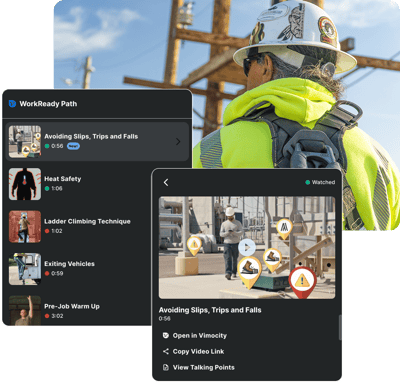
With Vimocity, utility leaders are cutting injuries by up to fifty percent, keeping crews safer and powering stronger operational readiness.
Teams stay engaged, your safety impact scales across every work group, and you gain the insights to prevent serious injuries before they happen. Vimocity delivers expert content, seamless deployment tools, and real-time risk data in one workforce readiness platform. Learn more at vimocity.com.
That's a-- those are great stories, and this hits home. I just had a conversation with someone yesterday, and there was a journeyman lineman who, uh, died on the lines. He was electrocuted, and he was doing some work. He should've covered the lines with, uh, with rubber, and he didn't. The apprentice who they interviewed afterwards said, "Hey, I even told him, 'I think we should, you know, follow procedure here, put the rubber on the lines.'"
And he's like, "I've done this 1,000 times. It's gonna be a quick job. Let's just do it without." And that younger apprentice, uh, you know, should've had that stop work authority, should've been able to, um, communicate to the entire crew, "Hey, we've gotta stop. We've gotta do the safe procedure." But they just continued on, and someone lost their life.
So in that situation, h- what would you recommend to that apprentice, or what would you recommend to the foreman on the job to create that environment where that stop work authority does happen?
Um, safety knows no rank Safety does not care about rank. And you don't know if that guy who says, "I've been doing this a thousand times," if he had something going on in his life emotionally, personally, that he wasn't thinking correctly, that even though on the outside he was composed, underneath the surface he might have had a lot of stuff going on that was causing him to make reckless and perhaps careless decisions.
And we've all been there. We've all been there at some point in time in which we've made careless and reckless decisions. What I would say to that apprentice is your job is to protect. And as a result, if you see something where we- somebody is becoming either blind or complacent to sustaining safety, I don't care if they are a four-star general, you gotta let them know.
Um, I'll give you an example. Uh, General Rand was a four-star general, um, and we were sitting around the table trying to figure out how do we improve selection processes. And ar- around this table there were, there were several, uh, other generals, um, and, and then you had myself who was kind of like, kind of in the peanut gallery, right?
Lo- one of the lower ranking guys in the room. Um, still an officer, though. I think I was a major at the time. Um, and he says, "Guys, here's what I'm thinking. This is what we're gonna do." And all the lesser ranking men around the table said, "Sounds like a great idea, sir." And then Staff Sergeant Jamie, the lowest ranking person in the room, he stood up and he said, "Sir, that's a stupid idea.
And let me tell you why. Here's the con-- If you decide that this is something that you're gonna do, just because you can doesn't mean you should. Let me tell you what the consequences are and, and the elevated risk that that decision would create." And General Rand stepped back and he was like, "Man, I'm impressed."
And he looked at this, his other generals, the l- the, the one and two stars, and he goes, "Why did you not say anything?" Why did you not say anything? Now there's two lessons to be learned. Safety knows no rank Not at all. The best idea always wins. Doesn't care who it comes from We always need to be protected from ourselves at times.
And if you're not-- if you are too uncomfortable to tell a boss no if you know it's a safety issue, then you don't belong. You don't belong. So yeah, you, you have an obligation and a responsibility to protect your brother or your sister, whoever it is, regardless of the rank that they wear. Um, so just know that.
Now, you might get in trouble, and they might look at you and go, "Wow, that's stupid," but you won't have any regrets.
I love that. Safety, safety has no rank, and, um, and that always has to be the priority.
Well, and there's also regret too. Can you live with that decision? And I have an idea that the apprentice, and my heart goes out to the apprentice because maybe nobody trained him or encouraged him, or the culture wasn't there, but that's a decision that he'll have to live with for the rest of his life.
And I know that there is-- there are gonna be times where he wakes up with regret, and that's hard to carry.
We were preparing for this conversation too. One of the things that I think is just so intriguing about the work that you're doing presently, especially with the Oklahoma City Thunder, is they're a small market, uh, NBA team.
I mean, they're, they're not the Knicks, and they don't have the budget, but they have, like, broken some unbelievable records. I mean, records that have, uh, stood the test of time in the NBA forever on a small budget. But it's-- it really comes back to the culture that they've developed and the work that they've put into the individual players building that resilience, but then being able to come together and work together as a team.
Can you talk a little bit about some of the, the characteristics that stand out with that organization and the things that you've done to help them identify the right players, um, for that organization and then how they've continued to, to grow and develop and how that relates to maybe a foreman who's trying to put together a high-performing team, uh, for their crew?
So, um, again, I'll try and make it, like, very, um, simple. Um, when, when you're looking at somebody to be a part of a team, the first time-- the, the first thing that we traditionally look at is do they have the education and the skills to perform the task? And oftentimes that's where eighty to ninety percent of the interview goes is I just wanna make sure as I look at your resume that you've hit all the certifications and all the training and had all the apprenticeship that you need in order to perform this task.
And I might actually watch you perform a task so I can see a sample or an example of your work. To get a good idea in terms of how good you can perform. That's only half of the equation. M-many organizations and many hiring practices focus exclusively on that. However, it's also important that you really understand what are the emotional, behavioral, and social traits that that person must exemplify.
Must exemplify. I need to repeat that. Must have in order to be successful. So whether it's emotional stamina and toughness to humility, to courage. Courage is not the absence of fear, but the ability to work through that fear effectively. To compliance, which is I'm gonna do it the right way re- not the speedy way, right?
Uh, um, to trust, to openness to thinking about things differently, to being behaviorally flexible. Once you identify the top seven to nine traits that you know is needed for this person to personally adapt, not just simply to the stressors of the job, but to the social atmosphere, to the other team members, how well they can adapt, how well they can adjust.
Um, see, when you pick up Jared McCain, when we picked him up from, from, uh, the, the previous team, the Sixers he was on, we weren't just looking at his ability. We were looking at can this guy actually connect with the team? Does he actually exemplify the very traits that are a part of the culture? Man, not only did he, as soon as we picked him up, he blended in with the team like he'd been with us for ten years.
It's awesome. So think in terms of the, the traits that are needed to be successful and that you have to work and exemplify those traits just as well as you have to have the knowledge and the skills to do the job. It's how well can you also emotionally, socially, and behaviorally navigate and adjust to the culture.
Now, some of you asked, or also as part of that question What are some of the things that make a great small market organization compete, especially with the Goliaths of the, of the NBA or perhaps teams of the NFL, teams that have just deep pockets and you don't have those pockets? Well, one is relentless pursuit of progress.
The relentless pursuit of progress. That means I don't have a casual attitude about it. I have an intense attitude about it. And it's not just progress with regards to how well can I do the job. It's progress with how well I manage and navigate and care for the people. Man, I'll tell you what, you can be really good at what it is that you do, but if you're an asshole, you ain't gonna, you ain't gonna last.
You're gonna be gone. Uh, you might've been really, really fantastic, but man, if you created toxicity, ain't nobody gonna want you around. You're gonna be done. I've seen people be let go who were extraordinary at what they did in terms of the tasks, but were terrible emotionally, socially, behaviorally.
That's not a good fit. No, we're not firing you because you can't do the job. We're firing you because you can't do the-- you can't work with the people. You can't do a good job of interacting with the people. Well, wait a minute. I, I did, I did my job well. Yeah, but you really created a lot of drama in the process, or it's really difficult to communicate with you, or we don't know what we're gonna get when it's a, you know, cold, rainy, wet, miserable day.
So no, you do the job. Most of the time you do it well at an extraordinary level, but man, who you are in the process is toxic, so you're gone. Um, now everybody likes to point out the toxicity in other people versus the toxicity in themselves, right? So you gotta be able to look at yourself in the mirror and go, "Honestly, what do I need to do to constantly and relentlessly pursue progress to be a better version of me?"
Um, so yeah, that's, that's part of it. And then you also gotta know your why. You gotta know your why.
Comes back to purpose again. You've, you've mentioned that two times in, in, uh, this interview, so appreciate that. And Dr. C, how I first got acquainted with you is I, I listened to you on one of my favorite podcasts, which is the Craig Groeschel Leadership Podcast, and you were talking about the book that you just released with, uh, with Craig Groeschel called Heal Your Hurt and Mind.
And so I'd love it if you could share a little bit more about that book, what prompted it, and some of the key takeaways from it.
So this is something I think is really important for linemen to know, and it's directly rel- relevant to this book. Um, this book was me working with one of the most prolific and prominent leadership developers in our nation.
And people would look at him and go, "Wow, you got it together. You are awesome. You look great, and you perform at a high level." Well, appearances can be deceiving. Um, and even though a person was still performing and doing exceptionally well, below the surface, they were still struggling with things like anxiety and burnout and even some aspects of trauma in their life, and it was costing them a lot of emotional energy, and they were pretty uncomfortable, and they were pretty miserable And my job was to help them work through some of those things so that they can become better and have greater longevity in the career that they were in.
And so a lot of the stuff that is in this book is really things that I do with professional athletes. It's Fortune 500 companies, linemen, special duty operators. Every chapter looks at something that we're all gonna, as human beings, struggle with at some point in time, and the suggestions aren't just to help you overcome so you can not struggle and survive, but the suggestions really are to help you thrive.
And interestingly enough, you may not be experiencing some kind of negative emotional state, but the recommendations in the book for navigating your emotions to developing a, a, a resilient lifestyle are relevant to any ordinary individual who wants to perform and become extraordinary in the things that they're, that are important to them.
So awesome, especially individually, but organizationally, you know, we work with a lot of very large organizations, and so for someone listening who may be in a leadership position and they're looking to bring some of these concepts to their organization, what, what would that look like in terms of organization-wide implementing some of these, uh, strategies?
Oh
my gosh, it's very, very simple. In fact, I'm, I'm doing that now where, like I just finished up working with and this entire police department where we assessed everybody. Everybody got their, their individual reports, and then from that, we also have collective aggregated reports of the entirety of the staff, and then the, the police chief was able to go, "Oh my gosh, I know now what I need to do, and I know what I need to invest in that would be in the best interest of my people.
I thought it was this over here, but because you came in and did these evaluations and we see exactly where it's at, now we know exactly what we need to do."
Dr. C, this has been such a great conversation, and we covered so many incredible topics. It's hard to boil it down to like one or two or three things, but if you were to leave our guests with just three things that they could step away from this conversation with and apply to their life, what would those three things be?
Yes. Oh, I love it. First is be intentional with your daily habits. The small, ordinary habits that you do consistently develop you to become extraordinary. So that intentionality of diet, rest, exercise, the small things, um, they add up. They're ordinary things, but be intentional about it. Um, two, self-care is not selfish When you engage in self-care, you might say, "Man, I spent an hour at the gym, but I took it away from time I would have spent with my wife or my daughter or my son."
You are in a better position of being able to be present with them when you engage in, in a level of self-care that helps you emotionally, socially, and relationally, mentally. Um, it's not the quantity of your presence, it's the quality of your presence. And if you could be with them for three hours but be only partially there mentally, well, that's not gonna sit well.
But if you've engaged in self-care and you're fully present with them for twenty to thirty minutes, that's more valuable than the three hours. Um, and then also be understanding that the idea that nobody ever becomes the best version of themselves by themselves is very, very real. Um, even the greatest have people that they have to rely upon.
And so what that means is constantly, relentlessly pursue progress. If you look around and go, "Oh, I'm totally fine. There's nothing I need to work on," you've become complacent. Whether it's complacency in the workplace to complacency in your personal life, it usually brings disaster. I'll tell you what, in war, uh, what kills people oftentimes is complacency.
I don't need to be vigilant. I don't need to be ready. I'm totally fine. I'm totally comfortable. And then all of a sudden, the rockets and the mortars are coming. Um, so yeah. Those are the three things.
Thank you so much. And is there anything we didn't cover in this conversation that you wanna make sure that we leave people with?
Um, yeah, I'd have to say that, um, people would think that spirituality isn't very important, and, uh, it is. The spiritual component of your life is absolutely critical. Now, if, if you have a belief and you're willing to, to open up and be connected with that belief, man, I'll tell you what, you will navigate moral and ethical decisions and complications with a greater foundation when you have stronger spirituality.
But let's just say that you're like, "Well, I'm an atheist," or, "I don't believe necessarily." That's okay because if you define spirituality as having a clear sense of values, the values in your life that are important to live by that are in alignment with who you desire to be, when you have a clear perception of the values and who that individual looks like, you can become that best version of you because now you have a compass.
You can say to yourself is, "Am I acting and responding in a way that's consistent with the values of the person who I aspire to be?" And when you have that, you're able to navigate complicated, difficult conditions with a greater level of clarity.
Thank you for leaving us with that. And Dr. C, how can people find you?
There's two, two ways people get ahold of me. One is drchappelle.com, which is D-R-C-H-A-P-P-E-L-L-E.com. And then the other one is PsyOptimal, which is P-S-Y-O-P-T-I-M-A-L.com. And if I can't interact with you personally, I will have a member of my team. So if you call up and say, "Man, I, I think I could benefit from three or four or five sessions and kind of help me become the best version of me," man, we're on it.
And if I can't do it for you personally, I will make sure that I have very good providers to interact and meet with you and to meet that need.
Dr. Chappelle, thank you so much for your time, sharing your insights. This was just a fantastic conversation. I'm so grateful for the time that we've been able to have together.
And if you aren't already subscribed to the Work Ready Podcast, make sure you do either YouTube, Spotify, Apple Podcasts, wherever you, you find your or listen to your podcasts, just go ahead and hit subscribe, and we drop new episodes every Tuesday. And until next time, take care of yourself, take care of your team, and stay Work Ready.
Discover how Vimocity can help keep your crews WorkReady.
One comprehensive platform to help safety and operational leaders prevent more injuries and incidents.