
.png?width=20&height=24&name=Vector%20(15).png) For Leaders
For Leaders For Workers
.png?width=24&height=23&name=Vector%20(16).png) Partners
PartnersFrom Ordinary to Extraordinary
WorkReady Podcast Episode 48 (Part 1)
-
Speakers
Dr. Wayne Chappelle | PsyOPTIMAL
Dr. Kevin Rindal | Vimocity -
View The Transcript
I really wanted to know what does it take for the ordinary individual to perform extraordinary? You've worked with most elite special forces. Now you're working with professional athletes. What alignment does makes what professional athletes do child's play. Now, this is where psychology screws things up. The more emotionally connected you are, the better and healthier you are. That is absolutely a load of crap.
Dr. Wayne Chapelle, you've worked with the most elite special forces. You served yourself in the military for many years. Now you're working with professional athletes all over the country. But it started out when you were younger. Your dad was a lineman in Northern California. Can you tell us a little bit more about that?
I grew up with a father who was a lineman for 35 years. I would watch him go out underneath some of the most extraordinarily difficult conditions to work. And I'm like, "Wow, these are not easy conditions." While everybody else is huddled underneath a roof and staying dry, this guy's out there in the snow and the wet and the rain.
And oh, by the way, even in the summertime, it could be beating down at 100 degrees, and he's out there working. Um, and so watching my father over three, almost four decades, uh, serving the role of a lineman, I believe shaped my interest in terms of how do people excel under extraordinarily difficult conditions.
One of the things we talk a lot about on the WorkReady podcast is that, these folks are athletes. I mean, the work that they do is physically demanding. They're in extraordinary circumstances where mentally they have to be sharp. How do you see the parallel between the trades and, um, the professional athletes and special operators that you've worked with?
Yeah. In particular, I think that there are some very salient, um, some very salient similarities to the special operations. So in the, the world that I worked in, it was with combat controllers, special operations air crew, uh, oftentimes Army Rangers all put together into small teams to go down range to perform extraordinary missions.
And what you realized was they had to have a specific mindset. In addition to being physically fit and capable to perform, to perform tasks under physically demanding conditions, they had to have a level of mental resilience that allowed them to stay emotionally composed and, and not to say, "Hey, I don't have fear," but to have the courage to work through that fear and to work through it well.
They also had to work well in teams because sometimes you change up who you're with, but no matter what is it you do, nobody ever becomes the best version of themselves by themselves, and nobody can ever accomplish a mission alone. And so the other thing that I see that's very similar in the special operations side of the house with lineman is the importance of being able to communicate and interact with each other under extraordinarily difficult conditions.
The other thing that I think is very important is in the special operations world, we have what is called a wingman. A wingman is somebody who we trust, that we connect with, that shares the same job, same profession, but who's there also to look out for us, to protect us, especially when we have blind spots or we become complacent or we become confused.
And a wingman, we think, is somebody who's really nice and sweet and supportive and says wonderful things. No. You need a wingman who's willing to punch you in the face too, and that is to tell you really difficult things to prevent you from doing things that would either cost you your life or the life of others.
That-- those are essential requirements in the special operations world, but it's also a requirement in being a lineman because there might be days in which you're tired, you're exhausted, you're fatigued, and you're gonna go and perform a routine task and yet miss a couple of things. But if you got a wingman who's next to you, he can k-keep you from getting electrocuted.
He can keep you from, you know, losing an arm, a leg, an eye, um, all those other good things. So those are requirements. Um I also see a lot in terms of sometimes it's difficult to compartmentalize the challenges of work and separating work from home. So if you've had a really, really tough, stressful, demanding day, you still have to, when you walk through the threshold, you know, as a husband or a wife, still have to deliver to your spouse.
You still have to be present and available for your children, and that's not easy to do. So a lot of, a lot of similarities there. With professional athletes, um, there's also a lot of similarities in the sense that your daily habits and routine are very much a requirement in order for you to be able to perform well in games and practices.
So your behavioral habits and routines in terms of how much sleep you get, how much rest and recovery you have, especially after dealing with a very stressful and long overtime, sixteen-hour day at times. The, the diet that you incorporate, how you eat, the supplements you take, and how much you exercise and work out is a strong predictor and correlation to your success as a lineman Well, I can't wait to dive in to some of these areas at a deeper level.
Can you tell us, uh, though first a little bit more about your professional background and how that kind of launched you into what you're doing now?
Yeah. So when I went into psychology, I really liked the idea of really helping people who are struggling. So if you have anxiety, depression, some kind of addiction, what can we do to help you overcome those and understand the function of the brain so that you can, you know, do well and function well?But I just wasn't satisfied with that. I really wanted to know what does it take for the ordinary individual, the average person to perform extraordinary? Um, because we oftentimes think that the reason that people who perform at an extraordinary level somehow have some kind of unique special talent or ability that they were born with, that it was innate within them.
And what I discovered, that's not the case. Anybody, any ordinary individual can accomplish the extraordinary under extraordinarily difficult conditions. And so I started studying Olympic athletes, and I-- and then I'm like, oh my gosh, I'm, I've just finished up with seven years of graduate school, and I don't wanna be, you know, looking at mac and cheese and tuna fish as like an exotic dinner for myself and buying the cheapest beer.
I need to actually like make a little cash here. Where do I go, and how can I continue to study how, how these ordinary individuals can be extraordinary? And that's where I did an internship in the military. Now, what I didn't realize is God had a plan. He says: Look, I know you don't think that you're gonna be involved in war.
You're a psychologist. You're in the back end. But when you get to your first assignment, I got something planned to you. My first assignment was Fort Bragg, North Carolina, in-processing September tenth. This is after I did my, uh, two years of internship and residency in the military. I was pinned on as an officer, as a captain, and I in-processed September tenth of two thousand and one.
And the world changed, and literally within two weeks, I had these people from Joint Special Operations Command come over and say, "Hey, we got this whole unique world of special duty operators, and we want to train you and work with you because you-- we know of your interest, but we want to- Help train you on how to select, identify, and also train individuals to mentally be prepared to do extraordinary missions.
And that set me into the world of special operations. And, uh, we got really good at it. And then General Wilson, Sevy Wilson, who was a four-star, said, "Man, I need you to start doing this with the generals. I got one and two-star generals that need this." Um, and I'm like, "Well, wait a minute. These guys are like pilots.
They're, they're, they're, they're former Rangers. I mean, these guys are highly capable and intelligent." He goes, "Yeah. What worked for them one year doesn't necessarily mean that it's gonna work for them the next year. And oh, by the way, I can't have a commander who is in charge of the lives of others and millions of dollars worth of assets signing divorce paperwork or having serious marital, marital and relational problems and thinking that they're gonna perform their best.
So I need you to really work with them at that holistic level." And then, uh, about five years ago when I turned fifty, I looked around and I go, "Whoa, I've been doing this for twenty-two, twenty-three years. I'm the old guy. I'm like the dude who's got gray beard, uh, and no hair involuntarily." Uh, most people, they don't make it in this sort of arena past mid-forties, and I've already been well beyond that.
And so I'm like, "Man, Lord, I don't know if I can keep up with this." Now, the other issue is I was also working with allied nations, several different allied nation countries, because some of our special ops is joint. And, uh, as soon as I finish that prayer, the phone rings and it's the Thunder, and they're like, "Man, we've seen all these publications that you've done in the behavioral science about how do the ordinary become extraordinary, what are the traits that are relevant for success in demanding conditions, and, uh, can you, can you apply it to professional athletes?"
And I'm like, "Well, ain't nobody dying. All you gotta do is put a ball through the hoop. Hmm, I think we can do that."
By the way, what a linemen does makes what professional athletes do child's play. See, professional athletes are gonna play on a court under controlled conditions. The air, the temperature, all controlled.
The, the court is the same, the rim is the same, the backboard is the same. All, always they're gonna be playing in controlled, desired conditions. Linemen? Not even that way. Not at all. And you could wake up thinking today's gonna be a good day and not realize, oh my goodness, this is like chaos right now.
This was completely unpredicted, and having to respond to challenging and very difficult situations where you've gotta be on your best. You could be physically fit and in great shape, but man, if you're mentally not in the game, yeah, you're gonna get hurt. Um, or somebody else is. So that's a little bit of my, my background.
Now I've been working with, um, the Oklahoma City Thunder for the last four or five years, helping them to rebuild, working with the Seattle Seahawks. Um, I have a dozen NFL players across the league that I work with, um, PGA golfers that I have on the tour now, and then, uh, individuals who, who have large businesses, typically in the neighborhood of maybe a hundred million or more, um, in terms of revenue and assets.
And it has been absolutely, um, a blessing. And so for me to be on your show to talk about linemen, that's more my wheelhouse than it is, um, you know, working with, uh, senior board executives making, you know, financial decisions Dr. Kevin here, and if you're finding value in this conversation and you aren't already subscribed to the WorkReady Podcast, I'd be grateful if you'd take a minute to hit the subscribe button on YouTube, Spotify, Apple Podcasts, or wherever you listen.
We drop new conversations every Tuesday, so this just ensures that you're never gonna miss the latest episode. Okay, let's get back into it
What are some of those key attributes that you identify in those top performers? What I'm gonna do for, for your listeners, I'm gonna, I'm gonna boil it down. I'm gonna make it very simple. But what I wanna do is I wanna back up just a little bit so that they understand what we're talking about in terms of mentally thriving.
So think of mental health as on a continuum. Now, most people think they either have mental health or they don't. It's either good or it's bad, but it's not that way. Think of it on a continuum. On one end is struggling, where there you have the presence of some kind of emotional, social, or behavioral problem that's really preventing you from being able to show up and work and/or function at home.
That's struggling. Surviving is, "Man, I'm doing relatively well. I'm healthy. I'm fit emotionally, socially, behaviorally. I'm actually doing relatively well on a sunny day under ordinary low-stress conditions And if somebody says, "Yeah, I'm performing exceptionally well," on a sunny day under controlled low-stress conditions, you're not thriving.
You're just surviving. Thriving is the ability to perform at an exceptional level under extraordinarily difficult conditions continuously, routinely. That's thriving. Most people assume that they're thriving, but in reality, they're just surviving. So what does this look like? It could be that you're a lineman who just pulled off a sixteen-hour shift while working under raining and flooding conditions, and you had to be very socially and, and cognitively aware so that what you were doing, um, didn't cost you your life or somebody else's.
When, by the way, now you go home, and you still have to be emotionally and relationally present to your spouse and your children. Oh, and by the way, you need to make sure that the bills get paid and some of the stuff that's in the, you know, sink gets cleaned up and a few other things. That's-- If you can routinely do that and perform at a high level, that's thriving.
So, so we gotta get that out there because most people, again, they assume that they are thriving when in reality they're just surviving. Now, 'cause by the way, there's no excuses. There's no excuse that you can say, "Well, man, it was-- the reason I, I, I did a poor job or I made him a lot of mistakes is 'cause the conditions and the environmental climate I was working in were horrible."
Yeah, guess what? That's, that's not acceptable. It is an expectation and a requirement that you perform extraordinarily well under extraordinarily difficult conditions always. Not sometimes, but all the time. Um, now, what are the traits that go into that? So I wanna break it down and make it very simple: ability, stability, and motivation.
Now, most people assume that when I talk about ability, I'm gonna talk about your job training, your job education that helps you perform the very skills that are required on the job. Mm-mm. This is a little bit different. It's related but different. When I talk about ability I'm talking about speed and accuracy of information processing.
Your ability to remember, your ability to solve problems, your ability to think complexly at a complex level, your ability to reason, good judgment. Your speed and accuracy of information processing is directly correlated with your behavioral health habits. The things that you do intentionally on a daily basis that affect your overall physical health, because the mind and the body are connected.
The better you take care of your body, the, the greater the speed and accuracy of information processing. Now, why? Because your job training and your education can only help you with certain things, but there's a lot of stuff as a lineman that you're gonna es-- that you're gonna get exposed to that they didn't teach you in the textbooks, that they didn't teach you in terms of on-the-job training during your, you know, your, your internship or your, your, um, the time you were bui- developing your trade So your ability to think and solve problems continuously is absolutely critical.
And so when you talk about your rest, how much you exercise, how intentional you are about your supplements, how well you take care of your, your, your, um, heart, your lungs, your muscles, all of that is a direct correlation to speed and accuracy of information processing, solving problems. Two is stability.
Now, stability is emotional, social, and behavioral traits that allow you to be reliable, dependable, consistently over time, not just on the sunny days, but also on the bad days. So what are some of those emotional traits? First emotional trait is emotional toughness, the ability to compartmentalize your emotions.
Now, this is where psychology screws things up. Most psychologists will tell you, process your emotions, connect with your emotions, love your emotions. The more emotionally connected you are, the better and healthier you are. Now, that is absolutely a load of crap. When anybody ever tells you that when you're on the job process and connect with your emotions, take that and throw it out the, out the door because the psychologist is not being helpful.
They're actually being hurtful. They think they're being helpful, but in reality, they're being problematic. Now, do you want to be able to connect with your emotions? Yes. Emotional intimacy is a key part of your relationships with your children and your spouse. But on the job, underneath very difficult te-- situations, here's what I need you to do.
I need you to take your emotions, put them in a ball, put them in a box, put a lid on that box, and put that box of emotions on the shelf. Because in order for you to perform exceptionally well, one of the most important traits is the ability to compartmentalize your emotions under high stress. You have to stay calm, composed, and controlled even when the situation looks tough and dire.
We train people to say, "Get connected with your emotions." And yes, there's a time and place for that. But when you want to perform your best under extraordinarily difficult conditions, you have to be able to take your emotions and shove them aside. Um, I don't want a brain surgeon working on me or a heart surgeon working on me processing his emotions into the fight that he had with his wife the night before, or, um, upset and letting anger get the best of him because he had an argument with the nurse on the outside.
No, I want him so focused in on what he has to do that he's not thinking about his emotions. Um, number two Life is not safe, it is not predictable, it is not comfortable, nor is it pleasant. When you have those moments, love them and embrace them. We're taught from a psychology perspective to love the predictable, love the certain, love the comfortable, and love the safe, but that's not life.
In fact, if you have that mindset, take it and shove it and throw it out the door because life is unpredictable, unpleasant, unsafe, and uncertain. Once we get that into our mind, when the uncertain, unpredictable, unexpected does occur, we don't freak out about it. Why? 'Cause we were expecting it. We have a realistic view.
The goal isn't to be paranoid or neurotic about bad things that are happening. The goal is to be vigilant and prepared. See, when you walk into a situation, by all intents and purposes, it might look like it's fine, but it may not be. There could be things that you haven't seen. There could be seen-- things that you don't know.
There can be things that surface at the last second that you weren't, weren't expecting. But when you expect the unexpected, the emotional center of your brain doesn't light up and panic. Now, you're gonna feel pressure, and you might feel anxiety based upon whatever intensity is coming your way, but you're gonna be much more controlled because your brain was prepared and it was vigilant.
So that is a truth that we should have and embrace in life, and that is because we don't know from one day to the next whether we're gonna get a car accident, whether we're gonna get a phone call saying that a family member has died unexpectedly, or we get diagnosed with terminal cancer. Um, or, you know, bad things happen to good people all the time.
Houses burn down. People lose their lives. So we have to prepare for that. That creates a level of emotional resilience and toughness when you have that particular mindset. A-another trait, um, that's really important is growth mindset. Now, what is growth mindset? Mo-most people say, "Well, it's this desire to constantly learn."
Yeah, that's part of it. It's not just the desire to constantly learn. Growth mindset is a sense of confidence in your ability. "Hey, I am confident that if I prepare, that if I study, if I train, I'm therefore going to be capable." And that growth mindset then is paired with humility, which is, "Even though I'm really good at what it is that I do, I can make mistakes, and I should be receiving feedback and looking at how I can be better."
So growth mindset is, "I have a confidence that if I study and learn, I'll be more capable," combined with a sense of humility, of saying, "And this is something that's important because I'm not perfect." You could be confident and arrogant, and you ain't gonna have a growth mindset. You could re-love learning but be arrogant, and you're not gonna want to, like, be humble enough to get corrective feedback.
So growth mindset is humility with confidence and a desire to continue to learn, um, because, this is really important, who you are today should be different than who you were a year ago, and who you are a year from now should be different than who you are today The world is constantly changing, continuously evolving, both unpredictably and predictably.
And in your ability to succeed in life is a direct correlation also to your ability to adapt and continuously get better. See, if I look at you today and go, "Man, you're the same as what you were three years ago," man, I'm gonna say we got a problem, 'cause you ain't grown. You're plateauing. And sometimes we can peel back the layers and go, "Well, why is that?"
A lot of times it's growth mindset. Another trait that's really important, and I see this with alignment, but it was very important with special operations and professional athletes, is correction equals caring. See, in our society, we're often taught, gosh, words are, are, can be, can be triggering. Uh, negative words that were directed towards me can, can be bad and, and, and, and therefore hurtful, and I need to find a safe space in order to prevent myself from hearing things that upset me.
Man, take that psychology which we've been taught, and I want you to take that mindset again, and I want you to write it on a piece of paper, and I want you to torch it, because that is absolutely unhealthy. Take that safe space out of your mind. Take this idea that, that words hurt me, um, and that the only way I'm gonna feel better is if somebody says something that makes me feel better.
Um, you have to realize that correction and criticism, if delivered well and appropriately, is a form of caring. Now, I'll give you an example. So if I see somebody who's doing something that they shouldn't be doing and I don't say anything about it, I am complicit. I am actually contributing to that, that person's downfall.
So I am just as bad, right? The other piece to this is in a special operations environment, we'll do a special operations mission, and I don't care if we were really successful in that mission. At the end of the mission, we're sitting around in the conference room and we're telling each other what we did well, what we excelled at, but also what do we need to do to get better.
And I always look at the rookie and I go, "Hey, how do you think it went?" And the rookie says, "Man, it went well." I go, "Why do you think it went well?" "Well, everybody told me things that I did well, and I never got one comment of corrective feedback. Nobody, nobody corrected me on anything or said I had to get better on anything."
And I go, "Oh, that, that didn't go well for you at all." He's like, "What are you talking about? Nobody said anything negative. Nobody said anything that I could've done better." I go, "Yeah, it's 'cause they didn't care." See, correction equals caring, and if they were really invested in you, they would actually correct you But they didn't Welcome it.
Now, if you're the type of person... Now, the other thing is self-consciousness. Thick skin. See, in special operations or even professional athletes, you gotta have a thick skin. You gotta be able to receive criticism and take it and not get emotionally reactive about it, right? Um, and in this case, you have to be welcoming the criticism, take it for what it is, and don't take it as a personal attack on your character or your value as a person.
Most people get so sensitive and insecure about receiving criticism that they're like, "Oh my gosh, he criticized me, therefore this is now a-- He's, he's saying something about my worth as an individual or my, my, my value as a person." No, he's not saying that at all. He's just saying, "Hey, you gotta get better over here."
Don't take it personally, take it professionally. Absorb it. If you're provided feedback, corrective feedback, and you don't respond to it well, that's on you, man. That is really on you. If it's-- If I see somebody that's making a mistake and I don't correct them, that's on me now. So that, those are social hallmarks and mental hallmarks of the special operations team.
Um, purpose and why. Why you do what you do. You know, I look at my father and I'm going, "Man, why do you get up at three clock in the morning, put your boots on, lace those things up?" They go all the way to his knees it seemed like sometimes and, and, and do that. And he looks at me, he looks at me and says, "Because if that family doesn't have power to their house, they freeze.
Kids don't make it to school. Parents don't make it to work. The costs on their lives are significant. Um, if, if this hospital doesn't get power soon, even though it has a generator, there are gonna-- potentially lives are gonna be lost. Businesses will go down. Um, I do this because of the purpose and the impact that it has on the lives of the community that I'm around.
Now, yes, it's a thankless job. People will complain more than they give me compliments, but I know that what I do is exceptionally important for the lives and the well-being of the community that I'm a part of. So I know when I get up there and I'm working my ass off to keep the power on and keep the lights on in somebody's house, I'm making the world a better place."
I'm like, "Wow, that's, that's inspirational." Know your why. If your why is simply to collect a paycheck, you ain't gonna be getting up and motivated at three o'clock in the morning or midnight or staying that double shift. Your why is alignment, is absolutely critical, and it's very similar to special duty operators.
The why is, I need to make this place a better place. The other why is, I need to make sure that whatever we're doing, that everybody gets home, everybody gets home safely. So a lot of overlaps. Now I got some other traits I wanna throw in there. Motivation The motivation to excel and be extraordinary is a requirement.
See, if you're just simply motivated to be ordinary-- And well, by the way, motivation to succeed and excel is a stronger predictor of success than IQ. See, most people think, "Well, gosh, the reason those guys are, are millionaires is because they must have had A-pluses in school and went to Harvard and Ivy League schools."
What they don't realize is almost half the millionaires have no college education. Most of them went to-- If they did go to college, went to a public school. And oh, by the way, you look at the average grades of millionaires, you know what it is? C-plus. They were the guys in the back of the room that were bored out of their mind, going, "I can't sit here much longer, and by the way, my teacher seems like whatever she's saying seems stupid."
Um, they were already thinking and wired and energetic to say, "I-- Whatever I do, I just wanna do it well, and I wanna be extraordinary at it." Now, most psychology will tell you your motivation to excel is really critical, so let's push that That's only half the story. Wait a minute. I desire to be excellent.
I desire to excel, and so I'm likely to work really hard at being able to achieve that. Yes, but you also have to have the motivation to change. Again, who you are today should be different than who you were a year ago, and who you are a year from now should be different than who you are today. And in order for you to always be the best version of you, you have to be humble enough to go, "What do I need to be doing differently?
How do I need to be thinking differently? How do I need to be responding differently?" So you have to be motivated to change. See, the Special Operations motto is improvise, modify, and adapt so that you can overcome. But the only way you improvise, modify, and adapt is by being different, doing things different.
Doesn't-- improvise, modify, and adapt are the exact opposites of stay the same, be stubborn, have a rigid mindset, think always the same way, and always do the same thing. Um, get comfortable being uncomfortable because you're gonna have to step outside of your comfort zone in order to get better. It's funny, when people come to see me for individual consultation, they're like, "Man, I thought speaking to a psychologist, you'd make me feel inspired and really good."
And I'm like, "No, I'm not here to make you feel better. I'm here to make you get better." And by getting better, sometimes you're gonna feel worse because we gotta change things that you do that you're comfortable with doing, and now it's gonna get really uncomfortable because you gotta stop doing those things, and you gotta start doing other things.
Motivation to change. That is, in fact, the biggest obstacle to oftentimes a person's success, occupationally and personally, is their, their, uh, stubbornness, their lack of motivation to change. Oh, I desire and I want to excel and I want to be the best, but I'm not willing to change. Good luck then. You're not gonna be extraordinary.
Um, you might be extraordinary now, but it's only gonna last for a period of time. I'll give you an example. Um, we'll get a, a, a Division I... I don't know, whether you are a Division I football player, and we're gonna draft you for the first round in the NFL, or you're a Division I college basketball player, and we're gonna pick you up the first round of the draft in the NBA.
I always ask them, "Hey, man, what are you gonna do now that you've made it to the pros?" And the person always says, "I'm gonna do exactly what it took me to get here." And I'm gonna be like, "Really? What got you through the door is not gonna keep you in the door." So if you're gonna do all the stuff that you've been doing for the last two to three years to think that you're gonna excel and be extraordinary, man, we got another thing coming, 'cause that's not gonna work.
In order for you to constantly be the best version of you now that you're in this even higher pressing environment, demanding situation, what you were doing before is gonna be wholly inadequate. You gotta be even... You, you've gotta be doing things differently, and you gotta be doing things more effectively in order for you to stay here.
And we're gonna hit pause right there. So far, we've covered the traits that separate the ordinary from the extraordinary. Knowing those traits is one thing, but knowing what to do when your stress levels spike on the job is another. And that's exactly where we're headed in part two. If this has already changed how you think about performing under pressure, join us for part two next Tuesday.
And until then, take care of yourself, take care of your people, and stay work ready
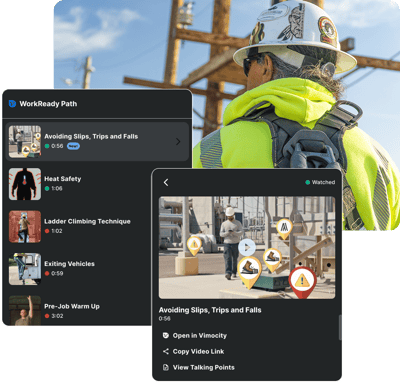
Discover how Vimocity can help keep your crews WorkReady.
One comprehensive platform to help safety and operational leaders prevent more injuries and incidents.