
 For Leaders
 For Workers
 Partners
What Champions Do Differently
WorkReady Podcast Episode 57
-
Speakers
Dr. Kevin Rindal | Vimocity
Felipe Carrillo | Wye Delta
Joe Maynes | Sturgeon Electric California
Leigh Conducy | Missouri Valley JATC
Ken Lulow | Lineworker Solutions
Jenny Lavin | Union Care Solutions -
View The Transcript
Kevin: Last year, the winning team at the International Lineman's Rodeo took the title by five seconds. Five seconds. That's one hesitation, one missed move, one body that wasn't quite ready. At this year's rodeo, I sat down with the competitors and the people who support them to talk about what it takes to perform at the highest level, and what the rest of us can take back to the job site.
Whether you compete or just work hard on the tools, readiness isn't built in a day. It's built long before you climb, and that's what we're going to talk about today. This is the WorkReady Podcast.
FELIPE CARRILLO, WYE DELTA
Kevin: All right. We're here at the 43rd International Lineman's Rodeo with Felipe Carrillo from Wye Delta.
Felipe: Let's go, man. Good to see you.
Kevin: Good to see you.
Felipe: Likewise. Thank you for inviting me here. One of my favorite parts of being here is getting to meet people and doing stuff like this. It's amazing. I never thought I'd be doing this.
Kevin: What's so cool is you're bringing athletic performance gear to the trades. Most people have had protective eyewear that fogs up within a couple of seconds if you're breathing hard. But the athletes out here love and trust your brand because you put that innovation into it. So why is it important to have proper eyewear that not only protects your eyes, but also performs at a high level?
Felipe: When I first started all this, I got in trouble all the time. I'm going to throw myself under the bus here. I got in trouble about five times a month. My boss would say, "Hey, put your safety glasses on." I'd put them on, but the moment he walked away, I'd take them off. That's dangerous. I could potentially get injured.
Kevin: So I have a question for you. Innovation often comes out of necessity. What was the reason you were taking your glasses off if you knew you needed to wear that gear?
Felipe: For one, they were pretty flimsy. And two, they would always scratch the back of my ear. I hated that, so I started putting rubber under the ear piece. I knew what was wrong with our safety glasses, and I knew how to fix it. It was a simple fix, and it worked. At first I did it just for fun, as a side thing, and then eventually people actually liked it.
Kevin: Felipe, you're an entrepreneur. You're always innovating. What are you excited about? What do you have coming out for Wye Delta?
Felipe: The best part of being an entrepreneur is that my mind is constantly running, thinking, "What can I do next? What can I do better?" I do have some stuff in the works, and it's going to be very interesting. It's a little bit of AI integrated with safety.
Kevin: Sweet. Can't wait to learn more about it.
Felipe: I said too much.
Kevin: So Felipe, you worked in the trades. You were a groundman. You've been on the tools. What does it mean to you when you think about people being work ready?
Felipe: Every day we come to work, a lot of the time one little cutoff in traffic on your way in will change your whole mindset, your whole attitude for the day. Work ready is when you're not going to let anything bother you. Put your gear on, make sure you've got your proper PPE, do some stretches, do some warmup.
I remember I used to do this all the time. I'd get to work, sit down and scroll on my phone, or try to fall asleep. Then for the rest of the day I'd feel lazy, not ready. What I learned is that every company does a 15 or 20 minute stretch, and if you take it seriously, which I know a lot of us don't, you actually motivate yourself. It's like working out. For the rest of the day you're pumped and ready to go. That's work ready. And believe it or not, it does prevent incidents.
Kevin: What are the barriers to people being more ready? Why don't people want to do the stretches? Why do people grumble about that stuff?
Felipe: It's a lot of factors. For one, you work a lot of hours. You're away from family, and you're overly stressed about everything you've got to do. You've just got to be ready. You've got to focus. Tell yourself everything's going to be okay, and believe in yourself. Tell yourself, "I'll be all right. Today's going to be a good day."
Kevin: And I believe you. Today will be a good day.
Felipe: If I wake up and say, "Nah, not going to work," that's your attitude already. You started off on the wrong foot. But if you wake up and say, "All right, let's go to work. Let's get this day over with," you're going to have an amazing day. It's a mind game. It really is. What do you think?
Kevin: Absolutely. It's one thing to be physically ready. A lot of us like to focus on, "My body feels good, I'm ready to go," but we don't give enough attention to the mindset.
Felipe: Exactly. You also have to train your mind, and it's very hard. Any little thing will get to you, so you've got to learn how to not let it bother you.
One of the biggest examples I give people: you're driving down the road, someone cuts you off, and you start throwing fingers and getting all mad. Then you get home to your wife and kids and you bring that attitude. Your wife says, "Hey, how was your day?" "Ah, some idiot cut me off," and now you've started a bad energy. And she says, "Why are you talking to me like that?"
But if you say, "You know what? It's all right. I'm going to let him cut me off. I don't care," then you come home and the conversation with your wife, your family, your friends, your loved ones changes. It's going to be different, 100%. I believe that.
JOE MAYNES, STURGEON ELECTRIC CALIFORNIA
Kevin: I'm here with Joe Maynes from the defending world champion Sturgeon Electric California rodeo team. Joe, it's awesome to see you.
Joe: It's always a pleasure seeing you. I love getting with you guys and talking with you. You have an amazing platform. I use you guys all the time.
Kevin: Well, thank you. I appreciate that. I think that goes to show that you are an athlete. To compete at this level, you have to take every advantage you can to perform at the highest level, and allow your body to perform at its highest level. At the end of the day, the body wants to heal. It wants to perform. But oftentimes we get in our own way. We eat garbage that creates inflammation, and our body is trying to fight that rather than repair.
You're kind of rare in this trade in terms of how you think about your body and recovery. I spent 15 years in sports medicine working with Olympic athletes, and everything you just talked about hasn't gotten to the trades. So how have you grown that mindset over the course of your life?
Joe: I've competed my entire life. Football, wrestling, track, mixed martial arts. I've always competed, and I've always tried to be the best version of myself.
Even when it comes to general work, our trade is very, very tough on the body. If you don't take care of it, your time here is very limited. It's very rare that you see a 40 or 50-year-old up on the pole climbing. Lucky for me, I surround myself with people that age who are still climbing, still doing it, because they took care of their bodies.
Kevin: There's a common mindset in the trades of people not taking care of their bodies. They don't stretch. They don't recover. They drink a bunch of Monster energy drinks. They smoke, they drink. There are all these things associated with the trades that are not conducive to high performance and career longevity. Why do you think that is?
Joe: Culture. I think it boils down to culture. And I see it slowly changing, especially in the yard I'm at. Everybody wants to be in shape. It's influence. If you plant that one seed that's influential, it sprouts.
The rodeo is really good for spreading that culture of health and wellness, because these guys want to compete. Nobody comes out here to lose. You want to come out here to win, and you can't do that if you're poisoning your body. Look at all the top competitors who walk up on that stage. They look good. They look good into their 50s, and they're winning because they take care of themselves.
So I think it just needs a little more time. We're moving in the right direction, with you guys getting very involved with utilities and contractors. And social media is huge. When people see the guys they aspire to beat working out, it's, "You're not going to outwork me." So keep that mentality of competition through your life, and everything will work itself out. I think we're going in the right direction as an industry, with people getting in better shape, taking care of themselves, and actually knowing what they're putting in their mouths.
Kevin: A lot of people listening may be thinking, "But I'm not competing at the International Lineman's Rodeo," or, "I don't even compete in rodeos." What's the motivation for somebody who just works hard every day and wants career longevity, wants to feel good? And what can they do to get there?
Joe: Be better for yourself. Be better for your family. Everything falls into place when you work on yourself. Your relationships will be better with your spouse, your friends, and your kids.
Kevin: What role do you think cardio conditioning plays in your performance when you compete, and in career longevity? That's something you don't necessarily get day to day when you're working.
Joe: 100%. I'll break it down. For rodeo, cardio allows me to hit that red line and stay there the entire time. My workouts are 15 to 30 minutes, but for every minute of those 15 to 30 minutes, I'm hitting it hard. EMOMs, every minute on the minute, or as many reps as possible. I'm at that red line the whole time to build my cardio.
Then when I'm here competing, I can sustain that performance the entire time without cramping up or needing to slow down. I can stay at that level for the four, five, six minutes I'm on the pole. Even if it's a 10-minute event, I can stay at that level for 10 minutes, fly down, and not even be gassed.
When it comes to work, the cardio is a little different, but you'll feel better throughout the whole day. If you're climbing, you're not gassed when you get up there. You'll be able to sustain a steady work pace all day without gassing out.
Kevin: What about mental readiness? What role does that play in performing at the highest level, and in performing day-to-day work safely?
Joe: Mental readiness at a rodeo is huge, because you're making small decisions in a fraction of the time, and they're either going to make it or break it. One second is big over here. Last year we won the entire thing by five seconds. So the decisions you make are huge, and you have to be able to make them on the fly.
Sometimes we go in with what we feel is a perfect plan, and then we get up there and the whole thing changes. You're communicating, your hands are moving, and your mind is on the next move. So mental readiness for rodeo is key.
At work, you need to stay cut in, because not every job is the same. You come up to a car-hit pole, or you're changing out a corner pole hot, or changing out a switch hot, or a backyard pole that's all hot. Every situation is different. Not one pole is the same as the next. So you have to stay cut in and catch the little things. Even when you're changing out one pole, go look down the line at the next structures to see if there's going to be a reaction to your action. You have to stay cut in and be able to see moves ahead. Mental readiness is huge for work, rodeo, and everything.
SPONSOR
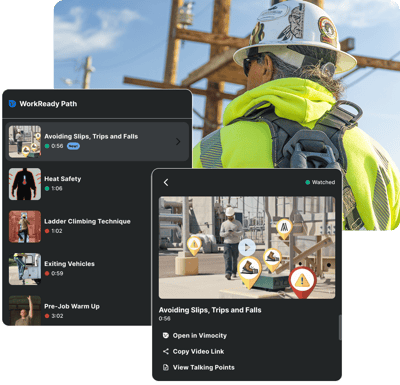
With Vimocity, utility leaders are cutting injuries by up to 50%, keeping crews safer and powering stronger operational readiness. Teams stay engaged, your safety impact scales across every work group, and you gain the insights to prevent serious injuries before they happen. Vimocity delivers expert content, seamless deployment tools, and real-time risk data in one workforce readiness platform. Learn more at vimocity.com.
LEIGH CONDUCY, MISSOURI VALLEY JATC
Kevin: So happy to be joined here by Leigh Conducy. Lee, what do you have to say about today?
Lee: There's no better day than today. It's like our Super Bowl every year. The thing I like the most is you get family. You see every wife, you see the kids. If you want to get to know linemen, this is where you really see how much this means to us. Family, friends, brotherhood. It all comes together here. It's a culmination.
Kevin: And you run the Kids Rodeo with the Missouri Valley JATC.
Lee: Yeah, this is our third International Kids Rodeo. Missouri Valley JATC does it every year, and last year we finally got full support. Buckingham is one of our premier sponsors, and they sponsor the Kids Rodeo every year. It's phenomenal. It almost books out every year. More than 70 kids come to compete in the International Kids event, and they take it seriously.
They're just as excited. You see the kids taped up, ready to go, focused. They want to win the rodeo. We've got big WWE-style belts for hardware. The kids walk the podium just like the linemen do, and they get an International Rodeo buckle. The same buckle, the most coveted buckle in all of lineman sports, gets held by the kids. It's pretty awesome.
Kevin: Pretty awesome. And it's the next generation, seeing their dads and moms compete.
Lee: Yeah. There's a concept I think you'd like: acorns to oak trees. And I think your company has the potential for that. You start by teaching our apprentices the right way to do the work, and how to have success beyond it. We've been trying to teach ourselves and the generations ahead of us that we want to leave the industry better than we found it. And that means not just leaving the industry better than we found it, but leaving the individual better than we found them, too.
Kevin: Absolutely. Off that point, what are you doing at the Missouri Valley JATC to think about workforce readiness, the physical, mental, and operational aspects of performing your best? And taking that beyond the 30 years, into retirement?
Lee: How are we going to help people live their best life, both on and off the job? It even goes into the financial side: how they're financially stable, and creating stability on all levels of wellbeing.
It's been a shocking year or two for us as we've really started to look at the health and wellbeing metrics for our apprentices and our linemen. From a mental health perspective, it's pretty alarming. Clearly we've done a horrible job of listening, seeing, and keying into how somebody is really doing. Like, how is Kevin really doing today? You put on a great face, Kev. You look great. You're physically awesome, and you've got it all figured out. But how are you doing? And how do you get people to talk about that and open up?
Kevin: That's a great question.
Lee: The number one way to do it is just like I just did. Literally, "Hey, how are you doing?" But make it personal. How are you doing, Kevin? You've got a lot going on. How do you do it? How's the mind? How are you feeling?
Kevin: I've been on the road nonstop. It's been a tough stretch. But what I will say is I've realized how important it is to take care of myself when I'm on the road. So I'm saying no to a lot of stuff, and spending extra time in bed so I can recover when I'm crossing time zones. It's intentional, because I beat myself up for years and didn't put myself in the first position.
Lee: That's funny you say that, because I'd imagine somebody like you starts doing the exact wrong thing that you're promoting.
Kevin: Oh, 100%. I teach this stuff every day.
Lee: You teach this stuff every day, and you're so focused on improving the health and wellbeing of everybody else that you're willing to sacrifice your own. We have to be careful about that, too.
Kevin: We've got great examples here with Sturgeon Electric California. They're doing all the right stuff when it comes to preparation. Then you have people who show up on a day-to-day basis and aren't using those same concepts to prepare their bodies and warm up for the day.
I'm going to call them out, because you have to. I was talking to Raul and Paul and the Sturgeon team, and I asked, "Hey, what are you guys doing today?" If you were at the expo yesterday, you could definitely tell there was an anxiousness in the room. Like, okay, tomorrow is when I need to walk in. And what's the Sturgeon team doing? They're out getting spa treatments and IVs, and doing stretch and flex and meditation sessions. There's a reason they win the rodeo.
And when you saw them this morning, I made a point of it. You look over at them, and they're all stretching, all flexing, having mental checks with each other. We need to do that. We need to embrace that concept, and not just one guy. We need to support that.
How do you get the industry to embrace that, even just another 10 to 15% more? It seems like there are some huge barriers. It's mostly, "We've done that before," or, "We don't have enough time." There are always excuses for why people don't want to prepare their bodies, but athletes know they have to prepare.
Lee: Yeah. If you look around the entire rodeo today, and we were talking about this earlier, this morning you had a thousand different teams getting ready to go, and 80% weren't stretching and flexing. They're just throwing their hooks on and getting after it. Maybe they are and we don't see it. Maybe there's some hidden trailer we don't see, Kevin, where it's getting done.
I love it, because you hear a lot of linemen say, "Oh, I stretch and flex before I come to work." Okay, then let's just do it again.
So you asked me what it takes. It takes more than one person willing to do it. And if one person is willing, it takes allowing them to do that, being okay with it, and it being acceptable and expected in our industry. I think what we'll see over time is the natural benefit of it. You're going to see more linemen in better shape toward the end of their careers.
KEN LULOW, LINEWORKER SOLUTIONS
Kevin: So happy to be joined by Ken Lulow. Ken, you've been a great friend over the years. You spoke at the safety conference leading up to this on safety culture. Can you tell me more about what you talked about?
Ken: At the International, I gave a talk about the example we set. Challenging the status quo and that old mentality of "this is how we've always done it," and really thinking about the influence we have. People are watching us, learning from us, and modeling their behavior after us.
So be aware of the corner we might cut to save a minute, based on our skill, our ability, our knowledge, knowing what the consequences might be. The person on the ground is learning that way. It gets ingrained in them: "Kevin's a great lineman. I want to be like Kevin, so I'm going to do this, because I saw him cut this corner. That's what a good lineman does."
We don't recognize that's the example we're setting, and it can become a habit ingrained in that person's image of the work they do. At some point, when they're doing the work themselves, it's, "I want to be like Kevin. Kevin cut that corner, so I can cut that corner, too." But they might not know the consequences, how to avoid them, or even what the circumstances were when we cut that corner. Then potentially it leads to a serious injury. Or they teach the next apprentice and forget to tell them the consequences, and somebody gets hurt.
So it's really being aware of the example we set, and taking ownership and responsibility to set a good example. We don't follow the rules and proper procedures just for our own abilities. We do it for the person who's watching us, so that we're good role models helping to create good habits. Set that example, take ownership of it, and challenge "that's how we've always done it."
Kevin: What do you think is at the root of "that's the way we've always done it," versus a mindset of "maybe there's a better way"?
Ken: Reflecting on myself, you learn a certain way. Especially if you admire somebody, you think that's how that person does it, so that's got to be the best way, and you don't challenge it. Especially in this industry, you're told to do what you're told to do, and you do it.
Kevin: It's almost generational. That mindset was passed down to the person above you, it gets passed down to you, and you continue it.
Ken: 100%. I do feel that the newer generations coming in are a little more advanced in that they ask. They want to know more about the why behind it. I think that causes a little conflict between generations now, but it's good for us, because we do need to challenge it. Sometimes it is the best way, but there are probably other ways, too.
Especially when we get in a rush. There's a lot more pressure now, and when you get pressured and hurried, you fall back on whatever those habits were. If those habits were a cut corner here or there, eventually it's going to catch up with you. Then we blame it on complacency, or say we should've known better, when it was just a bad habit somebody established because it's how we've always done it.
Kevin: For the person who has that mentality but is open to thinking about a different way, what's one thing they can do to start changing their mindset?
Ken: If you ever have that thought come up, "This is how we always do it," that should be the reason to pause. If you feel that autopilot taking over, call a pause and step back. What am I missing? What's the bigger picture here? Is there a hazard I might be overlooking, especially if I'm in a hurry? Even talk it out with the crew, with everybody on the ground: "What do you see that I don't see?"
Kevin: If you're someone younger approaching somebody you know is going to say, "This is the way we've always done it," what's a tactful way to ask open-ended questions and start exploring a different way of doing it?
Ken: If you're aware enough, just ask, "Are there other ways you've done it in the past?" That might cause the person to pause long enough to think about it and say, "You know, I don't really know. Maybe there is a different way." It's just to generate thought.
To do it tactfully, I don't know that I'd ask why you do it. I'd ask what other ways we could have done it, or what other ways you've tried that didn't work out. That makes the person pause and think, and maybe they've only done it one way because that's what they were told. Once you start thinking about it, it's, "Well, maybe I would have done it this way."
JENNY LAVIN, UNION CARE SOLUTIONS
Kevin: I'm here with Jenny Lavin from Union Care Solutions. Jenny, it's so nice to see you here.
Jenny: You as well, Kevin. It's nice to run into you again.
Kevin: A big part of what we talk about is being work ready: being physically and mentally ready to perform the work at the highest level. The mental side has a lot of different aspects. It's being prepped for the work and being focused, but it also comes back to mental health. Union Care Solutions does so much for the industry in that area. Can you tell us more about it?
Jenny: We focus on a train, mobilize, deploy model. Our goal is to get mental health trainings and crisis response trainings out into the workforce, especially at the crew level. Then we mobilize peer support and connect it between the companies and utilities, and back to the union. The deploy part is sending a crisis response team during an incident, a fatality, or really any life-changing event that impacts the workforce. We're able to send trained peers, people who are in the workforce. They're other guys and gals on the crew, so they're able to offer that support.
This is a fast-paced industry. When things happen, work picks back up very quickly, and people scramble to get the job done. What we're trying to do is create opportunities in that space for people to get the help they need, to debrief, and to take a breather. It's the human aspect of this work. Men are not machines. Being able to talk to other people during those times is really helpful.
Kevin: What's the first step you recommend for people to get help, or to even admit they might need to talk to someone?
Jenny: I think acceptance is the first step. Whether it's things at home, substance use, or just the stressors of life, when it starts to impact your work or your ability to be work ready, you have to take that pause and say, "You know what? Maybe I don't have all the tools."
Then reach out. We all have people in our lives, whether it's on the crew or people we trust, who we can reach out to and just talk. Sometimes just talking it out is like the pressure valve on a pressure cooker. It relieves it a little bit. And when you hear somebody say, "Yeah, me too. It was rough. This is what I went through, and this is how I handled it," that is huge.
It's also knowing that we do have resources and groups we can send people to, and helping people get back on track. A lot of it, and I know a lot of the stuff you share is like this, isn't fancy. It's how we take care of ourselves. How do you come home from a hard day at work? What is your rest like? Do you have those plans in place with a partner? It's talking it through and giving people ideas for how to better take care of themselves.
Kevin: Thank you so much for all that you do. It's such important work. Sometimes it's just knowing you have somebody on your team or your crew you can talk to. What advice would you give someone who sees a coworker whose head isn't in the game, and they want to make themselves available, or at least let that person know they're willing to be a listening ear?
Jenny: Safety is the utmost. That's the most important thing. We always want to make sure we're safe and that they're safe. If you notice somebody's off, maybe they had an argument with a partner on the way to work or something's going on with their family, I think just checking in and saying, "Hey, man, what's going on?" To me, that's the spirit of my brother's keeper. We can't fix things for people, but sometimes just the acknowledgement helps.
From there, if their head isn't in the game and they're still showing up for work, maybe there's a lesser task on the crew. Call it crew justice. Crews mitigate it themselves, and it happens all the time in a very informal way. But it's having that plan for how we support people and make sure everybody's safe, so that we all go home safe.
Kevin: Jenny, you have lots of family in the trade. You're in this world day in and day out. What does being work ready mean to you as a spouse and a mother of people in the trade?
Jenny: Community is really important to me. I've been in this trade. My husband has been in the trade. My kids are now working in it. I've noticed a lot of success happens when you surround yourself with good people and know who to go to and talk to, because there's a lot of information and a lot of opinions out there.
And it's taking care of themselves. It can be really rough. What works when you're in your 20s doesn't always work as you get older. We can get away with some things, and then we get a little older. So I think it really comes down to educating yourself.
I was a stay-at-home mom, and now that I'm in the trade, I've learned there was a lot I didn't know as a wife. So I think educating yourself on what that work looks like is important, especially as a wife or partner. Your partner is doing things they might not bring home to you, but they do bring it home, and it does affect the family. Being able to create that protected space for them is really important.
It's just being there, and understanding that there's some stuff I might not get. I've never been on a crew, so there are some things where I think, "That doesn't sound right," and then, "Oh, wait, I think that's just the way it is." So I defer to my husband, his uncles, and other colleagues. Some things are better suited for them, and I think that's really important.
That's the best part of being part of the union and this industry, and I know you see it around here. There are all these families walking around, and it's so important to remember that's where we come from. I teach classes at the JATC, and I'd say half of them always have family in the trade. Someone has an uncle, a brother, a father, or a mom in the trade. We are family. Remembering that is really helpful for a lot of people. We're not alone.
Kevin: Jenny, it's been so awesome to watch you build this organization and see the lives you're impacting. Thank you so much for all you do for the trades. You fit the WorkReady principle and the WorkReady concept in every way.
Take care of yourself, take care of your team, and stay work ready. Thanks so much for sitting down with me.
Jenny: Absolutely. Thanks, Kevin. It's my pleasure.
Discover how Vimocity can help keep your crews WorkReady.
One comprehensive platform to help safety and operational leaders prevent more injuries and incidents.