
.png?width=20&height=24&name=Vector%20(15).png) For Leaders
For Leaders For Workers
.png?width=24&height=23&name=Vector%20(16).png) Partners
PartnersWhat Every Foreman Needs to Know Before It’s Too Late
WorkReady Podcast Episode 43
-
Speakers
-
View The Transcript
For someone in the trades, it's probably pretty intimidating to pick up the phone the first time and call an EAP.
This industry can eat you alive. A lot of it comes from intuition. We'll lean into that spidey sense. Replacement seems easy, but right. Good safety folks like are done with the 5,000 pound pile of procedures.
Light that thing on fire and start dealing with humans in the way that humans do things. Don't be afraid to tell people about it because your story can help people change their lives.
Josh Vitale came up in the trades as an electric lineman. He's the co-founder and CEO of Project BUILT, a national nonprofit he started with his wife, Amy. He chairs Construction Suicide Prevention Week, and he's part of the team behind the Recharge Room, which we covered earlier this season. Josh, welcome to the WorkReady Podcast.
Thanks, Kevin. Yeah, glad to be here.
And Josh, I, as we've talked together about the trades, I've heard you use terms like this idea of human extraction, and it's that the industry is set up, uh, to take everything a person has and not put much back into them. And when did that phrase first land with you, and what does it actually look like on a job site?
You know, uh, there's been a lot of moments when I felt that way personally, but I think as a project superintendent, watching what would happen to the guys in the field when we would start to get behind on schedule, and we would ask them to start working seven 12, seven 14s. And I can remember there was a sprinkler fitter, and, uh, his superintendent called me and said, "Hey, Josh, I need you to come check on a guy for me."
I said, "Okay, tell me where he's at." And he was, uh, on a scissor lift working in the building. I went and found him, and, and I checked on him, and I said, "Hey, buddy, how you doing?" He's like, "Oh, I'm doing all right. Working a lot of hours, and, uh, I'm doing okay." And I just stopped, and I said, "Hey, hold on a second.
How are you really doing?" And there was a moment where he was wanting to withhold, but then he just kinda let it out, and he said, "Yeah, actually, I was gonna kill myself in the parking lot." And I said, "Okay. Let's, uh, let's go sit down and talk." And we, we got to what was going on, and what was-- what happened for him was he was working for a subcontractor as a foreman, running a crew.
They got way behind. We descope them, and all of their people got laid off. He was one of them. Then another subcontractor picked up the scope, rehired all of the same people. He got bumped up to journeyman, and then they were working seven 12, seven 14. And, you know, he was a guy that had a prior attempt. So a year prior, he had used ibuprofen.
He had eaten, like, four hundred ibuprofen in a park somewhere, and woke up in the emergency room, and the one thing that he remembers was the emergency room physician saying, "Man, this guy's super lucky. If he'd used Tylenol, he'd be dead." So fast-forward a year, he's feeling bad about himself. He's disconnected from his kid-- from his kids, excuse me.
Uh, his girlfriend and him are having troubles 'cause he's working every day of the week, and he's burnt out. And now that he'd been working seven 12s, he stopped going to his psychiatrist. He didn't get his medication that he needed. So he was in this crisis moment. He was ready-- He had a bottle of, uh, ibuprofen that he had bought at Costco, and he was convinced that he was gonna go into the parking lot that afternoon, eat them all, and that was gonna be the end of it.
And had that superintendent not noticed, maybe somebody on his crew hadn't noticed to call that superintendent to call me, we would've lost that guy that day. And so that's really when it hit home for me that what we're doing and what I was personally doing was putting people's lives in danger because what we're asking folks to do without a safety net is dangerous.
We're playing with fire or a loaded gun or whatever you wanna call it
Thanks for sharing that story, Josh, and I can imagine that right now on every job site there's probably someone in a similar position. But, you know, people just don't even see the warning signs. What were some of the warning signs that you saw, uh, in the people that were on your crew that may have alerted you so that you were actually able to intervene?
Uh, I think it's different for everyone. A lot of it comes from intuition, and I, I try to get people to lean into that spidey sense. When you're with someone day in and day out, and you share lunch together, and you're working together, you know, like it's not enough to just go like, "Hey, how's it going?" And then they go, "Oh, living the dream," and we just move on, right?
It's, "How are you doing? What's going on with you? You seem different today." And then most people... I mean, really we're, we're just mammals, and we need to co-regulate, and we feel that. And so most people will go, "Oh, man, it, it just sucks today. My, my debit card didn't work on the way in. I had to beg for 20 bucks so that I could fill up my gas tank, and I'm feeling like I've worked my whole life for nothing."
Or, "My wife just, uh, showed up at home last week, and all the stuff was moved out, and I haven't told anybody." I can't tell you how many times in my life, and I, I don't know if it's a blessing or a curse, for people to say, "You know, I've never told anybody this, but..." And then they go in on this thing, that secret they've been hiding for years.
And
that's a lot of times what's between them and that next place that they need to go emotionally, spiritually, uh, psychologically to get to another spot of growth and, you know, promise, I guess.
Josh, uh, we've had another guest on the show, Justin Asbill. He's a good friend, but he talks a lot about the 14 mindset risks, and it sounds like you're describing almost exactly that.
It could be financial stress, it could be family stress, it could be, I mean, a lack of sleep. It could be all different types of, uh, issues. But what are some of the other things that you have seen that have driven people, especially on those jobs that run over a long period of time, um, that may cause someone to start to reach that burnout, uh, territory?
Yeah. So, well, first, Justin's a great friend, man. Super good guy, and first guy I called when I started the project that I'm on now and realized that I need support too, you know? And luckily, Justin's someone that I would reach out to if I was in crisis and just, he's a, he's one of those beautiful human beings that dedicated his life to saving other people and, you know, you know his story.
It's, it's just beautiful. But, um, those mindset risks, it's y- it's like a house of cards, right? So I, I think what you guys work on with Vimocity is a huge piece of that, and that's the musculoskeletal stuff. It's aches and pains that have been nagging us for the last 15 years because we've been lifting like crap and eating like crap and sleeping like crap and living like crap and drinking too much, and all those things that us construction folks do.
And then it starts to build, right? So it's lack of purpose, it's a lack of hope, it's a lack of having a vision for the future. It's financial insecurity. It's, um, you know, uh, not having deep connections with people that are closest to you, and that was one of the reasons that, like you mentioned, we started Project Built because I was going around talking to people on my sites and throughout the country, going to safety conventions or a retreat up in Spooner Lake or whatever it might be.
All the construction folks had the same thing that was lacking the most, and that was a connection to family. It's like, "I worked my whole life. I've sacrificed my life to provide for my family, and they think that I abandoned them." You know? That, "What I did was totally worthless. I, I, I didn't... What I did didn't mean anything."
And Josh, it- I, as I hear you tell that story, there's probably a little bit of personal connection with, with what you just described about. And, you know, some people, they wouldn't be able to actually pull out of that and do something that ended up changing not only their own personal story, but changing the story for other people.
And so you and your Amy went through some hard times, but out of it, you built, uh, Project Built. Can you tell us a little bit more about Project Built, and what the mission is, and why family is such an important aspect of that?
Yeah, I'd be happy to. So- Well, luckily for us, for maybe not luckily for Amy, but we have a similar makeup in that when we found each other, I think, and I- maybe this is why all relationships exist, she's my mirror for what I need to heal.
You know, we just started working on things and, and, and opening ourselves up to being different, doing things differently, and being a student of recovery and, uh, love and healing generational trauma. But we, in 2021, we read Gary Keller's book, "The One Thing," and we really got right with what our one purpose really was in life.
Mine was transforming li- transforming people's lives through experience, and Amy's was kinda similar but was more on the education side with kids. And so we, we started living that way and started asking those questions. And so for me, my job as a superintendent and a construction guy shifted to, "How can I transform people's lives through experience on the job site?"
And then early in 2022, we had a late second trimester loss of a baby, and so for me it was just gut-wrenching. It ripped my, my guts out because I had waited until I was in my 40s to have kids. Just had a really rough upbringing, and I had this delusion that there was something in my DNA that was cursed or, um, I'm just bad, and I didn't wanna pass that on to another human being and have them go through what I went through.
So it took a lot of healing to get to the point where I was ready to have kids. And so when, when Amy got pregnant and she had had a vision of this child walking home with us, and when she told me about that vision that she had, I felt it in my soul and I knew that it was gonna happen. It was a little girl.
And, and so we went through that pregnancy. When we lost that pregnancy, it, it just gutted me. And I had just started with a new company, and I was out of ideas, and I wanted to be there for her and the other kids, and I didn't know how to do it. And so I reached out to our EAP, and I got nine free sessions with a psychologist during COVID when you couldn't get an appointment, you know?
And that's really where I went from having an idea of what my purpose was to living in it every moment of every day. And I shifted from being someone wanting to do things for me to just asking the great spirit or the universe or whatever it was, 'cause I don't even know what that thing is, "Just get me out of the way and show me what you want me to do."
And that mantra that started coming up day after day and minute after minute became a journey through this place that led me to being the suicide guy on a project or the mental health crisis. And then from becoming that guy that was helping people and participating in all of these interventions, I started asking, what work can we really do and, and how can I be of service more?
And it just kept coming up that just heal the same things that were happening for my family, for other people's families, you know, being away, um, showing up with generational trauma, trying to run the kids like I'm a superintendent. Like all of the things that we were struggling with and having, you know, tension over and fights about, these are things that we can help other families with.
So really at the end of the day, all I have is my story, and that's the thing that I can share with, you know, real knowledge, right? That I could, I could read a book about it and try to pass that on, but that's nothing like what I have, which is my lived experience. And so everything that we create comes from lived experience.
We want people that show up from that lens. We want people that act from that lens. And so that's why I think what we're doing resonates a little bit more with workers, 'cause that's what I am, a, you know, construction worker, the son of three dads, one a drywall contractor, one an operator, and one a lineman, you know.
And so that's the life that I lived. That's the guys that were abusing me and teaching me how to live and act, and so I understand it. And I am also now I'm in the process of healing from that and trying to do it better for my kids. And so I think we have an opportunity to share what we're learning being in the mud with other people and, you know, maybe we can make a better life for each other together.
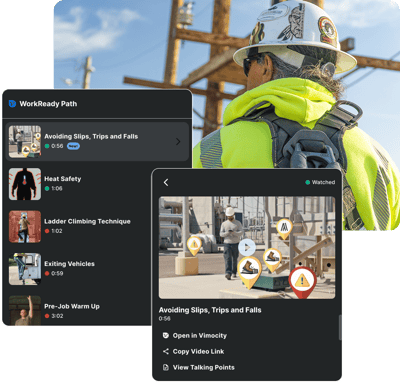
As a safety leader, you have more risks to cover than hours in the day. That's where Vimocity comes in. We give you one platform to scale your impact, delivering expert-curated safety campaigns on everything from slips, trips and falls to heat stress and soft tissue injury prevention. You'll reach every crew through the channels they already use while gaining data insights to guide smarter prevention.
With Vimocity, you can boost awareness, prevent serious incidents, and keep your workforce ready for the job. Scan the QR code or visit vimocity.com to learn how leading utilities are cutting injuries by fifty percent.
For someone in the trades, it's probably pretty intimidating to pick up the phone the first time and call an EAP and, you know, ask for help. You did that, and that changed your life. Can you walk us through what that was like at that moment and what you had to actually break through to actually make that f- initial phone call?
Well, lucky for me, Kevin, I started my journey to healing at, like, 18. I've, I've been a student of fixing this busted head of mine for 30 years. Back in, gosh, 2015 is when I first went to rehab, and, um, that, that took a couple of tries. But... And I dabbled in sobriety for a year at a time, or nine months at a time, or another year at a time.
And, uh, not until '21, I woke up in Thermopolis, Wyoming, in, uh, solitary confinement about 300 miles from where I thought I was. Uh, and w- that was the last time that I ever took a drink or did any sort of mind-altering substance. I, I don't even take Tylenol or ibuprofen anymore. But there was a long road that led me to just picking up the phone and being able to call that EAP.
And even then it was tough, right? So the-- if I'm being honest, what got me to call the EAP was that I convinced myself that my kids and my wife needed it. I was willing to bite the bullet for them. The reality was that I needed it just as bad or worse as anybody, you know what I mean? That, that was my moment and my dark night of the soul all at the same time, and if I hadn't done that, I, I'd still be suffering, you know?
There may be someone listening to this conversation who is contemplating calling their E- EAP. What would you say to them right now?
It can't hurt. It cannot hurt. Look, I've sat with guys that we've called the EAP together, and it wasn't super helpful. But for me, that moment, whoever it was that picked up that phone and that made that appointment for me, that got me connected with that psychologist, it was incredibly impactful.
But it doesn't have to be an EAP. I've called an EAP, but we know that what? 10% to 20% is the top amount of people that will actually use it. So it's there, it's a tool, utilize it. But I'd say even deeper than that is have people close to you that you can pick up that phone and call. Make it a practice that you're doing every day when things are okay, so that when things are bad, you don't feel like a burden.
It's just normal for you to call, and they know when you're feeling like crap, and they can hear it in your voice. Like Justin, when-- he was on a board meeting for Project Build one day, and he goes, "Bro, what's the matter with you?" I was like-- He called me afterwards, and I was like, "Oh, you heard that?" And he's like, "Yeah, man, you seemed weird."
And I was like, "Ah, I was feeling guilty. I'm on this board meeting for my nonprofit, and I'm feeling like I'm ditching school because I'm actually at work, and I, you know, it's even my lunch hour," but I felt guilty about doing something that's gonna help the community. So, you know, it's just so great to have people that are close, that know you, that can call you on your shit when you're trying to hide it
Justin calls, uh, those people allies.
And can you tell us a little bit about the allies that you have in your life? And for someone who feels like they don't have an ally, what are-- what's the first step that they can take to ask somebody if they can be on their team, in their court, um, both in the good times and the bad times?
Yeah, it's tough.
You know, a lot of what we do is isolating We work alone. We think we have to do it alone. We pull ourselves up by the bootstraps. We create this identity of the lone wolf like it's some sexy thing, and it's just unrealistic and it's not who we truly are as human beings. I I think maybe setting that intention where you say, "Look, I need an ally because I know I'm gonna be up against it at some point, and I want you to be that person because I love you."
And if you're not comfortable saying I love you, because I respect you or because you're the man or because you're a tough son of a bitch or whatever you gotta say to make it make sense for you. But creating a space where you intentionally say, "Look, I wanna be there for you when you need me, and I want you to be there for me when I need you, and we can do that together.
And as long as I have one person in my corner, I know I'll be okay." You know, every single person that I've sat with that was ready to kill themselves, I, I mean, within moments of them recognizing that someone is sitting there eye to eye, knee to knee, ready to just sit and listen and open a container, it's like we just put this container right between us and we dump our shit in it together.
And I'm not joking. It's one of the most... I get goosebumps
right now just thinking about it. Seeing that happen for someone, because I, I know what it feels like. There's a weight that presses down on you for decades, and then you can just set it down. You're allowed to pick it up back again and, and, and you, you might. But for a, for a minute, somebody walks in and says, "Hey, I don't even know you, but I see you and I love you, and let's just set that shit down for a second."
That's one of the most impactful things that, that I've ever experienced. And what was tough for me in the beginning was it triggered my ego, which wants to be a, a hero, and a savior, and a Jesus complex thing. And so I was like, "Well, man, I'm so responsible for these guys now. What's gonna happen when I'm not there?
Like, I'm gonna save them," you know? It took a lot of work, and a lot of therapy, and a lot of, you know, cognitive behavioral stuff to, to realize that, hey, it's not on me. It's on them, but, but we had a moment, and that's it, you know? And if I get another moment with them, then great, but this was my time, that moment to be there with them, to set that shit down, and to share my lived experience in a way that maybe got them to open up.
And then after that, they gotta take it, you know? Whatever their destiny is, that's their destiny, and that's not my responsibility. But man, what a beautiful thing to be there in that moment when it was make or break, you know?
Can you tell us a little bit more about the power of purpose and why that's so important, especially when you are at your lowest?
Well, I think when we were at our lowest, at least for me, uh, there was no purpose. That was the whole point. I can't be at my lowest if I have a purpose. Like, I wouldn't, I wouldn't get to being open enough to raising a white flag and asking for help from the powers that be, like no atheist in foxholes moment, if I had a purpose.
'Cause my purpose is what drives me to perform and take care of myself and take care of others. It really aligns the
energy that we have inside of
us towards movement,
right?
But it, you know... And I, there have been a lot of dark moments in the soul in my life, Jay. It was not like a one-time deal that I just, like, figured it out and, you know, hit the door running.
I had to, I had to learn those lessons over and over again before they really stuck. But once it did, and then I was able to heal enough to think about a purpose, then I was on that path of just constantly learning. I was drinking from a fire hose at that point. And we talk about, like, peeling the onion, you know, it's like the one that goes inside, and it's, it's like, okay, why am I really here?
How am I made up? You know, what, what did, what did, what did I get put here to do? And, and then just living into that, you know, curiosity and discovery for a few years was really wonderful. And then, and then coming out of that with a true understanding of not, not what you're going to do, but, but I guess what defines me as an individual in this forest of trees, like what makes me unique and what I can use that for to help other people.
That was, that was the true beauty of peeling that onion.
Can you dive a little bit deeper into then what led you to build, you and Amy to build Project Built? And tell us a little bit more about the mission of Project Built.
Yeah. So I think a lot of it was realizing that I wasn't unique What was always resonating for me and for Amy was that the, these individuals can't do it individualistically.
They have to do it with a family. And you can't just leave the family behind, you know? Like, we see that a lot in, like, drug and alcohol recovery, where the individual gets better and then the family's just completely forgotten. And, you know, they're the ones that experienced the brunt of the abuse and the, the, the disgusting behavior, the distrust and lying and all that stuff, and then, and then they're just left to figure it out on their own.
So we just thought what an egregious, um, like, injustice it would be to not bring families along with this recovery. So we can provide tools, and we can do all these things, you know, that can help them in the interim, but then we've gotta take them on a healing journey where they can get where we got, right?
And, and we even went to a retreat in the Dallas area with Project Sanctuary, a bunch of military families last November, and it was incredible. We got a new family purpose. We made a family crest. We have, like, a family handshake that we'll never forget, and we reinvented ourselves as a, as a cohesive group, and we want that for every construction family.
I don't care if you're the CEO or you're the, a brand new apprentice or a laborer just starting out, your family could use that. And so that's what we wanna give away, right? It's, it, we want it to be free. We wanna learn from those folks and hear what they need and, and create programs that are gonna make their lives better and, and that's why we created Project Build
Josh, for someone listening who may be just thinking, "Man, that sounds like exactly what my family needs," how can they find you or reach out or f- learn more about what these family retreats could look like for them?
Yeah. Thank you. So yeah, it's easy. Uh, getbuilt.org, that's our website. You can sign up your family right there, and then we have a list. We'll just start checking people off the list, and as many retreats as we can have, we're gonna have. It's gonna be free as long as you get there, and we'll choose the location to make sure that we're a good fit, and we'll put 5 to 10 families together and make it happen.
It's really simple.
What I love about these retreats too, Josh, is that, I mean, they're not cheap, I would imagine. No. But the financial aspect is something that could be a barrier from a family getting that help that they need. And so if someone's listening who, you know, may have resources that they wanna, you know, donate to support this or an organization, what are some ways that people can get involved to support these families through, uh, through this mission?
So the same way, we have ... We had our website. You can donate on the website. You can become a sponsor for a retreat. If your company wants to have a retreat for its own people, you wanna take 4, 5, 10 families a year, we can set up something for your company so you can keep it in-house if that's what you want to do.
We have a lot of options, right? And we're small. It's me and Amy and a few, uh, trusted, loving volunteers, so we can make it happen.
Josh, thank you for all of your focus on that. I really appreciate you and Amy and, um, just your dedication to families. I wanna transition now to talking about, uh, the job site that you're currently working on.
It's, you know, huge, huge project that's gonna span many, many months, and you've got people coming in from all over the place. You've already started to really focus on, um, creating an environment, uh, where psychological safety's built into the workday, where there are, you know, people like Justin coming out and, um, speaking to the, the, uh, workers on site there.
Can you tell us some of the things that you're doing on this job site that are maybe a little bit different from the, than some of the other projects that you've been on?
Yeah, you know, what's interesting about this hyper-scale construction that we're in right now is that I think they've really recognized that taking care of people is, makes good business sense.
So, you know, insulated, air-conditioned, and heated lunch tents with, you know, healthy food provided and, and clean. And we have, you know, cleaner restrooms. As a longtime construction guy, it is weird to me to have running water in a toilet that's heated and air-conditioned. You know what I mean? Like that, what's really great.
And what, the point that I wanna make about that is graffiti. Well, graffiti is something that we've dealt with in the construction industry for a long time. Really nasty, gross things being written all over those porta johns. And our concern was that if we put all these really expensive bathrooms out there, that they're gonna get destroyed.
And I, I don't wanna jinx it, but n- not one bit of graffiti. So my theory is, when you start treating people with dignity, like they're human beings, they start acting a little more dignified And so maybe it wasn't the people all along. Maybe it was us not taking care of them. I'm just gonna put that out there for folks that are like, "Oh, I would never spend a bunch of money on a bathroom, 'cause they're just gonna wreck it anyway."
That's not what happens. They respect it, they're thankful, they're grateful, and, and, you know, I mean, I wouldn't do it any other way now. But what gives us an opportunity and the budget to look into things like kinesiology and like, you know, Vimocity, and really taking care of our folks holistically, trying to get proactive about it.
And, and I think that that's amazing. But what we can't lose sight of is that 95% of the construction workforce works in small to medium-sized businesses that do not have this kind of budget. So what we have to do is use these opportunities when we're pushing the envelope of what's available for wellness and, you know, uh, technology and all the things that we're able to do at this hyper scale, how do we distill it into a place where we can really help the rest of the folks, right?
How do we take this knowledge and waterfall it out there to the people that need it the most, which are, you know, guys that are framing houses in Arizona in 120-degree weather that, you know, maybe they don't have any of this stuff that we're talking about, right? So I think it's important to not just get blinded by all the great things that we're doing, and remember that we're at the leading edge, and that there's, there's a lot of people back there that we need to be thinking about as well
You and Rich, uh, Ganney have been on, uh, a mission to bring the best in recovery to the workforce as well, and that for some people, they're like, "What the heck?
You're, you're bringing, uh you know, saunas and cold plunges and, and all these things to the workforce. How does that even fit on a job site?" But, uh, again, when you teach people or treat people with dignity, clean bathrooms, you know, a place that, uh, has nice facilities, all of a sudden people start acting differently.
Can you tell us a little bit more about the recharge room and how you see that being something that might continue to enhance the recovery and the performance of the workforce?
Yeah, man. Uh, I-- so when I met Rich, you know, I was on the Project Build mission, and our-- my son golfed with a woman that does the marketing for his, uh, med spa.
And she's like, "Oh, man, you gotta meet Rick." So we met, and I, I was like... I heard what they were doing for police and firefighters and EMTs, and I was like, "Why can't we do this for construction workers?" And so, you know, I don't, I don't know how it's gonna lur- look in three to five years, but I can tell you that at the nurse station, we can find a fifteen by fifteen room, and when guys are pulling their back and straining their calves and their shoulders are jacked because they've been pulling wire for nine months, getting into a cold plunge and a sauna and having infrared, uh, red light therapy and vagus nerve stimulation is gonna be transformational for them.
I want it for myself. We're under so much stress, so many hours a day, and our bodies are broken down that we need that kind of stuff, right? We need a good stretching routine. We need, uh, we need rollers to take home, and, like, my two-year-old daughter calls it the rolly butts. She, like, asks me, like, "Where's your rolly butts, Dad?"
'Cause I need that stuff to get through the day because I've broken my body down. So I don't know exactly how we're going to pull it off, you know, across the trades, but it, it's gonna happen because the science is there and the need is there. You know what I mean? Like, I think all good technology comes from a hole that's being filled, and, and this is, this is something that's hugely needed for our people, our industrial athletes, as you've taught me to call them.
Josh, you've also been a leading voice in Construction Suicide Prevention Week and have done some really innovative things. I'd love for you to also share some ideas with our audience of things that they can bring to the table when, uh, Construction Suicide Prevention Week comes up again, so that, again, we can continue to elevate these conversations together, uh, through the shared knowledge.
Sure, Ben. Thank you. Uh, yeah, Construction Suicide Prevention Week was important to me, one, because we need the awareness. Two, I think for whatever reason, construction likes weeks of stuff, so it just makes sense to, to do it for that. I, I would say if you're looking to get involved with Construction Suicide Prevention Week, the best way to do it is to go to the website.
We have a, like a roadmap for you to get from tweak to nuts. Like, here's how you get started. Here's the toolbox talks that you can do. Here's the stand down that you can hold. Here's how to hold the stand down. All that stuff has been taken care of. We have a really incredible board that puts this stuff together every year, comes up with new ideas and new ways to go about it.
There's some great webinars that you can watch the recordings or, um, you know, participate in the ones that are going on throughout the year. That stand down is a really cool one. So we do a stand down during Construction Suicide Prevention Week. It gives everybody an opportunity to just stop altogether in the field and for one minute just do a moment of silence for the people that we've lost.
Because I don't know about you, but I don't know a lot of construction folks that can say that they haven't lost somebody to suicide in the last few years. So, you know, it's, it... You can write it on a piece of paper, take a video of it, put it up there. You know, it's a small token of appreciation for the sacrifice that they made and that we really care.
We're not gonna let their memory die. Um, you know, we just... I've seen a lot of people get some, some really good feedback out of, out of going through things like that and participating in the stand down and just sharing about your, your lived experience. If you have an opportunity to talk, whether it's at your toolbox talk or if it's at a whiteboard meeting or if it's at your mass safety meeting, you know, just talk about it.
Talk about what you've seen, what you've been through, the people that you've lost, and, and keep their memory alive
Josh, we have people listening to this, uh, episode who may be a superintendent on a job site, maybe they're a VP and they are, you know, in that executive role, or may even be the business owner of a construction or utility company.
What's one thing that that person can do to bring a new way of approaching these issues like, you know, stress on the job, uh, suicide prevention, supporting the workers and their families?
Hmm. So I think the only way it can be done is to start with yourself. Josh Rizzo, my good buddy, just... partner likes to say, "Start with the three feet around you."
Right? If this is something that you're called to, you're watching this podcast and you're like, "I wanna do something about this," start working on yourself, right? Get the journaling practice going. Work on some breathwork. Find your purpose, and then start to grow that circle, right? So you start with the three feet, and then maybe it's six feet, and then maybe it's half a mile, and then maybe it's 100 miles.
But it'll happen if you keep working on that stuff inside. And really, the best thing that you can do is model vulnerability. Be honest about what you've been through, be honest about what you've seen, and, and don't be afraid to tell people about it, because your story is the only thing that really matters and that can help people change their lives.
Don't keep it a secret.
I love that. One of my good friends, he, he says, "You can't give, give away what you don't have." So if you don't have peace, if you don't have purpose, you can't give that away. But you do give away what you do have, so if you have conflict, if you have, you know, stress in your life, that's what you will give away.
So I love that advice because, you know, looking internally as a starting point and then being able to give away, um, that to others is a really good, uh, place to start. Josh, I'd love to s- uh, move into, uh, what we call the myth bu-busting section. Okay. So myth number one is family stuff is personal, the job site is for work.
Yeah. I mean, yeah, leave your shit at the door, right? It doesn't work. I mean, look at where we're at. Every safety incident that we respond to, every AAR that I sit in or after action review or root cause analysis, it, it, it's all based around a whole person that has stressors at home. If you haven't been the guy that was like, "Hey, I'd rather go to work because life is shit at the house," got more power to you or God bless you or whatever, but I'm like, I've definitely been that guy.
Number two, mistakes on their job are always due to complacency.
No, man. Um, there's so many reasons. I mean, complacency is easy, but right, and you hear that word thrown around so much. I disagree, like, categorically with that. Everyone is doing the best they can with the tools they have the whole time, right?
Everybody. If we come from that space, we-we're taking a different perspective, right? So you change the aperture on the camera, and now it's not complacency that's a problem. It's, it's human beings that are the problem. And guess what? We know human behavior, right? They're gonna step over the thing to get to the work every single time.
No matter if you put bright orange, you put a sign on it, it doesn't matter what you do, they're gonna step over the hazard to get to the work, right? We know that, so we have to engineer a way out of it. And good safety folks, like, are dealt with the 5,000-pound pile of procedures that are on the desk, right?
Light that thing on fire and start dealing with humans in the way that humans do things and make it make sense, right? But also, if you're not treating their bodies well, if you're not getting enough sleep, if they're drinking every night, it's all these things that that's not complacency, man. That's alcoholism.
That's being in a mental health crisis. It's risk tolerance because you don't value your own life. That's not complacency. Let's be honest about what those mental, um, uh, deficiencies, where they really come from.
Next myth, addiction in the trades is a character problem.
Myth. Uh, so addiction in the trades.
Think about it this way, and I, I, I know I'm preaching to the choir, but if you've been working for 20 years with bad lifting techniques, are you gonna end up with skeletal issues?
Absolutely
Okay. What, what's gonna happen when you go to the doctor?
They're gonna put you on pain pills
Okay. And how many days does it take taking pain pills before you're an addict?
It's around w- 10 days, I think
And then what do you do when that prescription runs out?
You go back and get more
Yeah, or you get them on the street. And guess what? There's some pipe fitter walking around your job that's selling pockets full of those every single day. Now you tell me that's a character problem.
That's ridiculous
Josh, the last myth here, bringing the family into mental health programming is a nice to have
You hurt my, you hurt my heart. Um, no, but think about that. We've compartmentalized ourselves into pure apathy and just failure. We can't do this in these little silos, just like you can't build a high-tech building with just CSA department.
You need everybody. You need the BIM department. You need, you need everybody involved. Everybody has to work together, right? We cannot fix a societal problem without gluing together the members of society, and the very, very bedrock of society is
family. Josh, we're gonna move now to the rapid fire questions.
And so the first one is, what's one thing every superintendent should know about the home their crew is going back to?
Hmm
One thing every superintendent should know about the home they're going back to
I'd like them to know that the way that they treat that worker is gonna go back to those kids and that wife
Josh, what's the hardest call you've ever had to make on a job site, and what did you learn from that?
I think the hardest thing I ever had to do was sitting next to somebody that I knew was, who was dying, and decide that I was gonna lean in to help no matter what. And what I did in that moment, and it, it, like, I'm not joking, like, I heard it, it was, "If not you, then who? If not now, then when?" And then I just decided, just do whatever you can.
Josh, w- what's one thing you wanna leave with a person in their first year in the trades to know about career longevity and taking care of themselves?
You gotta learn how to set boundaries, right? You're the only one that's gonna be able to take care of yourself. Nobody will take care of you. This industry can eat you alive if you take care of yourself. Like, find the good ones, right? Find the guys that still wear clean, well-pressed shirts, that, that don't take any shit from the GF or the superintendent, you know, that, that have, that can stand up to them when they're asking them for too much.
Those are guys that have boundaries. You're gonna need to learn those because this, this industry will eat you alive if you don't have them.
Josh, someone's pulling into their driveway right now. What's one thing they can do to get their head right before they walk into their home?
Big deep breath. Let it all go. You know what? That family of yours, they didn't work the day that you worked, right? They deserve you to show up regulated. Take some extra time to go in there and let them know how much you love them
Josh, is there anything that we didn't cover in this conversation that you wanna make sure we cover?
Yeah. So I've been working on this problem for five years, let's say. And while we need it to come from the top, we need companies to do what they can do, this has to come from us, the worker. We have to do this for ourselves. We have to own it. We have to share it. We have to take care of each other. There's no one coming to save us on some white horse.
This is something we've gotta do for ourselves. So if you're listening to this and you know that things are bad, and I know you do because you're in it, do something about it. Get involved, just even if it's with your crew, with your family. Let's make something happen. And I am a resource. I'm not joking.
This is an open invite to everyone listening. Call me. You're worth it. The whole reason that you're here is to figure this out, and there's a million ways for you to do it. You just gotta find the one that works for you.
Josh, this has been such a great conversation. How can people find you, Josh, if they wanna learn more about Project Built or any of the other things that you're doing?
You know, I'm fairly active on LinkedIn, so you can find me there. Again, getbuilt.org, you can reach out. Those emails go to us, so I'll read it, info@getbuilt.org. My personal email is josh@getbuilt.org. You know, just reach out in any number of one of those avenues and you'll get ahold of me.
Thanks so much for joining the WorkReady Podcast today. We drop these new episodes every Tuesday, and we're grateful for you listening. Make sure to subscribe to the WorkReady Podcast if you haven't already, and that just ensures that you'll get notified when a new episode drops. And we're on Spotify, on Apple Podcasts, and on YouTube.
Thanks so much for joining, and until next time, take care of your people, take care of yourself, and stay work ready.
Discover how Vimocity can help keep your crews WorkReady.
One comprehensive platform to help safety and operational leaders prevent more injuries and incidents.