
.png?width=20&height=24&name=Vector%20(15).png) For Leaders
For Leaders For Workers
.png?width=24&height=23&name=Vector%20(16).png) Partners
PartnersHeat Doesn't Care How Tough You Are
WorkReady Podcast Episode 44
-
Speakers
-
View The Transcript
Last time on the WorkReady Podcast, he gave us the cold playbook. And today he's back to give us the heat playbook. The one your crew needs before the next heat dome rolls in. Dr. Hammond, welcome to the WorkReady Podcast.
You mentioned before that humans are actually pretty well adapted to heat, but much more than cold. So what do you mean by that? And where does the adaptation break down on the modern utility or construction site?
Yeah, so what's fascinating in humans, and we're kind of an exception in the animal world, is we're actually experts at dealing with heat. And that was actually a hunting strategy, by the way. So most of the animals are not the same way. So humans are champions at sweating. they're champions at basically being able to do things when other animals need to rest and stay away from these very warm conditions. Humans are amazingly well adapted to face very extreme heat.
And to be able to basically chase the animals out and go hunt them in the middle of the day. So I mean and this comes down basically that whole genetics and that whole capacity is still there. It doesn't matter if you come from the north, it doesn't matter where you come from. Humans are tremendously good at sweating because of all the sweat glands that we have on a on our body.
And you know, one thing that I appreciate about our conversation leading up to this is that, you know, so often we think about the temperature of the air, but really the conversation needs to start with humidity. Can you explain why that's the case?
Yeah, so so it's interesting because every time we we we look at the weather, we're gonna look at the temperature, but we kind of don't really worry about the humidity. And one thing with heat is our capacity to evaporate or to s to to evaporate that heat requires basically low humidity. If you have very high humidity, your capacity goes down. If you're saturated at eighty to hundred percent of relative humidity, you cannot evaporate, which means that I'm I'm not gonna be able to cool down.
And we often focus so much on the temperature, but not realizing that it's a combination of the two things that have a tremendous effect. And especially when you're wearing clothing that will be saturated under the clothing, which means you're basically a hundred percent humidity, anybody wearing protective equipment,
It makes it extremely difficult when you're at that very high humidity. So that's the thing we need to keep in mind. Temperature matters, of course, but the actual humidity is the one that can cause havoc.
And think that's so interesting because you talked about other mammals and the thing that makes us unique is our sweat glands. So like my dog, when I take him out on a hot day, he's panting like crazy because that's how he's dissipating heat. But for humans, it's sweat glands, it's our ability to evaporate, that heat to dissipate and evaporate. But in humidity, our high humidity situations, it's just not possible. Is it am I getting that right?
No, and it and yeah,
and it's interesting when you you know, bringing up dogs because a lot of people like to go running with their dogs. I've seen people biking and pulling the dog along. If you do that in the middle of the day, you're actually putting your dog at risk. Because their capacity to get rid of that heat is not the same as ours. We might not feel it the same way. Whatever we feel is multiplied tremendously for dogs. They're not going to be able to survive if they if they're exposed to these very
warm conditions. So that's the thing that's kind of interesting. Like we like to go run with our dogs thinking, you know, they're gonna be way better than we are, but they're actually not better than we are because we have that capacity to sweat that is far beyond any other mammal.
So for a so I'm gonna pull up a a slide here that focuses on the different ways that our body either absorbs heat or you know dissipates that heat. And so can you talk about some of these factors like radiation, convection, evaporation, and conduction? How how should people think about those different factors when they're thinking about, especially trying to cool down in warmer, more humid climates?
Yeah, so when it comes to heat stress, what's kind of interesting is in the cold, we have that internal heat production that is actually going to work to our advantage. It's going to allow us to stay warm, it's going to allow us to produce that heat to maintain our core temperature. In the heat, it actually works against us.
In terms of the external heat,
we get all these factors. So basically radiation, which is radiation coming from the sun or any warm source that you would have around you. One that we often forget is if you're working with machinery, you got all that heat being produced by these big machines. And even though we think it's going to be trivial, it can actually help you in the cold, but will not help you in the heat. And you're going to start accumulating that heat. That warm pavement is also pretty bad on you because again, it does not allow that exchange and you'll be gaining heat.
Directly from any warm surface. evaporation again is the capacity to sweat and create vapor that will reduce your body temperature. When you calculate evaporation, you base it on relative humidity. So the higher the relative humidity, the less capacity you have to sweat. So that's one thing, and this is our main way of dealing with any type of increase in temperature.
In terms of conduction, it's touching any warm surface. Again, if I'm touching anything that would be warm around me, I'm going to be transferring from the warm to the colder surface. If my body's colder than whatever I'm touching, I'm going to be gaining that heat. I left convection for last, and convention actually in the heat is a huge advantage because it would be wind, for example. It could be I mean, most people would not be working in water, but it could be moving water, but it's basically moving that medium.
Which is the convection coming from the the air, the wind, that will actually allow you to deal with temperature much, much better. Only if you're not protected fully against that wind, which often for some cases, you're it doesn't it's not gonna matter that much. It could be highly windy, but I got protective equipment that does not allow basically to dissipate that heat through the wind. So convection is a huge advantage actually.
But could actually not help you depending on the equipment that you wear, which takes us to the last thing, which is I'm wearing clothing. Ideally, humans would not be wearing clothing. That's the best way for us to evaporate. But in certain conditions, you need protective equipment. You're not gonna be able to deal with whatever conditions you're dealing with. And you also have to deal with radiation, which again is gonna be burning your skin. So you do have to protect your skin. So this is gonna aggravate the capacity to dissipate.
So let's talk about a real world scenario here. So somebody may be working at a substation or they may be working in a tight environment.
Where there are metal panels. And so now you have the heat that the machinery or the equipment is putting off. You have reflection coming from the sun potentially. You have radiation coming off just the because the panels are metal. Maybe you're in contact with those. So now you have conduction and heat transfer. So in just that environment, there are way more things that people need to be aware of than you know, just checking out what is the ambient temperature on my
Phone. I mean there are a lot of considerations there aren't there.
Yeah. So yeah, so all these surfaces, anything that's radiating heat back to you will aggravate whatever situation that you're gonna be facing. So
again, it's being conscious of all these things and The reason why, again, as a scientist, people would say, Why do I need to know about conduction? Why do I need to know about evaporation, convection, and radiation? Like why does it matter? Well, because all these things are added up.
So whatever you're using, whatever you're you need to understand that these are the physical processes of heat transfer, which means that we need to account for all of them, especially if we're dealing with very, very dramatic temperatures. If we're not dealing with extremes, it's a different conversation. But if you're dealing with extremes, any little thing can actually make a huge difference.
And so I I know talking with a lot of our customers, they actually have wet globe thermometers that they may go to a job site just to get a sense of of what the the index is like for that day, but how can somebody practically use a tool like that to better understand what that environment is like for the worker?
We tend to try to generalize these things and say, okay, this temperature is going to apply to every human being. The reality is, you know, wet bulb dry bulb allows you to create that limit that most likely will be okay for.
every single individual operating below that temperature. It does not mean you cannot operate above that temperature, but you need to take special considerations once you end up on above these temperatures.
So that's really helpful to talk about the external. I want to go back to the internal and the metabolic heat before we move on to the clothing and PPE. So with the internal heat, talk about the the rate of work and how that influences, you know, how we're able to manage our heat. Because you know, somebody could be working really hard, and that's just gonna, you know, accelerate everything in terms of like the stresses placed on their body. So, how could how should people think about adjusting?
Their rate of work in you know temperatures and in environments that are more taxing.
Yeah, so that's actually a very important factor because you know when you and we've talked about this with cold. I work too fast, I work too hard, I start sweating, you sweat, you die. So the idea is to always work at lower levels, unless I really need to get out of that situation, then I'm gonna increase the intensity. But I know this is not something I can sustain.
and in terms of heat, it's kind of the same principle, right? So a human body, like if I take somebody that weighs about 70 kilos, so we could put that at one hundred and fifty pounds or one hundred and sixty pounds, you end up in a situation where you're producing about eighty watts of heat. That's resting.
So to start with, this is what I'm producing. When I start exercising, I can actually increase that heat production by up to 15 or 20 fold. So if I'm exercising at very, very high intensities, you multiply it by whatever factor that you're exercising at. So you're dealing with you know heat being produced at a thousand watts, twelve hundred watts. That's a lot of heat. Very difficult to dissipate. So again, the principle is the same. The warmer it is outside, if I want to be able to regulate temperature.
I I need to slow down, right? You know, you're not gonna win against Mother Nature. We've talked about this. And even if you try to work fast and hard, you will break down. And the things we're gonna talk about after this, I mean, basically exemplify the consequences of not respecting these limits. So internal heat production is basically related directly to the r the level of exercise that you're doing. And generally sweating is gonna be following it. So you actually if you have excessive sweating,
You also know that you're basically pushing yourself too hard.
As a safety leader, you have more risks to cover than hours in the day. That's where Vimosity comes in. We give you one platform to scale your impact, delivering expert curated safety campaigns on everything from slips, trips, and falls to heat stress and soft tissue injury prevention. You'll reach every crew through the channels they already use, while gaining data insights to guide smarter prevention. With Vimosity, you can boost awareness, prevent serious incidents, and keep your workforce ready for the job.
Scan the QR code or visit vomasi.com to learn how leading utilities are cutting injury by 50%.
I it almost gets helpful to think about like the human body like a vehicle. I mean, if you're driving in hot conditions and you're going really fast, you've got your AC cranking, there are all these additional stressors that are
Yeah, it's the same thing.
being placed on the engine of that that vehicle. It's it's running at a hotter temperature, it's going through more of gas, it's having trouble cooling itself because you're putting more stress on it through the AC. So how can somebody you know, maybe mechanically
technically thinking, equate like their vehicle to their own body as in terms of like heat dissipation and how you operate your your own machine, your body.
Well, anybody that understands a machine, even a car or whatever machine they would be using, it uses a combustion equation, right? It basically runs a combustion equation. We're gonna be using oxygen, producing CO2, producing water vapor, and there's heat being produced. The human body works exactly the same way. We don't use the same fuels, but we operate exactly the same way. Which means that if you understand how not to get your vehicle to warm up,
is basically the same pr the same principles apply to a human body. And what you're trying to do is to dissipate heat as much as best as you can. And one thing you're not gonna do, especially if your engine is overheating, is to push that engine with everything you can and increase the the speed, increase what the demand that you have on it, because you know at the end of the day the vehicle's not gonna be able to cool down and you'll have major issues. So it's the same
exactly the same thing that happens for a human body. So if we understand this for a machine, it's physical laws of heat transfer, it's the same principles that apply exactly for a human body using the same equations, everything's identical.
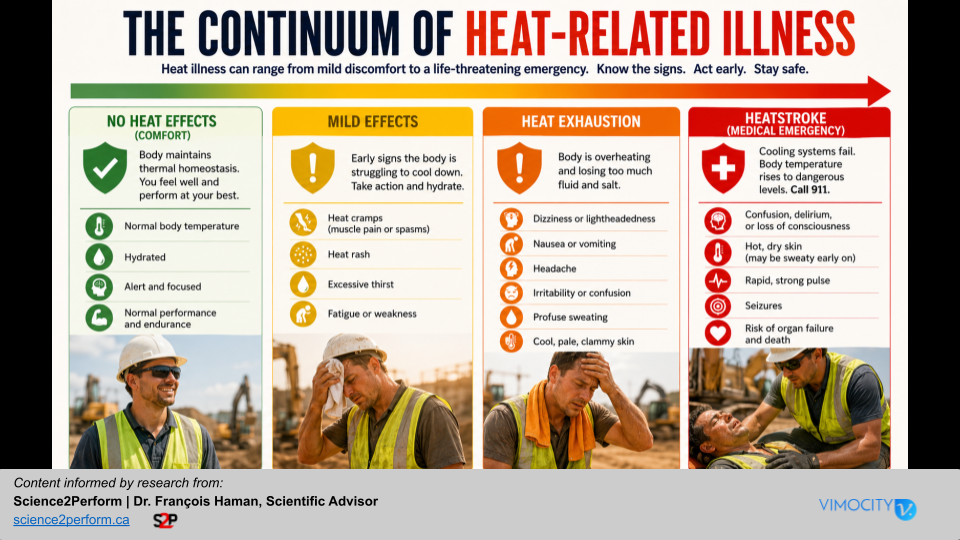
Well, in the cold episode, you and I talked about this this continuum of just it's more of a framework for people to think through, you know, being in the green, yellow, the orange or in the red zone as it relates to safety. And it it really I think was helpful for people to understand how to make decisions in the moment and
As we get closer to the red, obviously cognitively, we're not in as good of a position to make those decisions, but if people can catch those signs early in themselves or their team members, we can prevent people from getting to that orange or red zone. So could you walk us through the continuing continuum of heat related illnesses?
Yeah, and I'm just gonna, you know, one thing with these zones, the advantage is that it makes it very tangible for people. It just allows people to think about it continuously and realize that the last thing I want is to be in a zone where now there's a full emergency on and I need to evacuate the person. So these zones allow you to respond as things are happening. It doesn't mean that you should not be working in these conditions.
But what it means is that if you constantly make the right decisions, you will not end up in the red zone. So, same as I did with the cold, the green zone is basically no effect of heat, which means that I'm able to evaporate, my temperature is constant, I'm well hydrated, I'm focused, I'm not losing any type of physical capacity, cognitive capacity, or the capacity to thermoregulate. So this is the perfect situation. Could this happen at
you know, 80 degrees or 90 degrees or 100 degrees. Maybe it can. Maybe it's possible. If you have all the right conditions, you can actually be in very extreme conditions and still be able to deal with these conditions and stay in the green zone. When I get into the yellow, this is my first warning sign. So the yellow, I start feeling the heat and I start feeling the impact.
Of the heat and my body warming up. So I might have excessive thirst where I become very, very thirsty and I I I'm fatigued. I don't feel well. crance is a bit extreme, but crance can also occur depending on how long I've been in that situation. So the mild effects are the first signs to now what do I do to get back in the green zone, which might mean, okay, I need to recover, I need to get into a place where I regulate my temperature, or
Or I finish what I need to do because I know it's only a short amount of time and I'm not going to be there for long. So now I'm going to finish whatever I need to do. But in the back of my mind, I know that I'm being affected by the heat right now. If I decide to ignore these signs, which is the place we don't want to go, we get into heat exhaustion. So heat exhaustion is something again that can be managed managed to a certain extent, but we need to make a decision right away. We cannot stay in that zone. Dizziness.
I can be lightheaded, right? I can feel like vomiting, which is again never a good sign. It doesn't matter what situation you're in. If you keep pushing through, you will get in trouble. You can get headaches, confusion, sweating. It's like a waterfall coming down, right? So you know you're in a situation that is not very good. And often, which is can can actually be worse, is you can actually
see pale skin or you can actually in some places feel cool and you go, okay, this is not normal. Like there's something going on here. Okay, so for me, I would never want just like I never want somebody to be shivering excessively in the cold. I don't want somebody being in heat exhaustion. I ignore it, I end up into heat stroke. And heat stroke is a medical emergency. Again, for anybody working in the heat, this is not where you want to be. And if people go, well, no, I'm tough, I can do it.
Always remember that you're never alone in that situation, which means that whatever decisions you make along that scale will influence other people. Right? So people might have to stop their work to go help you. You might put other people in danger while they're dealing with you. Other people that were already in the zone that was difficult can actually aggravate their situation. So this is something that you have to be tremendously careful about. So now my cooling system goes down, my body temperature starts.
Increasing dangerously. I got confusion, delirium, loss of consciousness. My skin can actually become dry. Again, dry skin in the heat, not a good thing, right? Which means that I'm metered completely dehydrated and I'm not able to sweat. But this is not a situation I want to be in. And my heart rate is going to go up. So one thing we have to remember is the heart rate is actually affected by the increase in your body temperature.
So, just like when you have a chemical reaction and you warm up that that temperature, the chemical reaction will actually go faster with higher temperatures. If you bring the temperature down, it's gonna slow down. We get the same thing with the heart. If my heart rate starts flying up, this is not a good sign. I can feel it like in my chest, and I can feel my my heart rates pounding. So I see rapid, strong pulse. I can get seizures.
I can get organ failure and eventually death. So again, I don't I I don't need to tell anybody this. Like this is the last place where we want to be. Does this happen? Of course it happens. Of course it happens because people think the job is more important than dealing with these scales. But at the end of the day, for a foreman or crewman, this is something that is extremely important and it's everybody's responsibility. So these zones allow you to create a safety net that you always know where the person is at whatever temperature.
Think it's worth pointing out that like when you think about being in the yellow zone, excessive thirst or heat cramps, or even like fatigue or weakness, you know, things have been going on for a while for you to even get to that point. And I you know, by the time you're thirsty, you're already dehydrated. By the time you're starting to get confused, I mean you're you're pushing on that that orange zone. And so maybe if you could talk through
You know, the additional risks beyond just the thermoregulation that people may experience. I mean, if if you're getting heat cramps, weakness, you know, less coordination, you're confused, that could put you and your entire crew at risk for making a pretty substantial error that could be life threatening or life altering. So can you maybe share a little bit more about your thoughts on that?
Yeah,
so we didn't really talk about the consequences as you're moving down the scale, but you're you're a hundred percent right. So one of the things you're decision making, it's gonna be awful. You're gonna start making mistakes. You can trip because you're becoming dizzy or not be able to function the way you want to function. And you end up in a situation where again you could be making a mistake that could cost somebody's life or your life and or actually hurt somebody pretty bad. So this is one part of it. The other part is
Again, when you're doing this and you're not making the right decisions, you end up in a situation where you can increase the rate of of the effects of the heat. So you can actually go through this tremendously quickly or slow it down depending on the decisions that you're making. So your capacity to deal with the environment is entirely related to your capacity to make these decisions. And the other part that we often forget, and we'll talk about it afterwards, is basically as we start losing.
water and we start becoming dehydrated, we also lose physical capacity and performance. So and this is extremely well related to one another. So as I become dehydrated, my strength goes down. I'm not gonna be able to endure whatever I need to endure. And again, strength goes down. Stuff you were able to do before suddenly you can't do it. In your mind you're going, I should be able to do this. And in the lab we've tested this multiple times by the way, having people run five kilometers
preheated or not heated and you see the impact of it. The impact is tremendous. So again, this is something to keep in mind is that as soon as I'm in that situation, my capacity to perform physically, mentally, and ramentally starts going down.
I think it's worth pointing out as well.
When you're about two percent dehydrated, which is roughly about sixty-four ounces dehydrated, I mean you can be there pretty quick. Like in the certain environments, I mean, that could be an hour if you depending on your physical capability, but our muscles are about 80% water. Most of our tissues are about eighty percent water. So when you're dehydrated, it actually makes your tissues more vulnerable to injury, especially tendons and where the tendons attach to the muscles.
So there's a much greater risk of experiencing a sprain or strain. I mean, the reason why most injuries in sport happen in the, you know, the fourth quarter or the third period, it's it's because people have started to hit those those levels of dehydration and they're at greater risk. And they're just their bodies aren't as coordinated at the same time. So anything else that you'd like to add as it relates to just our physical capabilities when we ignore
Yeah.
Yeah, so it all comes down to your self-awareness and situational awareness. You have to be aware of these things. And again, people might say, okay, I can just ignore that factor. But all these factors eventually can come back and cause you problems. So it's it's not a question that factor might be okay. Like radiation is okay, there's no sun out. Okay, that's perfect, but that can change. Right? And and and one thing that and you kind of alluded to this.
You can go into that situation with no planning and be fully reactive. This to me is mistake number one. Or you go into that situation fully aware of what's gonna what could have happened, and you've already taken steps to stay into that greed zone, even before you face these conditions. And I think that's a very important factor that we tend to forget. We often tend to think that, you know, we just show up in that situation and we're gonna face it, and whatever happens.
we're gonna be able to face it. Well the reality is you might not be able to face it. So preparing for it is actually tremendously key.
So I think the the key thing, and this is what I loved about our conversation in the cold. It's like, man, when you see shivering, that's one of your first signs. You should never you know get to that point or your your fingers or toes starting to experience numbness and tingling. I mean, those are just key things that people can focus on. So obviously in the heat we want to keep people in the green. And so let's talk about some strategies for keeping people in the green. And and you came up with you know five modifiable factors that we can talk about.
So can you walk through those five factors?
Yeah, so when it comes to dealing with heat, just like dealing with cold, it's a management issue.
which means we need to plan for it. Again, some people might think it's excessive. They go, well, it's not a big deal, it's not the end the world. But honestly, this is where you start making mistakes. So one thing we need to remember is each individual responds differently to these to this heat.
So even though we could get people with exactly the same morphology and you know you could have people twins with the same genetics, the reality is some people might be heat acclimatic acclimatized. So they basically experience heat on a regular basis, they know how to deal with it. if you have never been in the heat, and now nowadays one of the issues that we have, and we kind of talked about it a little bit, is the fact that we stay within a very, very tight temperature comfort zone.
in the summer we got that air conditioning blasting. And then in the the winter we basically have that heat blasting. And we try to prevent ourselves from facing these extreme conditions. And then we just show up and now we have to face them. Again, that whole preparation towards getting into this. So we that individual readiness is actually a big deal. How fit you are, so fitness level actually also plays a role.
Because within exercise, you learn to deal with high temperatures because you're producing a lot of this heat and you also stimulate sweating, get better blood flow, and you're able to deal with these changes in temperatures very, very effectively. Like we ran some work in the in the lab having some of these triathletes and marathon runners, and you could see it like you're dealing with temperature and they can regulate tremendously well because they're able to evaporate. Again, there's a morphology question, but this is something you're able to do. So
Again, the morphology matters. Like if I'm somebody that's very long and stringy, very long arms, very not very heavy, I'm adva there's a huge advantage in being this way to be able to face heat. The opposite works the opposite way. So if I'm more stocky, I will tend to retain heat. My heat storage is is much greater. Again, big, big differences you would get. Not sleeping, not eating, not drinking regularly, these are all things that
Can have an effect. And we did bring it up last time with the cold, is any unnecessary substances that we might decide to consume, which also includes nicotine pouches, which are very popular these days, can actually increase metabolic rate. Again, the impact on your capacity to deal with heat, I'm not clear about it. I've never seen really a study about it. If somebody has anything, I'd be interested to see it. But metabolic rate does go up when you start taking these nicotine pouches.
caffeine use, alcohol use, all these things accumulate. Let's not get into the medication because the ranges are tremendous. But these are all things again come down to the individual readiness.
C yeah, and I'm gonna interrupt you here 'cause what about energy drinks? I think th they're so prolific, especially in the trades. I mean, it is not uncommon for people to drink two or three, maybe even four energy drinks and they're working in a hot environment. What are some of the risks associated with that?
Well, that's interesting because the energy energy drinks is why are we drinking them? Like most of the time we we're tired. Instead of taking coffee, we like I mean, we we get that little boost of of caffeine that is pretty extreme. And we we end up in a situation where we want to take it to stay awake or stay, you know, kind of focused. That comes down to that sleeping thing. Like if I decide to go out the night before when I know I might be facing something that's gonna be extreme the next day, it's up to you, but you are putting yourself at risk.
Right. So if you decide not to sleep or you're not able to sleep, this is something you should articulate to whatever people you're working with that you know you're struggling a little bit on that side. And then people hammer down these energy drinks to try to keep that energy level up, but all you're doing is contributing to that increase in heat production.
Okay, so non-essential substances is one of the modifiable factors. Number two, it's physical conditioning. Can we talk about physical conditioning, but then also the acclimatization? Because that's huge. If if there's a storm, let's say there's a hurricane in Florida, you have crews coming from you know different parts of the country that may have like hardly any humidity, and then they go into this new environment and there's no acclimatization, and that just puts a ton of stress on their system. So love to hear about this.
Yeah, and that's not even working.
So you can actually end up in this situation. Like even Florida, I've been to New Orleans and in New Orleans when you show up and you come from Canada and you know you're it's you're in May or April where it still hasn't warmed up and you show up in New Orleans and you're being beaten down by ninety degrees, eighty percent humidity, I don't care what you're doing, you're gonna be struggling. You're gonna be facing these conditions. So you're st
You always have to know where you're going and the impact it's gonna have. So again, that whole idea of being ready comes down to that heat acclimation thing. Where if I practice this and we always talk about seven to fourteen days, if I know I might be facing some some heat, ex intense heat, the advantage with heat acclimate acclimatization is I'm increasing sweat rate.
And I'm preparing my body to basically be able to face conditions that I might be facing in the field. If I'm constantly in thermal neutrality, and then I go from that to Louisiana or Florida or any of these places, good luck with that one, because it will be tremendously challenging. And it's gonna take you eight, eight to fourteen days to deal with it, and then you might be going home.
So why not get ready by doing some heat acclimation before you end up in that situation, which is what what we mean by preparing for wh whatever you're gonna be facing instead of being fully reactive. I mean, that's how the military operate. They will do some of this training in these conditions before going to deployment, just to make sure that they're ready. Other workers should be doing exactly the same thing.
So the third modifiable factor is nutrition. Can you talk about talk about how nutrition helps your body actually deal with heat?
So nutrition again will not necessarily help you deal with heat, can actually because it it will be producing heat, by the way. So when you eat, you're producing there's something called thermic effect of feeding, which you will be increasing heat production. But what it allows you to do is to again keep you in a state of balance, which is not a state where you're degrading continuously. So nutrition alone will not prevent you from becoming hyperthermic. It could actually make the situation
slightly worse to a certain extent, but will be affecting everything else. So if I'm not eating, then decision making is gonna be affected. My capacity to work's gonna be affected. Now if I add this on top of the fact that I'm facing heat, I just aggravate that situation.
So it could almost be a double whammy if you're short on calories, your brain's not getting the glucose it needs, and you're dealing with heat, you're getting disease, like it could actually compound that that effect. Is that what you're talking?
Yeah, yeah. So basically what you're
doing is adding another layer, which is again within the checklist. The other thing is when I'm eating, I might be slowing down. I might be, okay, now we take a break, we go eat. This is part of recovery. Now I go back and face these conditions. So that to me, I mean, these modifiable factors are also part of recovery. Right. It's also a part of recovering, which is we never worry about recovery because we think we just we're tougher than recovery. But the actual capacity to operate.
Is all based on recovery.
And so nutrition also includes electrolytes. Oftentimes we think we get electrolytes through our drink, and you know that may be a way that we get those essential, you know, vitamins, nutrients, compounds. But can you talk a little bit more about you know things like magnesium, sodium, zinc, how all those may impact your body's ability to
ha stay saturated from a water perspective or replace things that are lost in in sweating.
Yeah, so one thing when it comes to facing the heat, and we all talk about it, is the importance of hydration, right? It's importance of drinking because it will allow you to sweat, also allow the systems to keep operating. If I start losing weight, and we're always talking about that two percent body weight loss, if you go down to five percent, your physical capacity starts starts dropping, and that can happen within that two percent decrease. So again, not drinking is gonna have tremendous impact. I could be drinking only water.
Right. So within an hour, if I'm only exposed for one hour, maybe if I'm only drinking water, it's not gonna be the end of the it's not gonna be cause many problems. But if I'm exposed for many, many hours and I'm only drinking water and I'm increasing that water load to three liters an hour, to up to even six liters per hour, and we go, I just need to to just drink water, I'm diluting my electrolytes, essentially.
And I end up in a situation where I have less and less of these electrolytes that play a very fundamental role when it comes to physiology and biology and the capacity of muscles to operate. So then the cramps are gonna start occurring and you're gonna get dysfunction when it comes to all these electrolytes changing. So again, if you're eating in food, especially some of these salty foods, but even if it's not a salty food, you might be able to to get enough sodium in there.
And whatever minerals are going to be in there to be able to allow to maintain that balance. So eating will I help in this situation. But the whole concept also of maybe adding electrolytes to water does matter if I'm exposed to the heat for extended periods of time. Especially if I'm exercising in addition, then the situation is going to get worse and worse. And what's going to happen is these tissues depend on these on these electrolytes. And as I'm I'm taking them away and diluting them.
I will end up in a situation where the body's gonna start failing and shutting down, which you're gonna get cramps, you're gonna get all kinds of disorders that will come up. Cranps is always the most obvious one because you're gonna you're gonna feel them pretty quickly. but again, it's finding that right balance of work rate with whatever I'm gonna need and the amount of water that I'm gonna be taking and how long I'm gonna be in that situation.
so the fifth modifiable factor is right along the same lines. I mean, we could use a parallel. So it's sleep, and sleep is all about recovery and our body's ability to have the energy and the capacity to recover, to adapt. And when we lack sleep, our body's not as responsive to th those conditions and it's less adaptable. I almost think of it like our phone's battery, like in the heat or in the cold.
that battery is not gonna have the same capacity to run my iPhone. And so can you maybe talk about some of the parallels between you know, again, machinery, equipment, you know, batteries, and how that recovery in the sleep impacts our ability to thermal regulate.
While the capacity for human body to operate is highly dependent on your capacity to sleep.
If I don't sleep, you know, over 24 hours, over 48 hours, I my sleep is not good. My capacity goes down dramatically. And then your body starts responding to this. And so, you know, some of the hormones are gonna be changing. You're gonna be facing your inflammation's gonna increase. You're putting yourself at tremendous risk because you're just ignoring the fact that I haven't been sleeping.
There's one thing I would like to know if I'm a foreman on any job is did my crew sleep? Have you been sleeping well? Are you well hydrated? Like all the big five that we show here. And you know, I used to fly planes before COVID, before he got out of price to actually fly planes. But the first questions the instructor would ask you as you would go in to go fly that plane is exactly do we have did you sleep last night? Were you
Are you well hydrated? Are you taking new medication? what is your stress level? All these things were actually questions that were being asked before you got into a plane. Because you always wish, and this is something to remember, you always wish that you'd rather wish that you were in the being on the ground wishing you were in the air than being in the air wishing you were on the ground. And I would say this is exactly the same thing. If you put yourself in a situation, there's no difference. If I put myself in a situation that is
that I might have tremendous consequences, I wanna know these things before I get into that situation. So this big five, I mean, to me, are key to make sure our human machine works the way it's supposed to be working, just like whatever machine we're gonna be using.
you know, there's mild effects of heat, there's heat exhaustion,
Yeah.
and there's heat stroke. How do I get ready for all these things before I get into that situation? And we talked about individual readiness. So this is something to remember. The b every single individual needs to be ready for whatever conditions they're gonna be facing.
The work practices are tremendously important here. And this we kind of alluded to it, but within the work practices, we do want to slow down. We do want to pace ourselves. We do need to create a work rest cycle and get into the shade because the shade, again, our bodies are made to heat dissipate in the shade.
We're basically able to absorb all the sunlight. If we're we're bodies that any radiation coming towards us will be absorbed. When we're in the shade, that allows us to give us a break from that radiation. Tremendously important. This is where our bodies are most efficient at cooling down. And we knew you do need to schedule task earlier than later when it's possible. And to be able to understand that even during a day of constant temperature.
The morning and the evening will not be the same as what you would have during in the middle of the day. any type of cooling you can get. So if you're able, again, it's all about that PPE stuff. If you're if you need these protective garments to face to be able to do your job, this is a different conversation. So let's be very conscious of it. If you don't have any type of requirements or standards to to meet in this case, you try to wear light, loose clothing.
breathable clothing and there's a lot of very good garments out there that you know the cool max stuff to be able to or dry fit is is one of the best ones that will be tremendously wicking and to be able to to allow you to again potentiate that evaporation. So this is something to keep in mind that is very important. So one thing for the bald guys out there, just like me, I'd always like to give a message to bald guys, but I use a skull cap, especially under
anything like bike helmet or whatever I'm gonna be wearing. So the advantage with the skull cap, even though we think might work against us, it allows us to spread the sweat and potentiates the evaporation and actually allows you to cool down much, much faster.
So these are things that are very important. When you don't have wind, you use a fan. Fan is tremendous. misting is great. So this is something I've seen a lot in Arizona in Phoenix, where you get into a hotel and there's misting occurring, which cools you down. The part that you really want to keep cool, and especially if you end up in a situation where you know heat is affecting you, is arms and
Even legs would be a huge advantage. Both would be even better. So your cooling rate is tremendously high. If I can put my arms into a cold tub, again, does not need to be ice, but just something cold enough to get to create that exchange. It will cool you down tremendously fast. And you do need to practice emergency procedures, right?
And within these emergency procedures, one part that I'm very interested in now and trying to develop with within the work that I'm doing, and we've talked about this many times, is first of all to screen for any type of medical risk. So a lot of people are not baseline. So you show up and we wait until there's injuries, and then we go, by the way, this is what you had. So why not do it from the forefront where you actually know this? Does not matter it's a do or die situation where you're not able to get in and do the job.
But what it means is at least you know where you're starting from and what how to approach these things.
So I like this chart because you know I'm thinking about maybe a foreman who's leading a crew and they're doing their pre-job brief in the morning. And this is just so practical for them to have a conversation with their crew to assess individual readiness. Like, you know, are people dehydrated because they're drinking the night before? Are people fatigued because they only got four hours of sleep? you know, so that's something that you can check on. You can come up with a hydration and electrolyte plan so that you can ensure that.
People are getting you know the right amount of fluids with the you know the appropriate electrolytes so that they don't over-dilute themselves. they can set up shade, they can set up brakes, they can you know modify the work based on what the demands are gonna be so that they can you know have a really strategic plan. They can also think through the cooling clothing, and there are some awesome products out there that still fall within the PPE guidelines for working in you know around.
electricity or where there may be you know risk for combustion, but they can get those you know proper cooling clothing and then having that emergency plan is is absolutely critical. Are there any other items that we should talk about related to coming up with a plan, especially I think
Being each other's, you know, brothers keeper, so to speak, and being able to understand, you know, the risks and others may help people avoid getting in the yellow and the orange zone and hopefully never the red zone. But what are some other thoughts that you have around, you know, coming up with the plan of the day?
Well, it always comes down and it's funny because and I'm gonna say it this way, and it might not be the right way to say it, but ego can get in the way. some people might think they're tougher than Mother Nature, and they actually think that whatever they do, they're gonna be able to face anything that's gonna come their way.
And I I think you bring up such a good point too, because it has nothing to do with being tough. Like we all, you could be the most well-conditioned person out there. I've worked with like the top athletes in the world and I've seen some of them in a swimming pool experience, you know, heat related consequences. And so there are just so many factors that like we talked about, it's the heat, it's the recovery, it's the sleep the night before, it's going into a session already dehydrated. It's
you know, what has happened the last three or four days leading up to that high heat event. You know, am I climatized? So there are just so many factors so we can never
you know, base it on the individual and how tough they are. It it really comes down to are we watching for all these risks and are we helping people make good decisions along the way? And then are we pulling people out early before we, you know, head into those yellow and and orange zones.
Yeah.
And the thing is I did, you know, I kind of thought about certain rules that that we should think about. And as we're going through everything that we've discussed up to now, I mean that whole idea and I've you know, I made us a little diagram there about and I'm just gonna go through it. We don't have to show it just to go through it. But basically heat acclimation is one thing that is often completely ignored. And I think this is very important factor. And you know what athletes, when you are gonna go extra you're gonna go for a competition in warm conditions.
You will heat acclimatize because you know it's gonna make the difference between winning and losing. This is not different from outdoor workers. There's no difference, right? It's gonna have a tremendous impact. We kind of see it differently because you're not winning a medal at the end, but you might be winning the medal of coming back and making sure everybody's safe. So that's your medal once you once you get home. Aerobic fitness, aerobic fitness is staying fit. Again, that's your responsibility to stay fit. It does have an impact on the overall goal. Hydration, making sure you don't lose your body weight.
So one thing you could do is weigh yourself before and after. And you don't want to get that 2% decrease in body weight. And one of the best indications that I always tell people is the best one you're well equipped for it. Go to the washroom, look at the color of the urine. If it's nice and clear, you know you're okay, you're clear. And if it's orangey, then you know you're in trouble, right? So you know you're getting in towards dehydration. And you do you might need to use some of these electrolytes again.
Above one hour working in very, very heavy work conditions in the heat, you would need these electrolytes. we're talking about twenty to forty milligrams per kilogram. So again, we we we could probably share some of that information on but this is highly dependent on each individual. So I can come up with one recommendation that's not gonna fit everybody. So again, we gotta be very careful. Body weight matters.
A lot of things matter is that if you come up with that magical solution that you find on social media that tells you you do this, you're golden, your your aerobic capacity is gonna triple. but this is not how things work. You need to to find out for yourself, okay, this is what I do when I do this, this is how I feel, this is what I'm able to do. So this is something to keep in mind. Pacing yourself is key, slowing down, making sure that you're not pushing yourself, increasing that heat load again, which is the total amount of heat being produced.
Which is also internally created. You create a workshade cycle when you're able to do it, to be able to work under these conditions. Think about clothing. How do I gonna be optimizing the capacity to sweat? While if I need PPEs to be able to to balance these things out, because again, the PPE is gonna make things worse worse. Active cooling, cooling arms, cooling legs, if you need to.
Cold towels, even frozen towels is something that you can think about. I love them by the way. When somebody shows up and gives you a nice frozen towel in hot yoga and you put it on your forehead, this is like candy. and then schedule smart. When do you work? When you're able to schedule smart and this is not an emergency, how do you schedule smart? Work in the morning, just like and again, would that be different from any competition? When do you run marathons in the middle of the day?
Or you're going to be running marathons in the morning. Like you're going to run marathons in the morning. Like you're not going to be running in the middle of the day. Avoid peak sun, very, very clear. And one thing you you talked about that to me is very, very important is that whole buddy system. Which means that you will tell that buddy how you're doing, how you're feeling. And as you're dealing with that temperature, that becomes more and more difficult. You don't wait until it's too late that you're able to inform.
And I think to realize that you're actually tougher by expressing it than you are by just ignoring it and trying to play tough.
Well it is so important too because we start to experience cognitive deline decline. So I mean we're already not thinking properly and so having somebody else who can recognize those signs and symptoms is absolutely critical because we may not even be in a spot where we can make that decision on our own.
You need to find a way that you're not just being fully reactive to these conditions, you need to learn to embrace it. So you need the knowledge, the know-how, and know-how to behave and be yourself in these conditions. And this is kind of that internal journey that you have in dealing with these conditions is you need to learn about how your body responds to it and the steps that you need to face. But you also need to realize that if you do things well, you can actually do it in an enjoyable way, which again.
will reduce the risk 'cause you're not putting all your focus on just fighting these conditions. You you naturally are able to function in these conditions and now makes your life much easier when it's time to do work because you know what to do. You know how to breathe. You know how to and again it's about that exposure history.
Let's go into some myth busting. I'm gonna say a few phrases here, and I want you to tell me if it's a myth and why. So, myth number one: if I'm not thirsty, I don't need to drink.
If you're not thirsty, you're in trouble in these conditions because you are evaporating much, much more. You are losing water way more. And if you become not thirsty, is it because you've pushed it way, way too far? So you should drink on a just like with food, where we're gonna have these three meals per day, when it comes to water, you need to drink regularly. And it's actually better to drink on a regular basis to just take down two liters in one shot and think that this is gonna solve all the problems.
You need to be able to drink in a regular basis to give a chance for your body to fit to take that water in and to deal with it. So drinking regularly, and if you're not thirsty, you create a schedule around it. Where just like with food, that the same thing we do with cold, we we say nutrition is so key that we need to create a schedule where it's non-negotiable that you take water every single hour or every 30 minutes that you take on a certain amount of water.
And you can put a timer on it and this is what you need to do. This is gonna make a whole difference than waiting too long and having to to reestablish. So thirst is not a condition for you not to drink.
So next myth, heat stroke happens to people who are out of shape.
It can, but it can happen to anybody. Right? So again, that whole idea of out of shape again is a is a different difficult one because out of shape, I mean your capacity to sweat and evaporate is very blood flow related. so being physically active, facing these conditions regularly does play a role. But let's say you're an athlete that never goes into the heat, then you end up in a situation where you might not be able to evaporate because you're not heat acclimatized. So again, you gotta be careful.
I always say any type of linear thinking when it comes to this, this is when you get in trouble. It's never gonna be one thing. Life is a matrix. It's a non defined matrix and you gotta look at it as a matrix.
Final myth: ice vests and cooling gears are for people in sports, not for people who are in the trades.
Well, they're for
everybody. Everybody that faces these these conditions. A human body is a human body and the conditions will be changing, what you're facing will be changing. With athletes, you're gonna be pushing because you're trying to win something. So you're pushing beyond limits. Again, when you depending on if it's an emergency or not an emergency and you have time to deal with these things.
Again, the equipment might be different, but in any case, these garments are actually tremendously well made. They're very, very good at dissipating heat and understanding how they work is very, very important. And it doesn't matter if you're an athlete, a soldier, or an outdoor worker, the principles are exactly the same.
So I'd first of all I'd like to end with some rapid fire questions.
what's one piece of gear every worker should have in the summer that they probably don't have right now?
So for me, a camelback again is a is a safety net that is great. You're very you're thirsty and you can't make it to water, even if the water is warmish, at least you're hydrating yourself.
So your preference, sauna or coal plunge?
I would say combination. I mean the cardiovascular effects are tremendous when it comes to the you the the use of sauna. but you need the combination of cooling. So if I go into the sauna for 15 minutes or whatever amount of time you you stay into the sauna.
and you don't cool, basically your session is done. but if you're able to get into cooling and then go back, you increase the volume. So I would say combination of both.
What are three things that you'd like to leave our audience with?
Well, I always start with I mean, my most favorite things when it comes to dealing with anything that is extreme is preparation. You need to think about preparation. This is not something that will occur if you don't make energy put energy into preparation. You need to know how to phase these conditions safely and efficiently to be able to do your job and to do it well. And the last thing is to focus on recovery. So recovery is as important.
as any of the other factors. And this is often the afterthought, which recovery happens in a bar after everything, all the work is done. But the actual recovery is something that needs to be a big, big focus, realizing that the next time you're gonna be facing it, it's gonna be dependent on the status of your body. And you don't want that body breaking down and after five to ten years, you're completely dysfunctional and you can't even do your job. So this is something that I would tend to leave people with is you know, preparation
Learning how to face these conditions, but focusing really on recovery, which is very understated now in many, many different fields.
Francois, is there anything that we didn't cover in this conversation that you want to make sure that we we don't leave on the table?
we always have to remember that health in the field or health at work translate into health in in your life.
So these things are not separate. Even though we tend to put them separately, we want to try to increase the the the health of every individual is that are operating in these extreme conditions, not to lose that knowledge and that capacity and that expertise.
And for those listening who maybe missed the con previous conversation with Francois, make sure to look at the the cold safety episode that we did. I learned so much in that conversation. There are a lot of parallels to what the conversation that we just had. So make sure to check that out.If you have not subscribed to the WorkReady podcast, make sure you do because each week on Tuesdays we release a new episode and there just are constantly these conversations coming out that have so much high value. So Francois, like so grateful for
Thank you for taking the time to be on the show. And until next time, make sure to take care of yourself, take care of your team, and stay work ready.
Discover how Vimocity can help keep your crews WorkReady.
One comprehensive platform to help safety and operational leaders prevent more injuries and incidents.