
.png?width=20&height=24&name=Vector%20(15).png) For Leaders
For Leaders For Workers
.png?width=24&height=23&name=Vector%20(16).png) Partners
PartnersFrom Apprentice to America's Favorite Lineman
WorkReady Podcast Episode 33
-
Speakers
Austin Carr | America's Favorite Lineman
Dr. Kevin Rindal | Vimocity -
View The Transcript
How did a lineman from Florida end up becoming America's favorite lineman? A lot of guys didn't know the difference between a regular MCOV arrestor and a gap arrestor. These guys haven't seen it. I haven't seen what they have. Next myth, real linemen don't stretch. The linemen want to be old linemen someday.
The most underrated skill for a lineman that nobody talks about. Knot tying. If I know it's fixing to be super hot tomorrow, pickle juice is a key ingredient for me. I'm telling you right there, that will pull you out of some dark places.
My guest today is Austin Carr. On the job, he's a journeyman lineman in Florida. Off the truck, he's better known as America's Favorite Lineman. Austin, welcome to the WorkReady podcast. Thank you. Thanks for having me. So a lot of our listeners are climbing poles, pulling wire, or sitting in a bucket truck right now.
Before we get into the training, the nutrition, and everything else that we're gonna talk about, tell them straight, what are they gonna walk away from this conversation with that they did not have before? Hopefully they can walk away with this without any excuse why they're hurting, why they didn't go to the gym, why they haven't been stretching, why they're not drinking water, why they're not eating better.
Hopefully after this conversation, they'll, they'll realize that they can do those things and still be the tough lineman that they want to be portrayed as. Love it. So for the people who do not know your story yet, give us a short version. How did a lineman from Florida end up becoming America's favorite lineman?
So I actually got trained pretty well through, uh, my municipality, and I didn't realize how good our training was. And I had a friend that worked for another company, a contractor, and they didn't do as much training per se, so it was all on the job. And they actually had a scenario where they were building a transformer bank and s- stuff kept happening, and they were there for a simple issue, and they resolved it, but it kept causing more issues.
So I explained to them what they were probably doing, yeah, fixed the problem, and they said, "You know what? You should make a video about that and post it on social media or just send it to me." I said, "Okay, yeah, I'll, I'll make one and I'll post it on my page and we'll see how it goes." And from there it just kind of snowballed.
It was like, man, you know, I got maybe like 10 comments on it. I was like, man, people want to know, and I didn't know that we were so well trained, so maybe there's a gap in the knowledge that needs to be spread. So I just figured I... If I have the knowledge, why not share it? What were some of those comments that you heard in that first post that encouraged you to, like, continue down this path?
So a lot of guys didn't know the difference between a regular MCOV arrestor and a gap arrestor, and in our apprenticeship program, that's one of the first things we learn about. But if you're not familiar with it- You might not ever run into that situation depending on your system, depending on what you work on day to day.
So just those little key things, I'm like, okay, I learn a lot of things from guys on social media, stuff that I don't see. So maybe the stuff that we work on is pretty unique too. So I thought to myself, "Okay, these guys haven't seen it. I haven't seen what they have. I can make really good connections by sharing what I know, and maybe I can learn what they know and we can make connections, so if we have questions, we can just call each other."
Austin, you're probably one of the most humble, generous people that I've, I've met in the trades. I, I've just really enjoyed getting to know you. But the- Thank you ... uh, the title America's Favorite Lines- uh, Lineman is a, a pretty bold statement. How did, how did you get that name? So that actually came from an apprentice that was on my truck, and, uh, this apprentice is more like a little brother to me.
He moved all the way to Florida from Oregon by hisself when he was 20 or 21, somewhere in there, because this was the first place that hired him. So me and a group of guys kind of took him under our wing, and we've been close ever since. And my page was starting to grow little by little, little by little, and he was one of my hype men.
I mean, he was really cheering it on, like, "Man, this is awesome, but you need to come up with a name." And I'm like, "Oh, man, I don't know." And he actually came up with that name, and I was like, "I... Uh, that's pretty bold." He's like, "Exactly." So I put it on there, and it's been that ever since. So his name is Anthony.
Love it. And you compete at line rodeos. F- so for every- or anyone out there who has never seen one, uh, what is a line rodeo? What does the training look like? And how do you actually train and c- compete for that while still working a full-time schedule? So basically a lineman rodeo is just a place for us to show our skillset.
We do regular day-to-day jobs. They'll throw in some rules that make it a little more difficult or to make it a little faster so we can see how fast we could really do things without the danger of getting electrocuted or getting somebody hurt. So basically it really helps us, for one, create a community, because all the guys from around Florida, it's our first rodeo of the year, we all compete together.
And then obviously at the banquet we're all talking together, talking about what each other did, where, where'd they get that idea, do they do that in the field, et cetera. And it does make us better in the field because when there's an outage, especially storm work, big hurricanes or tornadoes, we try to band together and get as many people on every day as possible.
It's really a competition, but it benefits us and it benefits the community as well. So this is a place for us to do it safely in a fun way where nobody's out of power, there's no tragedy. It's just all fun and games But it does build... For one, it builds our stamina, it builds our connection, so when these guys come to our system next year for a hurricane, we all know each other.
We can be like, "Hey Brian, I need you to go down there, and I trust you. We can work together. We can intermingle crews." So it, it's a great way to stay in shape, and the camaraderie is amazing. Outside of the skills, what are you doing to condition your body so that you can prepare for that? So we stretch a lot more because we know, okay, we're about to come out here and compete.
We're not just gonna walk in the backyard after a cup of coffee, climb a pole, hook up a new service, nobody's out of power. So we're stretching, we're making sure we're drinking enough water. We're looking out for our team because we know we all have to be competing at our best ability in order to compete with these other teams.
So we're not only thinking about ourselves, we're thinking about the rest of our team too, which helps all of us just get better in shape and, and think about our bodies more. Because if we fail, our bodies fail, we just failed our team as well. And are you doing lifting? Are you doing cardio? Like, what are, what are the requirements, uh, that you have to have to be able to do that and compete at the highest level?
Basically, it's kind of be- kind of like a combination, almost like a CrossFit. You wanna be able to lift heavy things, but you wanna be able to go all day long, all five events as fast as you can. You're climbing up and down fast, and then once you get there, you might have a set of heavy crossarms that you're pulling up.
You might be pulling a transformer up with a hand line. So typically throughout the year, I lift pretty heavy in the gym, at home. And then when it gets closer to rodeo season, I'm staying more of like the 50 to 60% range in my lifting and more cardio based for me. A lot of guys are, I feel, are that way too.
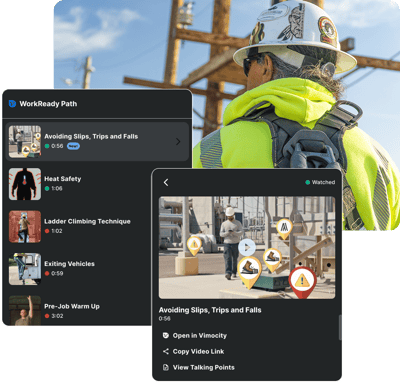
Vigemocity is more than training. It's a safety and readiness platform trusted by companies to keep their field professionals strong, healthy, and ready for the job. Now we're launching something new, the Work Ready Community. It's the first online community built exclusively for field employees, a place to connect, learn, and lead the future of our industry.
Join us and be part of the movement.
Austin, you told me, uh, when we were chatting one time that you You used to think that if you worked out at the end of the day, it's because you didn't work hard enough. Can you tell me a little bit more about how you got that mindset and then how it's changed over the years? Basically, that was passed down to me.
I was younger. I heard somebody older say it, so I'm like, you know what? He's probably right. That's a great excuse not to go to the gym and not to get off the couch when I get home, and I used that for years until, unfortunately, climbing and competing all these years started taking a wear and tear on my body a little bit, and then I wanted to research for myself, like, okay, I'm, I'm in my 30s.
I don't want my body to be breaking down right now, now and I don't wanna quit competing or get out of the field because my body's breaking down at such a young age. So I did my own research and, you know, talked to people who went to the gym and found out, oh, okay, you can work this muscle and this tendon and X, Y, and Z, and it'll actually strengthen it, and it'll be...
It'll give you more longevity. So maybe I'm not in there doing a max or in the gym for four hours a day like some people who bodybuild, but I know when I go in there and I do my squats and I stretch and I do crunches and lateral raises, stuff like that, when I'm working that pogo stick or when I got my rubber gloves on for 10 hours a day, my forearms aren't cramping near as much, my shoulders aren't hurting near as much because I'm working that body part, working it efficiently and not just on demand whenever I need it as hard as it can go.
What have you noticed from a durability standpoint? Uh, so my shoulders especially, so we have extendo sticks or a pogo stick that you're taking sections of little by little, uh, all, all day, and you're taking up a door that weighs maybe two pounds, but it will burn your shoulders and your forearms up if you're not used to it.
A lot of apprentices and stuff, they're like, "Man, how can you do that?" And it, it burned me up a lot as an apprentice. But like I said, just simple work on my shoulders, just lifting a little bit, stretching a little bit, making sure that I'm working them. Now, the pogo stick, I don't even think about it. I don't think about my shoulders.
I don't think about my forearms. It, it's not even an issue anymore. So I noticed that certain things I don't even think about that I used to think, "Man, I... There's no way I could do this all day, every day." So what I'm hearing you say is that you're training to have that longevity and continue to be able to perform, uh, not just at a high level from a lineman rodeo perspective, but just to be able to do your work day in and day out.
Is, is that what I'm hearing? Correct. Especially in the Florida heat, you know, some days 100, 105 degrees, it's 100% humidity. I'm working all day, and then when I get home, I wanna have the ability to still play with my kids and not be hurting or at 40 years old say, "Hey, I can't even do this anymore. My body's done," and then I've worked for nothing.
I want to be able to get to retirement age and still go hike and still play with my kids and still go have fun and not just work myself into the dirt- And think like, "Oh yeah, that's cool. I, I did this, I worked so hard, and now my body's beat up, but that's all right, I earned that." I think that that's a stigma that gets tossed around a lot, and I think that you can work around it by simple work.
And Austin, you called that a stigma, and I think it's because for so long that has been the mindset of like, "I'm just putting in my dues. You know, this is breaking down as part of the work." Are you starting to see a shift in how people think about that? Is, is there a new generation coming up saying, "Hey, we're not gonna do what the previous generation did.
We're gonna actually focus on retiring strong." Are you seeing a shift? Yeah, I see a major shift, I think because there's such an age gap. So for a while, the trades just weren't drawing the attention that they needed because people were pushing college, college, college, college. "You need this, you need this, you need XYZ."
And trades were kind of pushed down and they were kind of looked down upon, so people didn't want to go for that and people's parents didn't want them to go for that. So now that we have these younger guys in this gap, they're saying, "Hey, we have power tools. We have trucks. We have equipment that can pull this wire, that can lift these poles, that can do XYZ for us.
We don't need to use our backs just because we can. There's no need to show off for no reason. We know we can do it. If it needs to be done, we'll do it, but we're not doing it just for fun and we're not doing it to look cool. We want to get in there efficiently as possible, get the work done, and save our bodies as much as possible."
I think there's also been a, like a mindset that recovery at the end of the day is just like, why would you ever waste your time on recovery? But every athlete knows that recovery's almost more important than training, 'cause if you just train, train, train and don't focus on the recovery, you even- eventually, you know, you start to fall into a breakdown cycle.
So how have you s- incorporated recovery into your day-to-day? So it's interesting because when I first started going to the gym, I didn't know much about it. I was just going as hard as I possibly could, doing everything I could, and, you know, a couple weeks in, I could hardly move. I could hardly do anything because I didn't care about recovery.
All I thought was, "Okay, if I go in here, lift as heavy as I can for as long as I can, I'll grow. I'm gonna look good. I'm gonna feel good." And I was immediately humbled by that, luckily by a good gym community and a good community online that was like, "Hey, recovery is 80, 85% of what you're doing," the eating healthy, the staying hydrated.
You can't continue a lifestyle of more hard work If you're not taking care of your body, it's kind of the same thing as in the field. You can't just keep breaking your body down and not trying to fix it and not trying to build it back up. So I learned through the gym more than work that recovery is crucial.
It's, it's better than anything that you can do for your body. And Austin, you're in your mid-30s now. How have you noticed your body change and alter your decision-making in terms of how you hydrate, how you eat, um, how you focus on recovery? So I notice that I'm a lot sharper and a lot quicker when I'm hydrated.
And, you know, I'll start to notice little things in my body like, "Oh, I'm starting to get dizzy," or, "Hey, my back's starting to hurt a little bit. My kidneys are dry." Like, you know, I'm, I'm dehydrated. Especially when, uh, working in the heat and being in the bucket or just being in the sun in general, I can definitely tell when I'm starting to get dehydrated, and I don't care about looking cool.
I will break that bucket down and get on the ground for a couple minutes and cool down. Where as when I was younger, I'm not gonna show my weakness. I'm gonna push through this. And then you see guys that pass out, go to the hospital, have a heat stroke, have a heat illness, and then you're susceptible for that for life.
And that happened to me before I did lineman work. I did tower work on cell phone towers in Houston, Texas, and I got to the point where I was getting sick because I was so hot. And I quickly realized it doesn't look tough. It doesn't make you look any cooler. It doesn't help your body. It doesn't help anybody on the crew.
If you just take a break, 5 or 10 minutes, cool down, that's not gonna make or break anything. Even if people are out of power, even if people are rushing you, you have to listen to your body because I've noticed it takes a lot longer for me to recover now that I'm older when I do get to that point, or if I push it to the extreme, it's gonna be a day or two before I get back to normal.
And then what good am I to my crew at that point?
Okay, let's say it's 95 degrees. You're working in Florida, high humidity. What does a hydration plan look like for you on a day like that? So I typically start the day before, and that's kind of what I tell my apprentices and stuff, too. If I know it's fixing to be super hot tomorrow, I'm not gonna eat a huge dinner.
I'm not gonna drink a bunch of beer in the afternoon. I'm gonna get as much water in as I can, and actually pickle juice is a key ingredient for me. I'll drink a little bit the night before, and then that morning and during lunchtime, I'm eating pickles, drinking pickle juice. And I'm telling you right there, that will pull you out of some dark places There's some great electrolytes naturally occurring in pickle juice.
That's, that's a great tip. Uh, what have you learned from a nutrition standpoint? And I know it's, you know, when you're working long shifts, you're working a storm, y- you put in long hours, you're remote, it can be difficult to find, um, good food. So how do you think about planning for nutrition, and maybe what do you pack in your lunchbox, uh, to ensure that you always have the right type of fuel available?
So I'm actually really bad about this, to be honest. I do my best to bring some protein for the morning so I'm not super hungry by the time lunch comes around. But I, like I said, I'm pretty bad about wanting to snack and wanting to sit... When we're sitting in between jobs, I wanna eat something just because I'm bored.
And so I try my best to bring as much protein as I can to keep me satiated, and fiber, whether that be like watermelon, any kind of fruits, anything like that, I do my best to bring at least that. And then if I do snack on occasion, at least I've got some of the nutrients that I need to kinda keep my body going.
Because it's, it's really tempting when you stop at a gas station, whether you're just getting fuel or somebody else is going in there for a roller dog, you're like, "I could have two or three roller dogs right now and I'd be pretty happy." So it's just getting over that mindset of, okay, how am I gonna feel after that?
What if we get a broke pole after this and the day is not easy anymore? That's where my mind's kinda shifting to now, and I'm, I'm working towards that as a working progress. What's your go-to from a protein perspective, either in your lunchbox or if you're at a gas station and you're just looking for some quick fuel?
So for a gas station, I love beef jerky. I... And so I like the dry, hard, salty beef jerky. Everybody in my crew makes fun of me for it, but that's, that's the kind I like. For one, I think that the salt really helps replenish some of the minerals that I need, and I don't eat as much of it because I'm chewing on it so long, kinda tires my jaw out.
So it's not like the soft jerky where I'm just shoveling it down. I like Slim Jims, even though not great source of protein, but it's protein. You know, and a lot of times gas stations have eggs and simple foods like that where you can just go in there and grab something quick if you want a healthy option.
So for the 22-year-old lineman who's just coming out or maybe someone who's an apprentice and they feel bulletproof and thinks none of this applies to them, what would you say to them? I would say 22 turns into 32 really fast, and whatever you degrade on your body doesn't come back very easily. It is way easier to maintain or upgrade- Right now than it will be in 10 years, and 10 years is not long.
It seems like a long time the younger you are, but you're gonna be 32, you're like, "I'm still 27. What do you mean I'm 32?" So it's super hard to think about it now, and everybody told me this too who was older, but plan ahead. You wanna be the old lineman now. You wanna act just like that old lineman's acting and work like him because that will save you through the rest of your career, and maybe you'll be in better shape than he is at this point.
You talked about brotherhood earlier, and how is, you know, having good nutrition, how is maintaining your body, performing at your highest level part of also showing up better for your brothers? Well, like I was talking about, you need to be ready in case somebody on your crew goes down, in case they need a break and you need to hop in the bucket.
You need to be ready to call 911 if need be or run to the road to get an ambulance or run to get a fire extinguisher. They're all extreme scenarios, but nobody ever went into work thinking, "Okay, my bucket buddy, he's gonna die today." Nobody ever thought about that. Nobody goes into work saying, "Oh, I'm gonna have to do a rescue today on my friend."
So you need to stay ready at all times, and I think that that's just being a part of the brotherhood. You know, when I'm out with my family, I'm watching, I'm vigilant, I'm protecting them even if nothing's going on, and that needs to be the same thoughts and mentality of line work. We're out there in a very dangerous job.
We all cut up, we all have fun, we all have a bad decision or two that we make or maybe some bad habits, but we need to be serious when it comes to being our brother's keeper and being ready when something happens. What are the lifestyle changes that you've made personally that allow you to show up as a better brother?
Mainly what we spoke about, trying to be hydrated for the next day of work, trying to be the sharpest person that I can so maybe I catch a mistake that they're about to make instead of sitting on the back of the truck hungover or tired or weak. Like, maybe I'll see something they don't, and I'm hoping when I'm in the bucket they will see something that I don't in case that happens.
So I take it upon myself to try to show up on time prepared with whatever I have that I need for the job and maybe more. That way I can tell them and the younger guys, "Hey, look, I'm living it. You can do it, too. It's not unattainable," and it's not somebody armchair quarterbacking. I'm right here with you So there's no excuse now.
Austin, right now we all know that, like, there's a mental health crisis going on in construction and utilities. You maybe have some, um, stories firsthand, but what does it mean to show up for a brotherhood from a mental health perspective? It's the stuff that we can't see maybe initially. Physically, it doesn't show up in that way, but it's, it's the stuff that people bring to work that they carry.
Uh, it's that burden. How can you, you advise people to be aware of that so that they can be a brother's keeper in that regard? Well, it's like I said, I'm gonna bring up stigma again. It's always been a stigma that men don't talk about what's going on, and they're not gonna tell you when they're bothered.
They're not gonna tell you when something at home's going wrong or something at work's going wrong. They're, they're just not gonna tell you. But if you're paying enough attention, you can tell subtle shifts. You can tell a difference in energy. You can tell something's going on. So you need to do your best to say, "Hey," you know, even if you don't feel comfortable asking them, "Hey, what's wrong?"
Or maybe y'all aren't that close yet. You can say, "Hey, dude, I'll work the bucket today." It doesn't need to be, "Tell me your life story. Tell me to the detail so I can help you." Maybe you're not good at that kind of stuff, but maybe you can say, "Hey, I'll work the bucket today. I'll climb. You take a little bit of a break.
I'll take care of you that way." And then maybe they'll open up to you, maybe they won't. But you do your best to meet them where they're at so it's not a big deal. You don't have to make it a big scene. You don't have to try to make them break down and have a cry session and hug and kumbaya, but maybe you guys can talk without talking, kind of like how men have always done.
Even if you don't want to break it and say, "Hey, listen, dude, I notice something's wrong. What's going on?" If you're not comfortable with that, do it in your own way. But try to make some kind of effort because then that guy, maybe he'll be like, "Okay, he knows something's going on. I don't have to tell him. I can relax a little bit.
I'm not trying to hide it. I'm not trying to hide it on my face or my actions. They know something's going on, they're taking care of me. I can put my mind there and just be at ease." Without naming names, Austin, do you have a, an actual story from your career where you have had to step up and do something like that?
Yeah, it happens quite frequently. You know when guys are either just feeling off, maybe they're g- having something going on at home, and they'll just... They'll either be reluctant to get their tools or reluctant to get up in the bucket, or they're up there and they're just thrashing around. You can tell they're being careless.
And then that's when you just say, "Hey, listen, let me work the bucket today." You know, sometimes you get an argument, sometimes not, but- You do your best to kind of step in, and then if they're close buddies of mine, I'll be like, you know, "What's up, dude? What's going on?" And if they say nothing, y- you let it go, and then you just try to help as little as you can.
And a lot of the times, being close, they'll open up to you, and then you can talk about it. But many times, especially during the summertime when it's super hot, you know, you come home already kind of mad because you've been hot all day. Everybody's aggravated, and then you get home and you... Somebody gets in a fight with their spouse at home, and then they bring it to work the next day, and you, you don't wanna make things worse.
Because in our line at work, it's not like you're in the office and now you're just bugging Jim and making his day worse and it's funny. You know, Jim might go up in the bucket and make a mistake because he's so angry now, or do something on purpose, and you don't want that on your conscious, and you don't wanna have to go to their family and tell them, "Yeah, we knew something was wrong, but we just let him go anyways 'cause he's a grown man."
Austin, the work that you do day in and day out, it's stressful, it's fatiguing. What do you, uh, do personally to get ready to walk into the front door of your house so that you can be present with your family? Huh, a lot of different things. It depends on the day. Some days I ride home in complete silence and I just stare out the window.
Other days I try to play some happy music, whatever I need to, hardcore metal, whatever, and try to get it out before I get home. And then some days I need to sit in the driveway for 30 or 40 minutes and just decompress, and it's really a mental shift. You are going from, "Okay, I'm mad. I'm angry at these guys.
This is how I deal with them at work. These are grown men. These are my coworkers," to now stepping into a house where maybe you have young kids and your wife isn't just sitting there doing nothing all day. She's been dealing with chaos all day long. The kids are screaming. The dog's barking. Nothing's done in the house.
You expect it to be done, but... And she knows that, and so she's upset about that. She's upset about the kids. So you have to walk in there knowing, "Okay, I have to understand where she's at, so let's not make it worse when I walk through that door on either of us." So sometimes you need that little decompression and that mental shift, like, "Okay, I don't deal with my family the same way that I deal with my coworkers, and they didn't give me the issues that I have at work.
Now I need to deal with the issues at hand here." And it's super hard to do. Easy to say, super hard to say, "Okay, I turn from this mode to this mode. Different person." That's great advice, Austin, 'cause I think that that's something that every lineman, every person in the trades experiences. I mean, they, they have to wear two different hats, and, uh, I think it goes back to where you talked about the empathy of also realizing what everyone else at home has been dealing with all day as well because they're, they're coming to that with, with their own stuff.
So thanks for sharing that. I'd like to shift gears now and talk a little bit more about social media. It's something that, you know, you've been incredibly successful with. I think it's actually been really impactful on the industry. It's encouraged a lot of people to, uh, want to engage. It's an extension of the brotherhood.
Uh, you shared a little bit about how you got into it, but, um, how has it now become almost like a mission for you to continue to invest in the brotherhood through social media? So, you know, at first it was really cool. I was like, "Man, I'm getting a lot of engagement. People are actually looking at this."
And you know, once you get to a certain state, then it's all the negative. It's all the BS, and you're dealing with that, and you're arguing back and forth. And I'm like, "You know what? This is the internet. People can say and do whatever they want. They're just trying to get a reaction. They're just trying to be funny, get the most likes on their comment."
So then I kinda put my head down, and at first I was like, "Okay, I'm... I'll make decent money doing this," and, you know, just start posting more and more and more. Well, then my first Florida rodeo, when I showed up and people recognized me from TikTok and Instagram, I'm like, "Dude, that's, that's super cool." And they're coming up to me like I'm somebody special, and I'm like, "I just, I talked to y'all last year.
Y'all don't even remember. Like, I'm nobody special. Just y'all see my videos now online." So that really changed my mind to, "Okay, I don't care if I make a cent off of any of this social media stuff." I think it's really cool when I show up and I see an apprentice that's like, "Hey, I watched your videos. It really helped me.
This was really cool. I learned this, I learned this," or just come up to say hi. Like, it's so cool now, you know, when I fly to California, and I see people that know me from all across the nation. I just think it's really cool that it's spread that far. And to me, it tells me people are getting some kinda benefit from it.
It's helping rather than hurting. You know, I'm making these connections with other guys that are big in the industry too and big on social media, and we're learning from each other, and we're elevating each other, which is elevating our audience. So I think it's just a really cool niche, and I think it's just a really cool thing that kinda fell into my lap, and now I'm just trying to progress it as much as I can.
And what's the thing that you most dislike about social media? Mainly How it makes, it makes people kind of portray you in a certain light that don't know you. And like I said, 90% of it has been positive, but then you get the 10%. You're never gonna please everybody. Not everybody's gonna like what you have to say or how you do things.
And I meet people all the time, and after talking to me for a couple minutes, they'll be like, "Man, I really thought you were an A-hole before I met you, or a douche. Like, I didn't think that you were a cool guy. But now talking to you, you don't seem like that." And it's... I think it's because when I'm speaking on camera, I'm trying to be direct and I'm trying to just talk and not put pizzazz on it and make it a show.
I'm, I'm trying to teach. So it's not about getting attention from me, it's, "Hey, I'm teaching you this. I'm gonna be very direct and to the point," which may come off a little different than how I am in person. Social media is so prevalent in our society, and it's a great way to connect with people. It's a great way to build a brand.
Um, for someone who is, has never really done much on social media, what are, would you recommend as the first steps to starting to build an audience or at least build a thesis for what you want, um, that brand to be through social media? So for one, I would take a step back and think about who do I wanna be portrayed as?
How do I wanna be portrayed? I wanna be myself. I'm not gonna copy somebody and try to be funny like him or do the same style jokes or same style teaching as this person because they are their own person. They have their following because they are them. And social media has a great way of sniffing out people who are impersonators, people who copy.
So it'll never work if you're being a copycat. And trust me, if you don't think you're interesting, you are. You know, I follow a guy named Higher Up Wellness, Michael Smoak, and he says it really well. He's like, "No matter what you do, post it." Talk to the camera three, four times a day. Tell them about your day.
Even if you don't post it on your story or post it on your feed, put it in your drafts. Post it every once in a while and just get comfortable talking to the camera, talking like you're yourself. 'Cause at first, I'm telling you, talking to a phone or any inanimate object is very tough, especially when you know people are around you watching.
Like, if you're in public or you're at the training center or you're somewhere, it's very nerve-wracking. But the more you do it, you'll get into it. And if it's something you truly wanna do, the price you pay for being successful in social media is embarrassment, and Michael Smoak also said that. You're not gonna get around the embarrassment.
You're not get... Uh, there's videos that I have still posted that I first made I'm like a wood plank standing there talking, and it's so awkward. And I look at it and I cringe, but I leave it up because people can go back and see that. They remember that kind of stuff, and I want people to see that, and I want people to be encouraged.
Like, I'm building as I go, and I'm still nowhere near where I wanna be or as good as, you know, maybe half of the rest of social media. But I get on there and I try to be myself no matter what when I'm on camera, and that's probably my biggest piece of advice is just be yourself. Somebody will find you interesting.
Well, we're like 32 episodes into the Work Ready podcast, and man, it took me about 20 episodes even to just start to feel comfortable getting behind a camera and to... You know, you listen to the episodes and you're like, "Oh man, that was such a terrible question." And you j- you know, you find every fault possible.
But you just start to realize that, you know what? People actually like the imperfection. They like knowing that you're genuine. And, you know, ultimately it comes down to why are you doing this? Is it for yourself to build up your image, or is it, you know, to help others and promote, uh, bigger ideas? And I think you do such a great job with that.
You gotta remember, you're not talking to robots. You're talking to people. So just try your best to put out something valuable or entertaining. That's basically the two things that people are gonna watch. And for the 20-year-old apprentice who maybe is just coming into the trades, what would you say to them in terms of how they can advance their knowledge through social media or different accounts that are online?
I mean, there's just so much out there to build your experience, build your knowledge so that you can, uh, be better in the trades and advance potentially faster than generations before. What, what advice would you give to the younger apprentices out there? So for one thing, one thing I don't like seeing is when apprentices are out on their phone during the workday.
Maybe lunchtime, break time, whatever, but I don't wanna see an apprentice up in the bucket looking at a video of him tying in... You know, somebody tying in wire so he can figure out how to tie in wire. There's a time and a place for it, but I do believe it's very valuable to go look at these guys, CC Lineman, Jesse, you know, M- Goody, multiple linemen that are posting free information for you.
And there's, there's no reason why you shouldn't soak up every bit of information you can, because you're only gonna retain so much of it. So the more you put in, the more you're gonna retain. If you put in 100 scripts into your brain and you retain 85 of them, you did good. If you do 1,000 and you retain 850, even better.
So I would say try your best to consume with intention. It's another thing Ryan says is you need to be consuming with the right intention. Don't go on there thinking, "Okay, I'm gonna, I'm gonna laugh at this guy. Let me, let me wait for him to do something wrong so I can comment it because I just learned about this in class this week."
Watch it with the right intention at the right place at the right time. All right, Austin, we're gonna move to some myth-busting and rapid-fire questions. So some of these questions you've already shed a little bit of light on, but, um, it's a good chance for you to dig a little bit deeper. So myth number one: performance nutrition is for bodybuilders, not for blue-collar guys.
Yeah. I don't understand that either because, you know, bodybuilders are in the gym four, five, six hours a day. Maybe that's too much. Maybe... That's what I hear. I'm not a bodybuilder. Well, we are out in the field 10, 16, 24 hours working physical labor, doing hard things. Maybe we're not lifting 500 pounds, but we're lifting 80 pounds 100 times in the heat, in the rain, in the snow.
So our bodies are being put under extreme pressure and extreme physical stress the same as a bodybuilder. So I f- I would reckon that we actually need to train it and be better at, you know, getting the protein in, getting the nutrition in, and recovering even better than they are.
Next myth is that real linemen don't stretch, and a pre-job warmup is for sissies. Yeah. I'll tell you right now, if I don't stretch and I climb a pole, one of my knees is gonna lock up on me. Real linemen wanna be old linemen someday. They want to be able to show the apprentice in 15 years, they wanna be able to race that apprentice up another pole and beat him.
They want to be able to take care of themselves enough so when their son wants to be a lineman in 20 years, they can still show him how it's done, they can climb up there with him, and they can do things with him. So I think that the stigma of being a real man means that your body's worn down and you broke down and tired 'cause you work so hard, I think that's just totally false.
Next myth: talking about your body or your mind on the job site makes you soft. See, I think that that's changed a lot in the past five or six years, I would say. You see even the, the guys like UFC fighters, Paddy Pimblett, those kind of guys, speaking about mental health and mental struggles for men because- There are so many different things, suicides and people that just go off the rails, you know, because they're men and they're just gonna keep it inside and they're not gonna do anything.
Well, there's a certain way you have to go about it because you have to be mentally there for your family. You can't be locked in your own head and think like, "Oh no, this is doing them a favor." Because now you're stressed, you snap easily, you, you may harm yourself, and they need you to be there to provide.
So part of being a man is a- admitting enough and being strong enough to say, "Hey, look, I need help. I don't know how to do it. I don't know how to say it, but maybe if I tell somebody, they can figure it out for me, or they might tell somebody who knows how to help me." Next myth: social media is ruining the trades.
Yeah, I think that comes from a lot of old-timers that don't understand. These are the same guys that say that the buck squeezes are ruining the trades and the fall protection are ruining the trades, even though injuries and deaths are going way down as far as falling off of a pole. You're gonna have the guys posting stuff that shouldn't be posting stuff because they either didn't get trained or they're doing it wrong, whatever, but you can't weed them out.
You can't tell somebody they can't do it. So it's the same thing as having a lineman get pushed through a program and training the guy in the field the wrong thing. Except for now it's exposed and people can comment on there, "Hey, please don't do that." And maybe one apprentice will look at that and say, "Hey, man, that is wrong.
Okay, perfect." Whereas Billy Bob showing Joe out in the field, Joe doesn't know any better. Joe's gonna do that for the rest of his life and maybe get hurt. And Austin, the final myth: you can sleep when you're dead. Yeah. I've heard that a bunch too. You need to be present for your family. You need to be present for your brothers out on the job.
So if you're falling asleep in the bucket truck while you're holding wire, if you're falling aslee- asleep in the cab while you're driving, not only are you endangering yourself, you're endangering your brothers, you're endangering your family, you're endangering people out in the open. I mean, we drive super heavy big trucks around all the time.
We are working on very dangerous stuff. We have people around us, so we're not only responsible for ourselves, we're responsible for other people too. So you can't be selfish and think, "Ah, I'm fine. I'm tough. I don't need to worry about sleep." All right. Well, Austin, next we're gonna move to rapid fire questions.
So first one is the best piece of advice a lineman ever gave you. I think the best piece of advice I ever got was pretend that you are the 60-year-old lineman on the crew. How would he do it? Think about it that way before you even climb up the pole or get in the bucket What's the worst piece of advice a lineman ever gave you?
Worst piece would probably be, you know, "Don't, don't worry about eating. Don't worry about going to sleep. You're fine. We're tough. We're lineman. You just get over it. There's nothing that needs to bother you. Just until the job's done, just work through it. People's lights are out, just keep going." What's one piece of gear you refuse to work without?
Definitely rubber gloves. If it's not grounded, it's not dead. So if I'm gonna touch a piece of wire that isn't tested, rubber gloves are on. What's your go-to meal the night before a rodeo? Probably something carb-loaded like spaghetti, shrimp Alfredo, chicken Alfredo, something like that. What's, uh, the most underrated skill for a lineman that nobody talks about?
Knot tying. Knot tying is so simple yet so effective. Rigging can save you so much work and so much fatigue on your body. What's one habit that has changed your life in the last two years? Definitely the way I go to the gym. It used to be just lift heavy, lift hard, as much as you can. Now I am more focused on the time of year, what I'm gonna do today, what I'm gonna do this week.
Do I need to train legs today 'cause I'm gonna climb today? So just focusing on what my body is telling me and seeing the results that it gives me throughout the day just through experience, that's definitely something that's changed in the past two years. All right, Austin, complete this sentence: America's favorite lineman is someone who...
Tries to show up his best every day. Austin, what is your compass, your true north that guides everything that you do? So basically, I'm a follower of Jesus, so I'm not perfect by any means. Anybody that knows me knows that I fail. I'm not perfect. I'm not judging anybody because I'm nowhere near where I should be or need to be.
But every day I try my best to point towards him and treat everybody like my brother or everybody like my sister and start off with respect and love for everybody, and then from there try to give forgiveness if that trust or if that respect gets broken. Austin, for the person listening to this and they're driving home, they've had a long day in the truck, and if they remember three things from this conversation, what should they be?
I think this should be you need to take care of yourself first in order to be able to take care of your family and to take care of your brothers. Second, that mental health is a big issue. It's not something that you should be scared to talk about or embarrassed to talk about. If you have an issue, tell somebody that you trust, tell somebody that you're comfortable with, even if it's a stranger.
There's help everywhere. There's phone numbers you can call endless. Just Google it if you don't feel like talking to somebody you know. And three, nutrition and hydration is the key to working a long, long career. Awesome. Where can people find you, follow you, learn more about, uh, what you're doing? So I'm on TikTok as America's Favorite Lineman and Instagram, and I recently started my Facebook page back up.
So just look me up on there and hopefully either leave me a comment, shoot me a message, and I'll try to get in touch with you. Awesome. This was fantastic. Thank you so much for taking the time. Um, and for those listening, if you haven't subscribed to the Work Ready Podcast, do so mostly because it just allows, uh, us to be able to, to ping you when we have these new episodes drop each week on Tuesday.
So again, until next time, make sure to take care of yourself, take care of your people, and stay work ready. Thanks so much.
Discover how Vimocity can help keep your crews WorkReady.
One comprehensive platform to help safety and operational leaders prevent more injuries and incidents.