
.png?width=20&height=24&name=Vector%20(15).png) For Leaders
For Leaders For Workers
.png?width=24&height=23&name=Vector%20(16).png) Partners
PartnersBreaking the Injury Cycle in the Trades
WorkReady Podcast Episode 45
-
Speakers
Ryan Hoover | Arizona Public Service
Dr. Kevin Rindal | Vimocity -
View The Transcript
What we talk about now as opposed to safety to them is safety with them.
What does bulletproofing mean to you? When you're on the mats in jujitsu or in life out in the field, things push back at you.
You're a third-generation utility worker. What is my future gonna end up looking like? I'm imagining, like, my dad in the early '80s going through that, and people must have just been a mess.
You're a third-generation utility worker. Your grandfather came back from Korea, went into the trades. He had had some injuries when he was in combat. Then your dad was in the trades for his entire career. Got to then broken down, but one thing that I've enjoyed talking to you about over the years is just your focus on physical fitness and taking care of your body. How did you break that cycle?
Yeah, it's interesting. So growing up, like, you know, my dad was a, uh, a crew foreman. He was a journeyman lineman, and, uh, he'd come home like soaking wet, kind of torn, tattered. Uh, you know, we work in the desert Southwest, so it was hot all the time, and he just, you know, never really talk about like what's feeling good.It was just always conversations of like, "This hurts," or my back or my neck, or, "I need to have this surgery." So just hearing all that growing up and kind of seeing also, you know, like one of my heroes, my grandpa, who like my whole life that I've known him, he came back after Korea, he had like one arm. So like him having that debilitating injury, I'm kind of like, "Well, what is my future gonna end up looking like?"
And it actually turned me off from like trade work for a while, um, but I am coming back to it later. I'm sure we'll get to that. Um, but it's actually like very little things like I don't know how it happened, but it was like reading Men's Health magazines when I was like 17, 18 years old. Um, and then there was some like really good articles from some trainers that I started gravitating towards, and they were like on the leading edge of now we look at as like, you know, athletic performance conditioning and training.
So, you know, the, the owner of Ethos Gym over in Phoenix, Arizona, like I was reading his articles all the time and picked up his book and like I thought like I was at the, the top end of performance at the time. If I was doing like planks at a time, people weren't even doing that. People were still doing crunches in like the early 2000s.
So it was like it started with little stuff like that, and then I just, you know, fell in and became in love with the process. When you were growing up, what do you think the mindset of people in the trades was as it relates to their body and longevity? Was it you invest in it so that it doesn't break down, or is it this is just part of the, the job is being broken down?
I feel like it's a little bit of an afterthought, right? Because anyone that goes through a trade, you go in as an apprentice, and you kinda learn from the generations before you. And I'm imagining, like, my dad in the early '80s going through that, and people must have just been a mess. I mean, 'cause, I mean, the equipment that they had to do, like, everything was more manual.
So I think in your mind, you just start coming to terms with, like, that's maybe what my future looks like. But at that same time, like, you know, that was, like, the craze of, like, pumping iron and, like, Arnold back then. So, like, my dad at least did go to the gym quite often and a lot of his friends, they'd tell me, like, go, like, hiking Camelback Mountain after work, like, often and regularly.
So he stayed active and in shape, but it was maybe with the wrong mindset and focus. Not that that stuff didn't help, because I do think of, like, building strength and bone density makes you more resilient in general. But there was a definite lack and neglect for some of the finer things that you need to do in your body, and recovery and prehab and motion movement, um, that everyone-- no one really knew at that time.
So they thought they're doing the best, but just the science has evolved so much that there's a lot more into it. But I think when you're early in your career, you're just seeing the older people are getting ready to retire, and you're like, "Oof, is that what I have to look forward to?" So what was it about that article in Men's Health that you read in the early 2000s that caused you to start thinking a little bit differently about health beyond just movement?
That is a great question about what stuck with me. I think sometimes when you read things, a lot of times it's more of the timing than what it is you're actually reading. So like the time when I read, was reading those articles was the time I was interested in getting into mixed martial arts because like UFC was getting pretty big, and I grew up like a, a scrawny kid.
I was only 130 pounds when I graduated high school, so I had a little bit of chip on my shoulder, like something to prove. And I was like, I wanted to get into that, but I'm like, I don't know if my body's like ready. Like, I don't see myself as that type of athlete. I was like lifting weights in the apartment complex I lived in, right?
But it was like, that was like my dad's cycle, right? And I kinda saw where that ended up if that's the way you train. So I don't know. At one point, I read one of those articles, I'm like, "Wow, this makes sense." And it just kinda like put in like... There was more than a few buckets, but I've kinda derived it down to like three, too, right now.
It's like you prep your body, you stress your body, and then you recover your body. So just making sure, like following that formula has like broken it down like so simple now that it's like easily repeatable, and it just becomes part of your routine. But part of it is a little something fun 'cause it kinda reminds me of a little bit of skateboarding, right?
I wanna do things differently than everyone else was doing it, just because like someone else is like going and just bench pressing and squatting all the time. I'm like, I wanna express myself athletically in a different method, so it's like how far can I broad jump? Or like what's my vertical? Or, you know, can...
how long can I hold a plank? Or the reps I can knock out in like body weight stuff. So I just kinda changed the measure a little bit and kinda carved my own path. So I'm like, I'm never gonna be as big as like the bodybuilders at the gym, so what is it that I can do to find my lane of athletic performance?
And that's, I guess, why it spoke to me. And so would you say that that's why Brazilian jujitsu really became your next venture? Because there is a lot of creativity in that sport. I mean, you're constantly having to think on your toes. You're having to adapt, uh, to your opponent and the moves that they put on them.
So for th-those who don't know a lot about, uh, jujitsu, can you maybe describe what that sport is, and then how you saw skateboarding translate over to that sport? Yeah. So I mean, the MMA was def- the mixed martial arts side, so anyone that watches UFC, it was definitely kind of the entry point that a lot of people take when they get into jujitsu.
They watch that, and they're like, "Oh, that's cool." 'Cause the original UFC, you know, Royce Gracie, it was an exhibition really about how jujitsu was the most dominant martial art in the whole world. And they proved that, like, for the first four or five. And then everyone started learning it. They're like, "Well, if I don't know this, I'm dead in the water."
So, and the whole premise behind it was using your body's strengths and leverage against the weakest part of your opponent. So for a small guy like me, jujitsu was, like, a perfect fit because, like, I can use my skillsets, um, to, you know, to step up against larger opponents. And then part of it, like, coming from the skateboard life, like, a little bit of the fun is the risk associated with it, right?
If there's no risk, it feels like you're just, like, a little more mundane. So the stakes are fairly high in skateboarding depending on what you're doing. You know, like when you're doing big stairs or big rails, like, that risk and reward that you get out of that is something that you're missing in a lot of other sports.
And mixed martial arts and jujitsu definitely have that, where, you know, the risk of not performing well, you're, like, proving it every day. Like, you know, the, the stakes can be high if you don't protect yourself. Um, but you know, the part of bra- Brazilian jujitsu that, like, for the, the general public that maybe doesn't pay attention, it, it's like all the groundwork.
So it's basically submission wrestling. So it's just getting the opponent to the ground without taking a lot of damage, holding them and putting them in positions where they can't get up and feel uncomfortable, and then, you know, joint manipulation and/or putting them to sleep by, um, cutting off circulation of the brain, you know.
It sounds harsh when I say it that way. But it's like, what's cool about training that is, like, every day you're, like, proving to yourself, like, what you can and can't do and what you're made of, right? So there's no like... There's winning 'cause there's, like, a competitive side of it that you can do. But it's really, like, for me, it's a constant daily test of, like, what I'm made of and, like, what I'm willing to endure.
I'm gonna give a shout-out to my friend Joe Minus from Sturgeon Electric, California. He, uh, does Brazilian jujitsu and mixed martial arts. He was also the ILR's world champion. He was on the world champion team, uh, for- Nice ... uh, International Line Rodeo. And he told me that he feels like that training has actually made him stronger as a lineman because there's the climbing.
You have to get into, you know, awkward positions- Yeah ... and so there's a lot of translation. Do you feel like for people who are working in the trades, there's a lot of crossover in terms of the benefits that you get from a mobility and a strength perspective? So I think there's a little bit of a misnomer of what you actually get directly from the sport itself, 'cause I feel like a lot of people come into it and they're like, "Yeah, I'm here because I wanna get flexible and mobile."
And I... You can get like elements of it, but I've seen like people that have trained for like four or five years that look like no more flexible than they did when they started. They just kinda work around their hindrances. So I think it's something you need to supplement with like the work you do outside of the gym.
Um, but I think what you get out of it, the benefits of like the life lessons you can take to any career you work in, you know, trade, your marriage, your life, is just dealing with adversity. It's like you're constantly just put in terrible situations and you have to learn how to live with it, deal with it, accept it.
Or there's days that go terrible. You're like, "I suck at this. Should I hang my belt up?" Like, and it's just this constant striving for mastery that you never make it to. But I'll give you example. Like, so when I'm training like really hard, my confidence level and just how I conduct myself and like my outside life, I feel like Teflon.
Like nothing you throw at life is gonna be any harder than what I had to deal with on the mats this week. And then so I go and like if I have like a really big presentation at work, I feel like the same way. I'm like nothing is gonna be as hard as what I put myself through like four nights a week. I'm like, "So this is gonna be a breeze."
So the confidence level that it builds on top of like, you know, knowing that you can take care of and handle yourself, I think it's just like this mental edge that translates throughout your whole life. As a safety leader, you have more risks to cover than hours in the day. That's where Vimocity comes in.
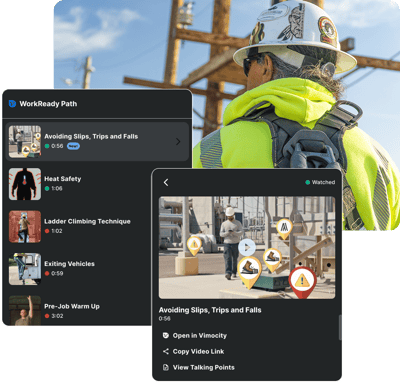
We give you one platform to scale your impact, delivering expert-curated safety campaigns on everything from slips, trips and falls to heat stress and soft tissue injury prevention. You'll reach every crew through the channels they already use while gaining data insights to guide smarter prevention.
With Vimocity, you can boost awareness, prevent serious incidents, and keep your workforce ready for the job. Scan the QR code or visit vimocity.com to learn how leading utilities are cutting injuries by 50%.
So take us through a typical week for you. What are some of the other supplemental forms of training that you do in addition to the mat work? So I train jujitsu like three to four days a week, and it depends on the schedule, right? Um, at this point in my career, I can't just dedicate my whole life to training all the time.
Um, but you know, I do three days of like full body strength and conditioning. And when I say it like that, it's not, you know, always heavy lifting. There's an element of that. It's funny as you get older how that's kinda changed. So let's just say like I have an hour window now to work out. Back in like my early, late 20s, it was like, you know, 10, 15 minutes of core and prehab work, and then like 45 minutes of weight or like hitting really hard on like a VO2 max, like on a cardio machine to try to boost it.
Nowadays, it's like 30 minutes of like prehab, mobility, like stretching, going through my warmup routines, um, on top of like creating some resiliency in the body, and then I'll be like 15 minutes to like knock out some major compound lifts and then like move on because I have to keep going. Um, on top of that though, I live in like the most beautiful desert in the country too, so I try to take advantage and I do a lot of hiking.
Um, for people that are... Audience are maybe familiar with rucking. R-U-C-K. I didn't mispronounce that. But, um, it's just like hiking with a weighted vest, and it's like a fun way to connect with nature and getting in like a little bit more resistance training. I also like to go trail running, like with my kid especially, who's like training jujitsu, and he's doing tournaments now, so him and I will do like hill sprints out there.
So it's a fairly good mix, but I think just as much movement as you can get. Certain days, like I'm not feeling it. I'm feeling pretty banged up and I'm like, "Ugh, I can't... I don't wanna jump rope. I don't wanna lift." I'm like, "I don't wanna ruck. I don't wanna..." I just do like a walk outside for like 20 minutes and like call it good, you know?
But keeping that movement going, I think that's something I've learned over the years, especially on the recovery side. It used to be like, you know, the RICE was the protocol, so we'd hurt ourself and rest. I'm like, now I'm like, as soon as I get hurt, I'm like, "I gotta keep moving as soon as I can," 'cause it flushes everything out.
So I know I've gone on a tangent on the recovery side. No, I mean, I'm right there with you. It's, it's so paradoxical 'cause everyone has always said like, "Get off it if you, if you get injured," but, man, in all my years in sports medicine, I would say that the key thing was getting people as active as possible, as quickly as possible, without causing more irritation.
And if you can do that, people just recover so much faster. So Ryan, uh, tell us your age right now. 42. I know I look like I'm 32- ... but, uh, no, not that fortunate. My body inside feels 42. And you described how your training has, uh- ... been adapted over the last maybe 10, 15 years, you know, as you've gotten into your 40s.
How do you see- Yeah ... this next decade of life looking in terms of how you continue to, to adapt your fitness? Yes, you do need to have a realization at some point of your body's limits, right? We're not all David Goggins, and you're
gonna like push through every little bit of pain. Um, at some point you have to kind of figure out where you're at. So, um, even the way you train, right? Like I think the volume is gonna remain. I think like a daily exercise or even sometimes two-a-days is where I wanna be, but the intensity and the load on my body is adjusting over time.
Give you an example, like in, uh, Brazilian jujitsu I used to be training like five days a week and sometimes like two-a-days when I was training for tournaments and it was like hard rolls all the time, right? I was just constantly drilling as hard as I could, rolling as hard as I could. 'Cause when you're in that kind of mindset of competition you can't really get used to like training softer, right?
So it was like always like ninety to one hundred percent output. But nowadays like three days a week and like there's certain days where I'm going like more of like a sixty percent with like lower ranked people so I can kind of keep my body from redlining so much. I think the, the redlining on the engine is like has to come down a little bit more as you age.
So just the intensity at which you do stuff and training smarter not harder. I mean back in-- and that was the old mindset back in the day, just drive through everything and don't listen to your body and now I'm like it's trying to tell me something and there's certain cues that I need to lean in on and there's other ones I'm like, "Okay, don't be a wuss and just push through."
So it's being more in tune with the body and, um, kinda just changing the intensity of it. But you know, there's certain pillars that I'm never gonna lose, right? Like strength training, um, as much as a lot of people think of it's like for the mirror, I think it just creates a very resilient body as long as your other joints and, you know, um, everything else is kinda cooperating.
But, uh, you know, everything I'm reading about like bone density and muscle mass as you age and how important it is to stay active, like that's something that I'm never gonna lose and I think when I'm taking care of that everything else in my life feels a little easier. We've had a conversation before about bulletproofing your hips, shoulders, and back.
You've, you've told me that those are some of the areas that you've had some vulnerability in the past. What does bulletproofing mean to you, and what are some of the activities that you do to help yourself become more durable? Yeah, so I bullet just that, durability, right? Um, those are kind of the weak links in the body I think of.
Um, I kinda... I was always taught like that you're kind of like, uh, your body's like a wheel, right? Your core's in the center, and then you kind of have these spokes on the outside that are vulnerable. But even looking through like the injuries that I commonly see, whether at work, jiu-jitsu, or just people our age, are shoulders, hips, knees, um, backs, you know, and they're all tied together one way or another.
Um, so yeah, like if you're doing jiu-jitsu a lot, like it requires a lot of hip mobility and durability in that, and, um, I've noticed if I kind of think that that's taking care of itself with doing like simple movements like core planks or like deadlifts, it's not necessarily the case. Um, so I've had to supplement with additional moves, and that's where I'm always on the hunt in Instagram of like what's the coolest new shoulder move I can do or what's a plane of motion I haven't really thought about?
'Cause you put yourself in such awkward positions in jiu-jitsu, and it's unpredictable, right? I can be-- When you're in the weight room, the only thing that's resisting you is the weight, b- and that doesn't change, right? Uh, y- there's different ways you can do it. You can add bands to it to get like a little different like output in different spots, but it's like consistent and predictable.
When you're on the mats in jiu-jitsu or in life out in the field doing work, like things push back at you at unpredictable ways. So how can I now absorb that force and not get injured? Because that's where I've seen people get pretty banged up in one of those three main areas, is they're driving into something that drives back at them that they weren't ready for, and so they're full on exertion, and then they get that pushback, and then they don't relax and go with that.
They just keep resisting into it, and then something ends up tearing or pulling. Um, 'cause I mean, forever I'm like, shoulders for example, it was like do your Y's, L's, T's, and W's and you're gonna be safe, right? Or, you know, do some, uh, bring it in and do your external and internal rotations. I'm like, oh, I was doing all that but still having issues with stuff, so I'm like, well, that's not the full picture.
But then you gotta be careful too as I'm like learning new techniques and moves to not throw out like the old foundational ones that I'm doing because you kinda get in this mindset of like, "Hey, all those moves I was, I was still hurt, so those things weren't doing anything." So then I'll fall in love with like some new kettlebell overhead like way of stabilizing my shoulder or like some like bent over shrug with like rounded shoulders as I go through my back, but I'm like, okay, I gotta go back to the same things that like also got me here and not throw those out.
But, uh, I know sports science is kinda cool like that and, um- There's a lot of garbage on Instagram and social media, but if you find some, like, good ones and I'm like, "Hey, let me try that. I wanna see how it feels." Or they're explaining an injury, "Do you feel it here?" I'm like, "Oh, that's me." It's like an infomercial, like late night.
I'm like, "Oh yeah, that's me." Um, so I'll always, like, experiment. I'm like, "How does this fit in my toolbox?" But, um, yeah, focusing on those, those main areas. Like, every day I'm in the gym, I'm doing something for my hips, and every day I'm in the gym, I'm doing something for my shoulders. And usually through that you're getting a little bit of the back.
But my dad had such bad back problems, and I had to go to the chiropractor a ton, like, when I was in my early 20s, 30s with, like, really bad kyphosis and, like, a rounded spine. So, like, I've really tried to make that an emphasis on bulletproofing my back 'cause it's just so debilitating when it's not going well.
And the mobility is a... And strength is a really big part of it, but then there's the recovery, the sleep, the nutrition, the hydration. How do you think about some of those aspects as it relates to the durability? They're foundational, and as you get older, they're that much more important. I think, um, as we age, there's plenty of people that are still putting in, like, high level work, like, in their 40s and even 50s, but they're blowing it on the recovery because your body's just, uh...
You can't get away with the, the things you used to when you're younger, right? It used to be before, like, tear it up at the gym, and then I would go and also wrench all day and then, like, go out that night and drink and then get crappy sleep and then the next day, like, be like, "Yeah, just brush it off. It was no big deal."
You know, now those days are far and few in between, right? I'm pretty disciplined right now. But, um, making that step to a choice of a little bit better structure and discipline in your life, it's hard 'cause it's a daily challenge, and there's temptations all the time and... But eventually it just becomes part of your character.
I have at least certain tenets that I don't break, and, um, do your best to make a, a structured life that makes it easy to follow. You know, when you have to travel or you have kids, like, things become tough, but you still make the best choices you can at those. And then as soon as you get back to your normal life, you jump back in the routine that you have.
And I think that's where a lot of people fall short is they've got a bad, like, day or two or a week and they're like, "Oh, forget it. Just throw it all out." And then they just, like, go wild. And I just try to get back to my basics as soon as I can. If you were to give our audience one piece of advice as it relates to nutrition, what's been the game changer for you?
Focusing on protein. It sounds super basic. Um, I've gone through different fads before, uh, depending on who I'm listening to. Um, so I've been big in intermittent fasting, and then it became like, well, fats and keto, like that's the way. And I just feel like focusing on making sure I'm hitting my, my one protein number that I'm trying to do every day and eat enough protein, and then two, making sure my body's got the right fuel it needs to recover, um, that's been a game changer for me.
You live in one of the hottest places in the country. I mean, not uncommon for it to be 110, 120 degrees. What is your go-to for hydration? Like, what does your protocol look like, especially when you're physically active? Uh, well, it doesn't start the day of. It definitely starts the day or two before. I learned that over my life here.
I'm big into water as my primary go-to. Like, I don't get bored of it. I know a lot of people, like, just get bored out on the taste. Every once in a while I'll grab something else, but, uh, water, I like coconut water, uh, electrolyte hydration pack of your choice from here to there. I generally don't have just too much water.
Um, there's just so many options when it comes to that, and I think it's just a preference thing. And let's talk about sleep because sleep is like- Yeah ... uh, definitely one of the most underrated, um, but most impactful things that we can do if, when it comes to optimization. So what are some things that you've done to maybe even track your sleep or just optimize, uh, the quality of your sleep?
I think the, the primary thing for me is the routine on the time going to bed and the time waking up, and try not to even let that window shift too much, even on the weekend. Um, 'cause, you know, I have a pretty ear-early schedule. Usually I'm a early riser and wake up and do morning workouts, so during the week it's not uncommon for me to be up at, like, 5:00 in the morning and getting that going.
So that means I'm going to bed, like, sometimes before my kids. That can be a little challenging in the summer. Um, so hitting that s- like, my bare minimum I have to hit is 6:00. Like, I've just figured this out over, you know, trial and error throughout the years. But I know that varies for every people. I know they recommend, like, that seven to eight-hour window, but maybe that's different for every person.
Yeah, I've, uh, I've found that the Whoop has been so helpful for me, especially as it relates to just managing load. Uh, I can start to see patterns when I'm falling into a fatigue pattern. So if I- Mm-hmm ... do, like, too many days in a row of running, I'll just start to see my heart rate variability go down, my resting heart rate go up, and then my sleep quality decreases.
And those are always signs of, like, okay, I, I need to back off today and really focus on recovery, focus on lower, uh, levels of exertion. And it's really helped me, especially as I've... I'm, you know, gonna be 47 here pretty soon, just being able to manage, uh, my body's recovery so that I don't dig in too deep of a hole, 'cause I've done that before and it's, it's tough to get out of.
No, that's actually something I can benefit a lot, 'cause I'm a, I'm a too much of an all or nothing type guy, so I'll have a tendency to overtrain, not under. So having something to be like, "Hey, you're, you're kinda hitting this line right here. Back it off a little bit," that could be helpful. The other thing that as I've aged as well that I've found has been really, um, impactful are supplements.
So things like creatine is, has been really impactful for me. Uh, vitamin D, magnesium, uh, you know, multiple things out there, uh, that really help with the recovery standpoint. What are some of the supplements that you have found to be most helpful to give you that energy or the recovery that you need?
Yeah. It's funny you say that 'cause I was looking in, like, my pantry just today and I was reading up on some supplements. I'm like, how much money do I spend on supplements a month? Kind of a little scared to quantify that. So I was looking like, uh, you know, like I'm 70 years old. I'm like the pill holder where I'm taking like 12 different pills a day.
Um, but you mentioned some of the big game changers, like creatine is one that's super important and the research that keeps... I mean, that's been around since I first started working out, but the research that keeps coming out is like better and better about additional health benefits and even for like women that are going through like premenopausal symptoms, like the amount of stuff and what it does for your brain and your gut lining.
So that's a staple. I get my creatine. Um, a- I take an ADK combo and then also a B complex. Um, I take a fish oil supplement on days where I know I'm not gonna eat fish. If like I'm gonna eat salmon that day or if I'm having tuna for lunch, like I won't. Um, then a little bit of a different game changer, I've been trying to experiment a little bit with like those organ and liver pills, right?
There's a... I know it's a little polarized topic for people that like follow some of the documentaries, but there's some good brands and research about it, and I do feel a little bit of a performance difference when I'm taking those. Um, obviously take, uh, uh, whey protein. Um, trying to... I'm, I'm looking through my mental pantry right now.
Those are the primary hitters that I feel a diff- That's what's hard sometimes though, when you're taking like too many things at once to really pinpoint like what's that one thing that's making the difference. So I do sometimes think about that. I'm like, am I just like really throwing away a little bit of money by adding like so many things?
But what I started doing over the last year is getting regular blood work, so like every three to six months we'll check the levels and we'll actually find supplements that are gonna fill up some of my gaps that I have. Um, so I'm working with someone that, um, does like more of a natural path type thing, um, and they can prescribe some different stuff.
So she evaluates all my blood work and at least now I have like more of a system approach 'cause as you're probably finding for me, like I have like this very feel, like I feel like it's, but sometimes that's not good enough to quite answer like is this a good use of money? Or sometimes you can even over-supplement on certain things and your levels are like way too high, and that could have different risks.
Absolutely. And I think that that's the key thing is having those regular check-ins w- with your blood evaluation just so you can see where things are trending. And it's amazing the information that you can get today in terms of, like, all those micronutrients. Uh, even, you know, your good cholesterol, bad cholesterol, you can see, like, what do your omegas look like, and all that stuff has really helped me.
I mean, I was in the basement when it came to vitamin D and magnesium. Yeah. And just that focus- The Pacific Northwest will do to you. Yeah, exactly. Just that focus has really made a difference. And so over the last 18 months, I've seen those numbers, uh, normalize. It's funny that you also mentioned, like, the organ, um, meat, uh, supplements.
Yeah. And so I actually do an adrenal support that's, you know, comes from the adrenal cortex of- Wow ... uh, bovine, and definitely that's something that I would say has also really helped me pull out of some of those, uh, phases where I felt like I was just really crashing and having a tough time to recover.
So definitely something to- I think it's some crazy stuff now that you... I mean, going back to the s- I mean, even more important than the supplements is hormone levels. Yeah. Like, especially as we get older, like, maintaining and supporting those hormones, like, that's where all the research seems to be now.
But, uh, people I've been talking with that, like, feel like they're hitting, their energy levels are hitting new peaks that they didn't know they could Well, Ryan, let's, uh, transition to talking about your role within the utility world, and that's in a safety function. It feels like safety s- in operations sometimes can be, uh, not necessarily working together all the time.
You know, safety's trying- Mm-hmm ... to keep things safe, operations is trying to improve efficiency. And so- Yeah ... uh, sometimes there's a little bit of conflict there. How have you been able to successfully navigate that? Because the people that I know in the operations side have a ton of respect for you because I think you approach safety from a slightly different perspective than oftentimes, you know, I think people perceive.
Yeah, no, I appreciate that. And my, my perspective's a little unique because I've worn those hats, and I think that's what has helped me a lot. I wrenched for the utility as a fleet mechanic for over a decade, so within that, like I understand the struggles of a frontline worker and the pressures they get from operations on trying to deliver on timelines and, you know, everything that they have to deal with and finding the right tool for the job and body positioning and everything else that goes into a frontline field worker.
So I've experienced that. I can relate, and even though I'm not always from the same trade those people are in, there's some level of respect of knowing that I've done that work before that's hard for other people in my field to get if they just came straight from school into it. Um, and on the other side, I was also an operations supervisor, so I ran a dock of linemen, um, for a few years.
And so I've worn the hats of the people that we're trying to influence, so I kind of know a little bit about what makes them tick. And I always think to myself, like, how would I want to be spoken to or how would I want this message delivered if I was in their shoes? So I can kind of look at it from their perspective, um, to build that collaboration.
But when we talk about at my company, we used to go from a place, and this is I think what you talked about initially, is safety being done to employees and to operations. Like the safety department says like, "Hey, here's what we think we need to do," and just, brr, everyone's gotta get on board and because this is what we decided.
That's not a good way of going about business. So what we talk about now as opposed to safety to them is safety with them. So here's the problem we're trying to fix. Help us solve it. Let's get the input of the people doing the work and then create solutions and strategies and also, you know, campaigns around that.
So when you're bringing people along with you, you get a totally different response than coming in and showing up and just dictating, "Here's how it's gonna go. I don't do your work, but you're gonna do this from now on." And with that, uh, methodology, how do you move people away from just thinking about compliance or check the box to really owning safety and, and doing it because they know that it's the right thing and it's, it's gonna keep them and their, uh, coworkers safe?
That's the challenging part, right? Because everyone has a different why. Um, at the end of the day, I have this belief that everyone's coming to work to try to do the best job that they can that day in hopes for creating a better means for them and their family, right? That's why we go to work at the end of the day.
As much as some people don't wanna recognize it, there's the paycheck element is a lot of reason a lot of people go to work, and there's pride in it, and there's identity in your work, there's purpose. There's a lot of other pieces that go into it, so it's not that cut and dry. But at the end of the day, people wanna be able to do a good job, go home, and do the things that they wanna do outside of work.
So a lot of time when I'm talking to, you know, linemen in my company or people working generation power plants, most of them are a little bit like me, where they like doing more risky, fun things outside of work. And to be able to do those things, you have to be healthy and in shape. And if you're taking it on the chin at work and, or you lose a finger or, you know, you tear your knee, you can't do those things.
So it's trying to bring it back to the why for them, and there's gonna be a certain percent of the population that you're not gonna get to, and you appa- unfortunately, you have to be like, "This is because we have to, and this is the OSHA regulation," or because of X, Y, and Z reason. But, um, for the most part, we've, we've had a lot of success by kind of shifting away from every injury is the same at our company to focusing on we don't want anyone...
For years, we saw everyone say-- people still say this, right? And then you're gonna hear this at every utility conference. Everyone should go home in the same condition, if not better, than the way they came to work. I'm like, "No one's going home better." I'm like, "You left something on the table when you went to work."
Some-- you put an extra mile or two on your body that you're not getting back. So that saying in itself is kind of fraud, and I never really liked it. I get the concept, right? We don't want anyone going home, like, in a different condition. But we focused on, like, you shouldn't have any serious injury that's gonna cause your, um, that's gonna alter your life trajectory or stop you from doing the things you wanna do.
So I think people are really gravitating towards that message at work, and it's less about, like, getting the speck in the eye that needs ointment or getting a, you know, something that requires a few stitches on your knuckle. If you never got a couple stitches, like, on the line of work, then you're either awesome or you're not doing very much.
You and your team have really been leading the way nationally on serious injury and fatality prevention. Can you tell us a little bit more about, uh, your approach to those big injuries? Yeah, I mean, that's-- we kind of take a quarter-by-quarter approach to trying to eliminate that. And the industry as a whole has gotten a lot better.
Um, and I'll say that's one of the things that's gravitated me towards safety, 'cause when I saw it before as a frontline worker was not my favorite approach to safety, and it was 'cause I had like a OSHA recordable that required a few stitches, and it was blown out of proportion to be like the worst thing that ever happened to the company.
And I'm like: "I'm fine. Don't, don't worry about me." Um, but the industry as a whole has realized that there's, there's certain things-- and we don't like to say this necessarily to everyone, but there's a certain cost of doing business that you're never gonna nerf the world to get rid of every little cut, bruise, twisted knee, twisted ankle.
We have millions of man-hours a year, and we're driving millions of miles on the road. Eventually, something's gonna get thrown at us, and our person's gonna be in the middle. But how do we create a more resilient system, kind of like we talked about with the body, build a more resilient body, that when something does go wrong, it's not so catastrophic?
So that's our focus now is we know people are gonna try to make the best decision they can, but how do we protect them that when there's a high-energy source that gets unleashed, you know, through some kind of failure or a mistake that happens as part of the human condition, that someone doesn't have to lose their life over it.
And I think everyone's bought into that approach. So they come up with a lot of ideas like, "Oh, if we did this, so we'd remove a lot of the risk. I don't have to get so close to the minimum approach distance." So that's been a game changer. So as you look ahead to the next five years, what is your vision for how safety, um, adapts, grows, and just becomes more worker-focused over the next five years?
We've laid a lot of foundation to get there. We've been on, like, on a six-year path at my company to kind of, um, get focused on, you know, high-energy hazards, stopping serious injuries and fatalities. I think the struggle with safety continues to be you never know day to day whether you're good or if you're just lucky, and I think that's something that we struggle with every day.
'Cause if you're measuring success by the lack of an injury, you never really know if you're making it any day. But there's a bunch of signs that say you're not, because from time to time you're gonna have, like, a run where we have five or six OSHA recordables. I'm like, "Man, we blew out, like, two shoulders and a knee this month."
Everyone goes, "What's happening?" And then you go, like, five months and nothing happens, and I'm like, so it's just very random. So I think the utility is struggling to measure success when nothing's happening. So what are the predictive measures and metrics in safety? That's a challenge that we need to figure out, um, because you're just one bad day away from someone in your company saying, "Are we doing the right thing?
Are we on the right path?" And then wanting to shift directions completely sideways. So that's something that definitely keeps me up at night. I'm like, things are going so good and we get people on the right path, but what's the thing that's gonna happen that's gonna derail the safety journey we're on to make someone wanna swing the pendulum back to, "Forget it, let's throw the book at these people, and then let's scare them into, you know, following the rules."
'Cause we've seen where that ends up, and I'm just trying to make sure we don't go back down that path again. Let's r- uh, go to some myth-busting, uh, here. Experienced crews know how to do the job and safety slows them down. Oh. I mean, there's gonna be an element of safety does slow down efficiency at times.
It's just what is that right amount of protection versus risk, and that's something we're constantly battling with. But yeah, we can go back to the Wild West where people just free climb up a pole and don't worry about anything, but we can also go back to those same level of fatalities. So I don't think anyone wants to go there, but it does come at a cost of speed at times.
Speaking up about a s- hazard makes you look weak in front of the crew Absolutely not. Um, it shows you're engaged and trying to make a better work environment. For too long, we got into a mindset, um, uh, field workers would be like, "That's not my job. I'm just here to get a paycheck and go home, and that's it."
And that mindset is not helpful for anyone involved. So the more people care about their work environment and are willing to speak up, that's something that's now celebrated. Physically demanding jobs are gonna break you down regardless of what you do. Um, I think that's mostly a myth. There's definitely things you can do to help your recovery.
There's definitely things you can do while you're doing the work to position yourself and protect yourself. I will say when I was, like, wrenching for those 10 years, there's certain things I... I knew certain tasks were just gonna suck. They were gonna hurt. I could have all the best intentions to go in the right body position, but they were gonna be awkward.
It's heavy. I didn't look forward to those, but you know, there's certain amount, like I said earlier, of mileage you pick up with some of those tasks that's inevitable, but there's definitely things you can do to reduce the amount of strain you take. If you could only pick one, skateboarding or jujitsu?
Definitely jujitsu at this point, 'cause thinking about falling down stai- stairs or hitting a curb, I'm like, "Ugh." I, I know some people are, uh, still sticking with it, some of my pro athlete heroes from back in the day. I just watched this video of, like, Tony Hawk still shredding on a new video, and, like, some of my old favorite street skaters still at it, but I pick up mine every once in a while, and people think I'm crazy.
What do you eat or drink before a workout, especially in the morning? Um, morning I typically do fasted workouts, 'cause I don't wanna wait to digest. Um, so I'll just do a pre-workout or coffee, depending on what the workout is. If it's straight cardio, coffee. If it's weights, I'll do, like, a pre-workout. What's your favorite movement to wake up the body?
Favorite movement? The body weight squats. I think, um, my hips, like, get a little bit of airflow going. It's challenging. There's a lot of moves on the ground that I like to do that I don't really even know what they're named, like some different bridge and reach type, um, things that I like to do. But I think just some simple body squats.
You can pop them out anywhere. I used to try to do, like, 10 to 20, like, every hour, like, throughout the day when I was, like, doing an office job because I was sitting so much, or when I'd get on car rides. Um, so yeah, air squats are great fundamental workout. What's one book or podcast that has shaped how you think about durability or leadership?
Uh, Kelly Starrett's book Deskbound, um, and any of Kelly Starrett's books are freaking amazing. Um, I follow him on Instagram. His podcast is awesome. Um, they got some very foundational stuff that anyone can follow, or they got some really advanced stuff for high-end athletes. I love all of his stuff. We covered so many amazing things in this conversation, so thanks for sharing your knowledge.
Is there anything that we haven't talked about today that you wanna make sure we leave our listeners with? If I was, I guess, to sum up what this whole conversation has been about is building resiliency, whether that is in your body, your mental resiliency, resilient systems at work to protect people. I think it's, like, a pretty powerful word that I maybe have taken for granted, but a lot of what you're trying to do is just get more resilient because life is gonna throw things at you whether you're ready for it or not, and how you are able to cope with and kind of focus on what I can do about it and not focus on all these other things outside of my control, um, is really grounding, and it's been helpful way for me to live, and I think I've learned that through jujitsu and other experiences throughout my life, is just focusing on what I can control makes life a lot more manageable in all areas of life.
Where can people find you online or just be able to connect with you? Yeah. So I think we're gonna post my LinkedIn profile for more of my professional side. Um, but then also on my Instagram is jujitsu.realtor on Instagram, so you can kinda figure out how those two pieces go together. Ryan, we appreciate you sharing, uh, so many ideas about building durability and resilience for a life in the trades or just longevity in general.
So really appreciate it. And until next time, make sure that you're investing in yourself.
Take care of yourself, take care of your people, and stay work ready. Thanks so much.
Discover how Vimocity can help keep your crews WorkReady.
One comprehensive platform to help safety and operational leaders prevent more injuries and incidents.